
What Is Power-to-Weight Ratio?
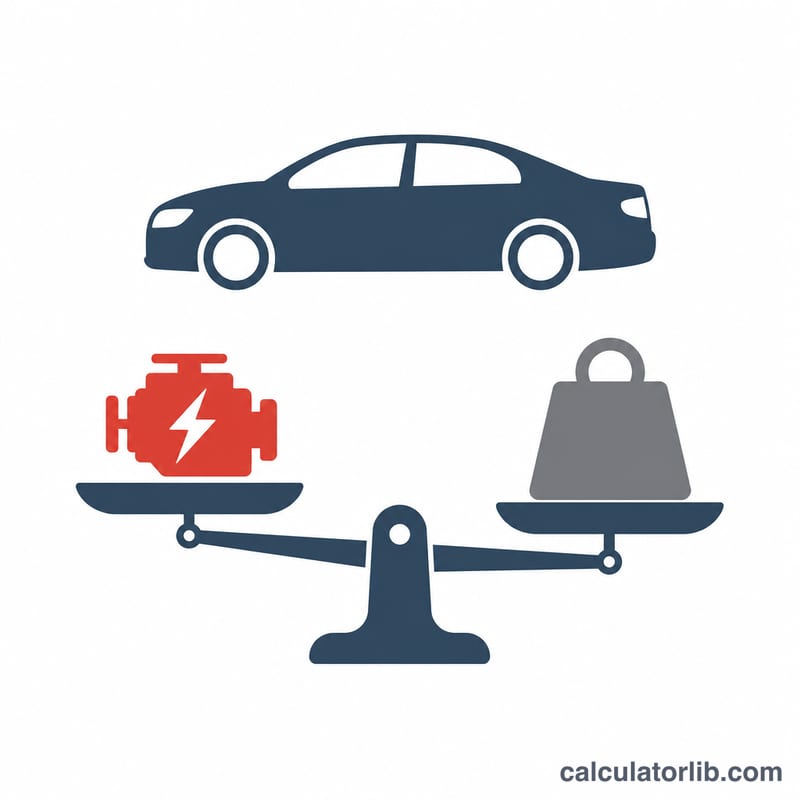
Power-to-weight ratio (PWR) is one of the most reliable predictors of a vehicle's acceleration and overall performance. It divides an engine's power output by the mass it has to move, so two cars with the same horsepower can perform very differently depending on how heavy they are. A lighter car with the same engine will accelerate faster, brake better, and handle more nimbly.
How to Use This Calculator
Enter the vehicle's power in horsepower and its weight, then choose whether the weight is in pounds, kilograms, or US tons. The calculator instantly shows the ratio in hp per pound, hp per ton, and hp per kilogram, plus the inverse figure (pounds carried per horsepower). Comparing the same units across vehicles makes performance differences easy to spot.
The Formula Explained
The core formula is simply \(\text{PWR} = \text{horsepower} \div \text{weight}\). Because raw hp/lb numbers are small, results are often quoted as hp per ton (multiply by 2000) for cars or hp/kg for motorsport. Weight in kilograms is converted to pounds using \(1\ \text{kg} = 2.20462\ \text{lb}\) before the division so every unit stays consistent.
$$\text{PWR} = \frac{\text{Power (hp)}}{\text{Weight (lb)}}$$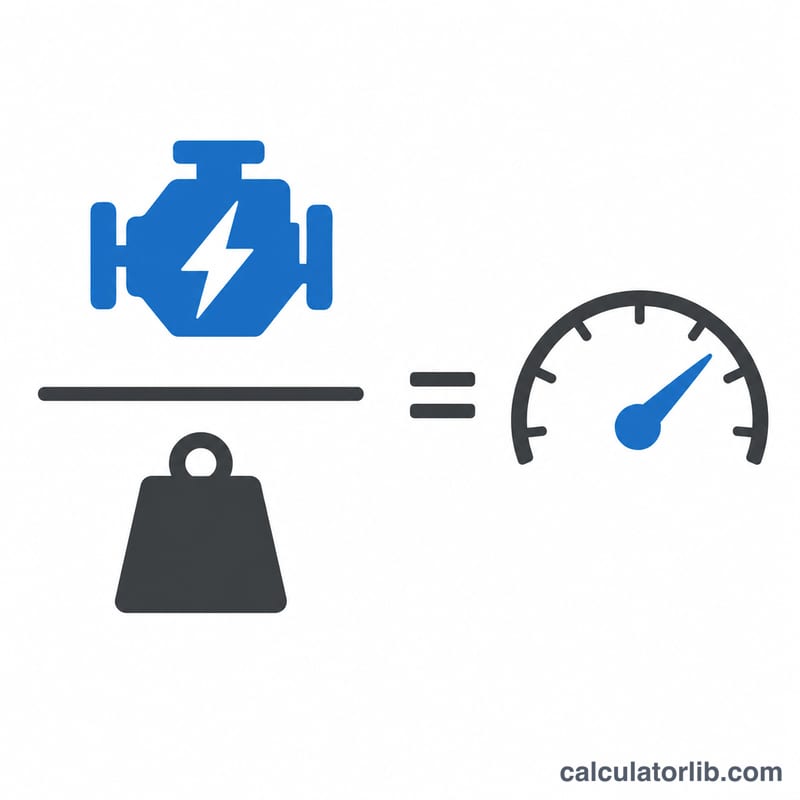
Worked Example
A car makes 300 hp and weighs 3,500 lb. The ratio is $$300 \div 3{,}500 = 0.0857\ \text{hp/lb}.$$ Expressed per ton that's $$300 \div 1.75 = 171.43\ \text{hp/ton},$$ and each horsepower carries $$3{,}500 \div 300 = 11.67\ \text{lb}.$$ A sports car at the same power but 2,800 lb would reach \(0.107\ \text{hp/lb}\) — noticeably quicker.
FAQ
Is a higher power-to-weight ratio better? Yes. A higher ratio means more power for each unit of weight, which generally translates to quicker acceleration.
Should I use curb weight or with driver? For consistent comparisons, manufacturers usually use curb weight. Add driver and fuel weight if you want a real-world figure.
How does hp/ton compare to hp/lb? They measure the same thing at different scales. Multiply hp/lb by 2,000 to get hp per US ton.