What Is a Balance Transfer Break-Even Calculator?
Moving a credit card balance to a card with a lower (or 0%) APR can save real money — but most issuers charge a one-time transfer fee, typically 3% to 5% of the amount moved. This calculator tells you how many months of interest savings it takes to cancel out that upfront fee. After the break-even point, every additional month is pure savings.
How to Use It
Enter the balance you plan to transfer, your current card's APR, the new card's APR (use 0 for a 0% intro offer), and the transfer fee percentage. The tool returns the break-even point in months, the dollar amount of the transfer fee, and how much interest you save each month.
The Formula Explained
First we find the one-time fee: \(\text{Fee} = \text{Balance} \times \text{Fee\%} \div 100\). Then the monthly interest saved: \(\text{Balance} \times (\text{oldAPR} - \text{newAPR}) \div 100 \div 12\). Dividing the fee by the monthly savings gives the number of months to break even. If the new APR is the same or higher, there are no savings and the transfer never pays off.
$$\begin{gathered} \text{Break-Even} = \frac{\text{Fee}}{\text{Monthly Savings}} \\[1.5em] \text{where}\quad \left\{ \begin{aligned} \text{Fee} &= \text{Balance} \times \frac{\text{Fee \%}}{100} \\ \text{Monthly Savings} &= \text{Balance} \times \frac{\text{Old APR} - \text{New APR}}{100 \times 12} \end{aligned} \right. \end{gathered}$$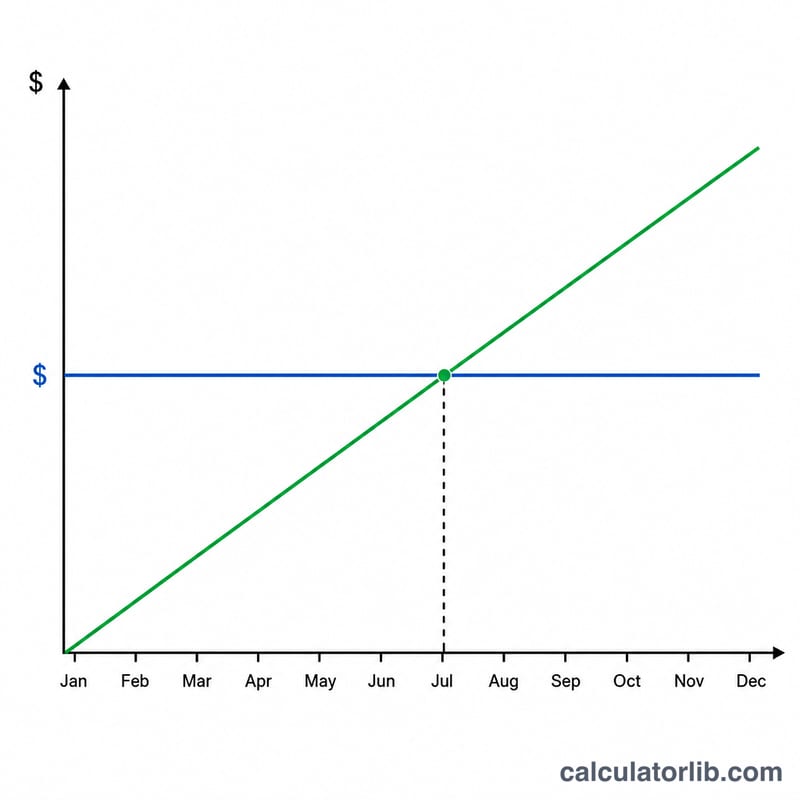
Worked Example
Suppose you transfer $5,000 from a card at 22% APR to a 0% intro card with a 3% fee. The fee is \(\$5{,}000 \times 0.03 = \$150\). Monthly interest saved is \(\$5{,}000 \times (22 - 0) \div 100 \div 12 \approx \$91.67\). Break-even:
$$\text{Break-Even} = \frac{\$150}{\$91.67} \approx 1.64 \text{ months}$$You recoup the fee in under two months, then save about $91.67 every month after.
Central bank policy rates today
The latest official policy rates of major central banks, updated automatically — the benchmark that bank deposit and loan rates follow.
- Federal Reserve · United States
- 3.75–4.00%
- As of
- 2026-11-13
- Change in 1 year
- 0 pp
Latest change Up +25 bp Federal Reserve changed its rate on 2026-09-17: from 3.50–3.75% to 3.75–4.00%.
| Central bank | Policy rate | As of | Change in 1 year |
|---|---|---|---|
| Banco Central do Brasil (Selic) · Brazil | 13.75% | 2026-11-17 | −1.25 pp |
| Banco de México · Mexico | 6.25% | 2026-11-10 | −1.00 pp |
| Federal Reserve · United States | 3.75–4.00% | 2026-11-13 | 0 pp |
| ECB | 2.50% | 2026-11-17 | +0.50 pp |
| Sveriges Riksbank · Sweden | 2.00% | 2026-11-17 | +0.25 pp |
| Saudi Central Bank (SAMA) · Saudi Arabia | 4.50% | 2026-10-29 | 0 pp |
| Reserve Bank of Australia · Australia | 4.60% | 2026-10-31 | +1.00 pp |
| Central Bank of the Republic of Türkiye · Türkiye | 36.00% | 2026-11-06 | −3.50 pp |
| Bank of Russia · Russia | 14.00% | 2026-11-10 | −2.50 pp |
| People’s Bank of China · China | 3.00% | 2026-11-10 | 0 pp |
| Bank of Canada · Canada | 2.50% | 2026-11-16 | +0.25 pp |
| Reserve Bank of India · India | 5.50% | 2026-10-19 | 0 pp |
| Bank of England · United Kingdom | 4.00% | 2026-11-17 | 0 pp |
| Bank of Japan · Japan | 1.25% | 2026-11-10 | +0.75 pp |
| Bank of Korea · South Korea | 3.00% | 2026-11-02 | +0.50 pp |
Federal Reserve: key rates and overnight market rates
The rates that frame monetary policy and the overnight market rate they steer, each with the date of its latest published value.
| Rate | Level | As of | Change in 1 year |
|---|---|---|---|
| Federal funds target range | 3.75–4.00% | 2026-11-16 | 0 pp |
| Effective federal funds rate (EFFR) | 3.88% | 2026-11-16 | 0 pp |
| Secured Overnight Financing Rate (SOFR) | 3.93% | 2026-11-16 | −0.02 pp |
Each rate keeps the date of its own latest published value; overnight market rates are published on the next business day.
Latest figure: 2026-11-13 Data last updated 2026-11-17 · current
Source: Banco Central do Brasil ODbL; Bank for International Settlements (BIS) Terms of permitted use of BIS statistics; Federal Reserve Bank of New York New York Fed Terms of Use; Board of Governors of the Federal Reserve System Public domain (U.S. government work); European Central Bank ECB reuse policy; Sveriges Riksbank Riksbank open data terms; The World Bank Group CC BY 4.0; Reserve Bank of Australia 2026 RBA copyright terms (Cash Rate); Bank of Canada Bank of Canada terms of use; Bank of England Open Government Licence v3.0
The one-year change is computed by CalculatorLib from these data. The EFFR and SOFR are subject to the Terms of Use posted at newyorkfed.org. The New York Fed is not responsible for publication of the EFFR and SOFR by CalculatorLib, does not sanction or endorse any particular republication, and has no liability for your use.
Source details and methodology
- Banco Central do Brasil
- Bank for International Settlements (BIS) — Central bank policy rates
- Federal Reserve Bank of New York — Reference rates (EFFR, SOFR)
- Board of Governors of the Federal Reserve System
- European Central Bank
- Sveriges Riksbank
- The World Bank Group — World Development Indicators (FR.INR.LEND, FR.INR.RINR)
- Reserve Bank of Australia 2026
- Bank of Canada
- Bank of England
FAQ
What if the intro APR expires? Make sure you pay off the balance before the promotional period ends, or compare the post-intro APR to your current rate.
Does this include minimum payments? No — it isolates the interest impact of the rate difference. Paying down principal speeds up real savings.
Is a transfer worth it? Generally yes if the break-even is well within the 0% promo window and you avoid new charges on the card.