
What is a balance transfer calculator?
A balance transfer moves debt from a high-interest credit card to a new card offering a low or 0% introductory APR. While the promo rate can save a lot of interest, most issuers charge an up-front transfer fee (typically 3%–5% of the balance). This calculator weighs that fee, plus any interest that accrues after the promo period, against what you'd pay by staying put — so you can see your real net savings.
How to use it
Enter the balance you want to transfer, the transfer fee percentage, the length of the 0% promo period in months, how many months you'll take to pay off the balance, the APR that kicks in after the promo, and your current card's APR. The result shows the total cost of the transfer and your estimated savings.
The formula explained
The fee is \(\text{Balance} \times \text{Fee\%}\), charged once at transfer. If your payoff period extends beyond the promo window, the months that fall outside it accrue interest at the new APR: \(\text{Balance} \times (\text{newAPR}/12) \times \text{monthsAfterPromo}\). Total cost is the fee plus that interest. The cost of staying is \(\text{Balance} \times (\text{oldAPR}/12) \times \text{payoffMonths}\). Savings is the difference. (Interest is approximated on the starting balance, giving a conservative upper-bound estimate.)
$$\begin{gathered} \text{Savings} = I_{\text{old}} - \left( F + I_{\text{new}} \right) \\[1.5em] \text{where}\quad \left\{ \begin{aligned} F &= \text{Balance} \times \frac{\text{Fee \%}}{100} \\ I_{\text{new}} &= \text{Balance} \times \frac{\text{New APR}}{1200} \times \max\!\left(\text{Payoff} - \text{Promo},\, 0\right) \\ I_{\text{old}} &= \text{Balance} \times \frac{\text{Old APR}}{1200} \times \text{Payoff} \end{aligned} \right. \end{gathered}$$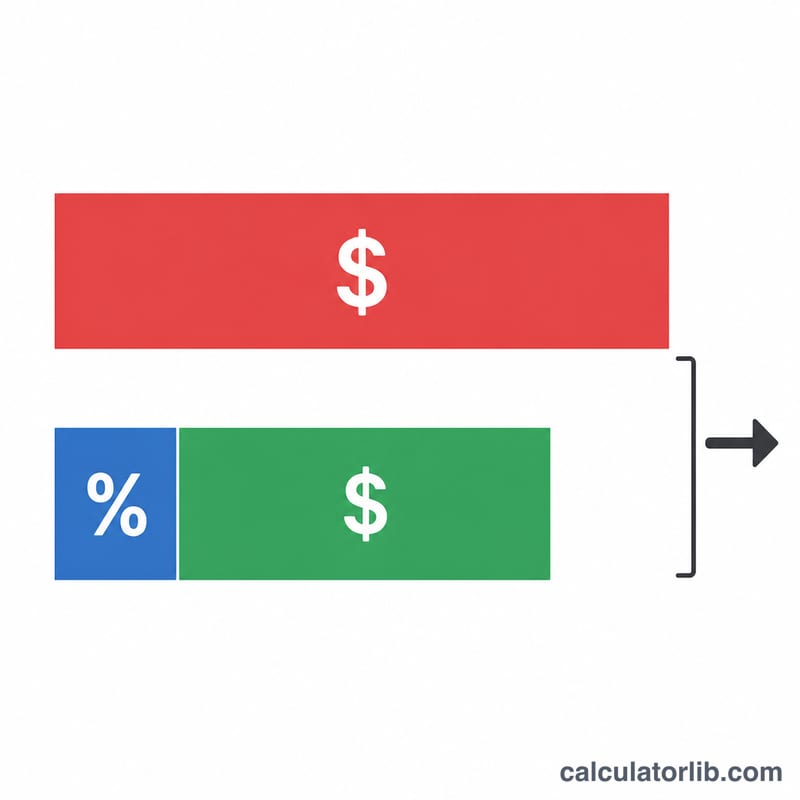
Worked example
Transfer $5,000 at a 3% fee, 12-month 0% promo, paid off over 18 months, new APR 19.99%, old APR 22.99%. Fee = $150. Months after promo = 6, so interest after promo =
$$5000 \times \frac{0.1999}{12} \times 6 \approx \$499.75$$Total cost ≈ $649.75. Old card interest =
$$5000 \times \frac{0.2299}{12} \times 18 \approx \$1{,}724.25$$Savings ≈ $1,074.50.
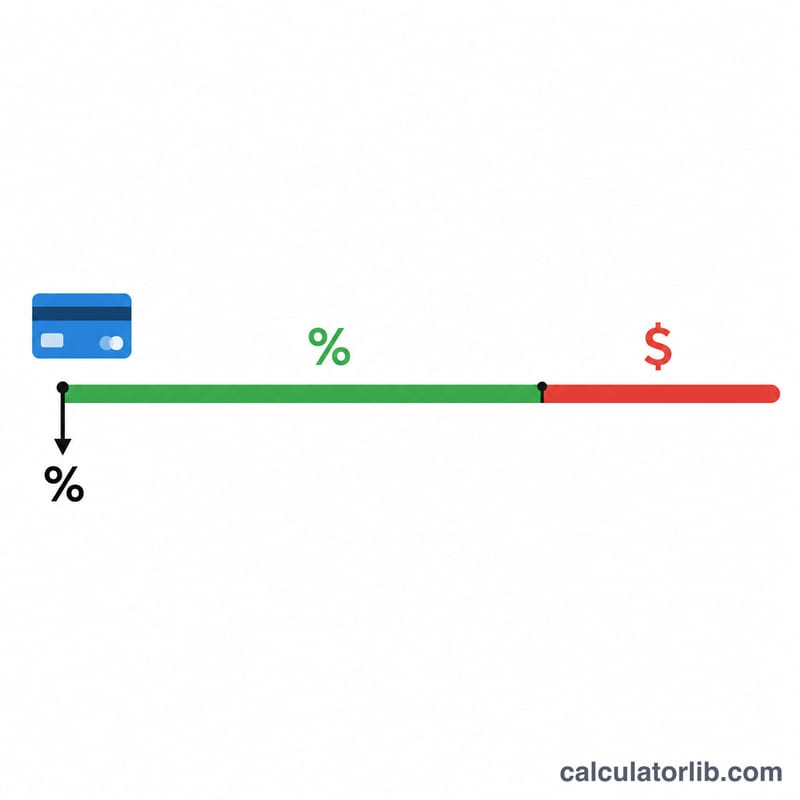
What Your Result Means
The calculator's headline number is your net savings — the difference between the interest you would pay by staying on your current card and the total cost of moving the debt to a new card (the upfront transfer fee plus any interest that accrues after the promotional rate ends).
How to read the result:
- Positive savings means the transfer costs less than staying put. The interest you avoid during the 0% promo window more than covers the one-time transfer fee, so moving the balance puts money back in your pocket.
- Negative savings means the transfer costs more. The transfer fee (and any post-promo interest) outweighs the interest you would have paid on the old card — usually because your payoff timeline is short, your old APR is modest, or the fee is high.
- Near zero is the break-even point, where the fee you pay is almost exactly equal to the interest you avoid.
The core trade-off is simply fee paid now vs. interest avoided later. A transfer wins whenever the interest you escape during the promo period exceeds the cost of the fee. As a rough check, for a balance \(B\), an old APR of \(r\%\), a promo of \(p\) months and a fee of \(f\%\), the transfer breaks even when the avoided interest \(B \times \frac{r}{1200} \times p\) equals the fee \(B \times \frac{f}{100}\). For example, a $5,000 balance at 22% APR avoids about 1100 dollars of interest over a 12-month promo, far more than a typical 3%–5% fee.
Why this is a conservative estimate: the tool applies each APR to the full starting balance for the entire payoff period. In reality your balance shrinks every month as you make payments, so the actual interest on both the old and new cards is lower than the figures shown. Treat the result as an upper-bound comparison rather than an exact dollar prediction — the relative ranking (transfer vs. stay) is reliable even though the absolute interest amounts are slightly overstated. This is general information, not personalized financial advice.
Key Terms Explained
- Balance transfer
- Moving an outstanding debt from one credit card to another — typically to a card offering a lower or 0% introductory rate — so the new card pays off the old one and you repay the new card instead.
- Transfer fee
- A one-time charge added to the transferred amount, usually 3%–5% of the balance (often with a minimum dollar amount). On a $5,000 transfer a 3% fee adds $150 to the new balance.
- Introductory / promo 0% APR
- A temporary promotional interest rate — frequently 0% — applied to the transferred balance for a set number of months, during which no interest accrues on that balance.
- Promo period
- The length of time (in months) the introductory rate lasts. Once it ends, the standard rate takes over on any remaining balance, so paying off the debt within this window maximizes savings.
- Post-promo APR
- The regular annual percentage rate the new card charges after the promotional period expires. Any balance still outstanding at that point begins accruing interest at this rate.
- Payoff period
- The total number of months you expect to take to repay the balance in full. If it exceeds the promo period, the extra months are charged interest at the post-promo APR.
- Current (old) APR
- The annual percentage rate on your existing card — the interest you would keep paying if you do not transfer the balance. This is the baseline cost the transfer is compared against.
- Net savings
- The bottom-line result: interest avoided on the old card minus the transfer fee and any post-promo interest on the new card. A positive figure means transferring saves money; a negative figure means it costs more than staying.
FAQ
Does it include the transfer fee? Yes — the fee is the main cost of a transfer and is always added to total cost.
What if I pay off the balance within the promo period? Set payoff months at or below the promo length and post-promo interest becomes $0 — you only pay the fee.
Is the interest exact? It's an estimate using the full balance, so it slightly overstates interest (you pay down the balance over time). Use it as a quick comparison, not a guaranteed amortization.