
What This Calculator Does
A balance transfer moves debt from a high-interest credit card to one with a lower (often 0%) introductory APR — but most issuers charge a one-time transfer fee, typically 3% to 5% of the amount moved. This calculator tells you whether the interest you avoid outweighs that fee, giving a clear net-savings figure over the period you choose.
How to Use It
Enter the balance you plan to transfer, your current card's APR, the new card's promotional APR, the number of months you expect to carry the balance, and the transfer fee percentage. The tool shows your net savings plus a breakdown of interest on each card and the fee.
The Formula Explained
Interest is approximated on a fixed balance: each card's APR is divided by 1,200 to get a monthly decimal rate, multiplied by the balance and the number of months. The new-card interest and the transfer fee (balance × fee% ÷ 100) are subtracted from the old-card interest. A positive result means transferring saves money; a negative result means the fee costs more than you'd save. This is a simplified, fixed-balance estimate — actual interest falls as you pay the balance down.
$$\begin{gathered} \text{Savings} = \frac{\left(\text{Old APR} - \text{New APR}\right)}{1200} \cdot B \cdot \text{Months} \;-\; B \cdot \frac{\text{Fee \%}}{100} \\[1.5em] \text{where}\quad \left\{ \begin{aligned} B &= \text{Balance (\$)} \end{aligned} \right. \end{gathered}$$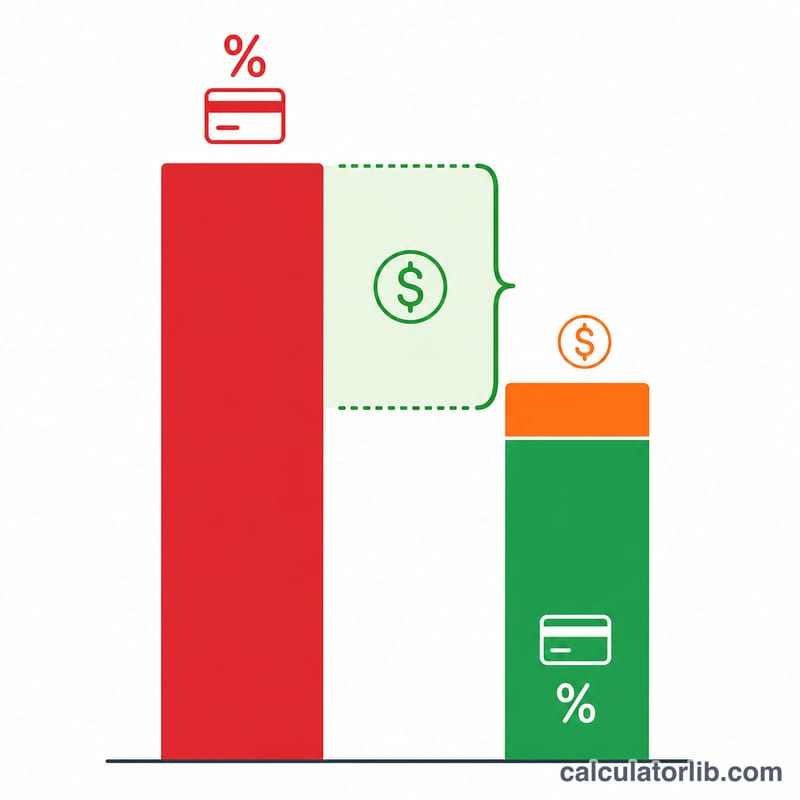
Worked Example
Transfer $5,000 from a 22% APR card to a 0% card for 12 months with a 3% fee. Old interest = \(22/1200 \times 5000 \times 12 = \$1{,}100\). New interest = \(\$0\). Fee = \(5000 \times 0.03 = \$150\). Net savings = \(1100 - 0 - 150 =\) $950.
FAQ
Why divide APR by 1,200? Dividing by 12 converts annual to monthly, and by 100 converts percent to decimal — combined that's 1,200.
Does it account for paying down the balance? No. It assumes a constant balance, so it tends to overstate interest for both cards. Use it for a quick comparison rather than an exact amortization.
What if savings are negative? The transfer fee exceeds the interest you'd avoid, so transferring may not be worthwhile unless you value other benefits.