
What This Calculator Does
The After-Tax Savings Interest Calculator shows how much interest you actually keep on a savings account or deposit once tax has been deducted. Interest earnings are often taxable, so the headline rate your bank advertises overstates what lands in your pocket. This tool computes the gross compound interest, the tax owed on it, and the net interest you retain — along with your final balance.
How to Use It
Enter four values: the principal (your starting deposit), the annual interest rate as a percentage, how often interest compounds per year (monthly, quarterly, etc.), and the term in years. Then add the tax rate that applies to your interest income. The calculator returns the net interest, gross interest, tax owed, and the final after-tax balance.
The Formula Explained
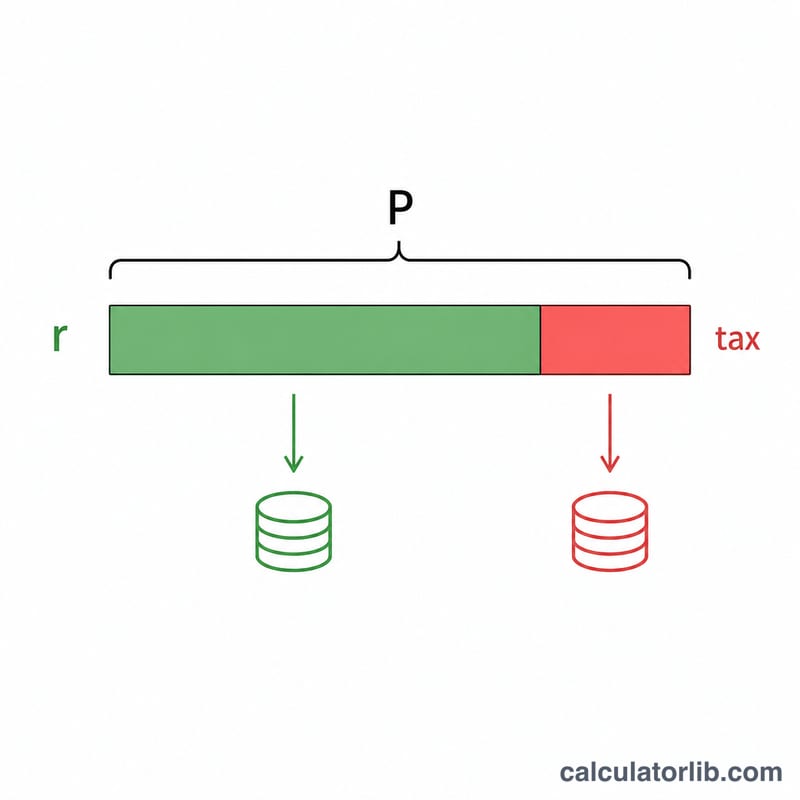
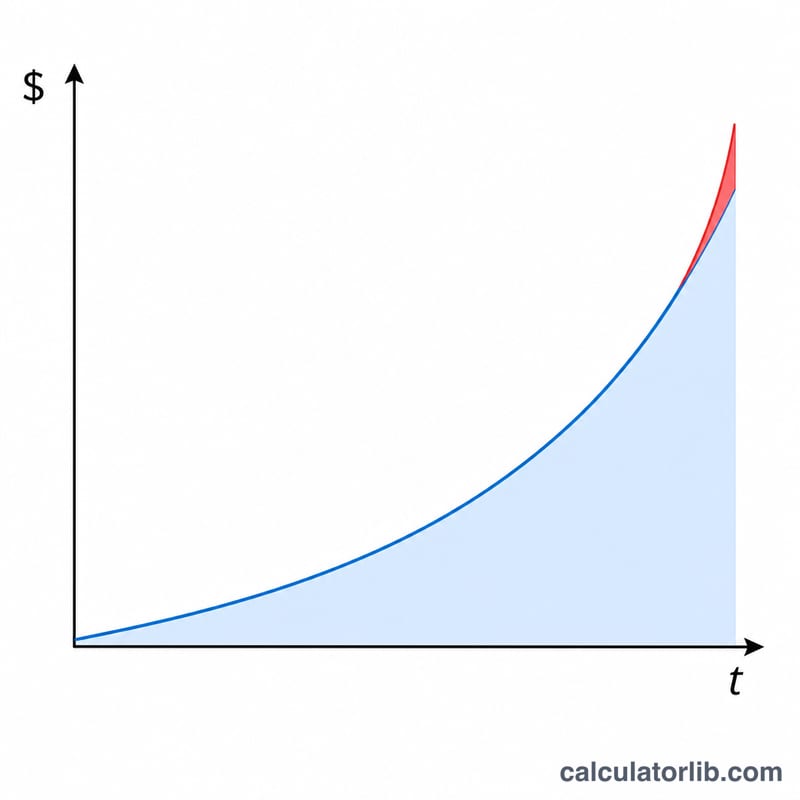
Gross interest follows standard compound interest: $$I = P\left(\left(1 + \frac{r}{n}\right)^{n\,t} - 1\right)$$ where \(P\) is principal, \(r\) is the decimal annual rate, \(n\) is compounding frequency, and \(t\) is years. Because only the interest portion is taxable, the net interest is \(I \times (1 - \text{tax})\). Your final balance is simply the principal plus the net interest.
Worked Example
Suppose you deposit $10,000 at 5% compounded monthly for 5 years with a 25% tax rate. The growth factor is \(\left(1 + 0.05/12\right)^{60} \approx 1.283359\), giving gross interest of about $2,833.59. Tax of 25% is roughly $708.40, leaving net interest of about $2,125.19 and a final balance near $12,125.19.
FAQ
Is all savings interest taxable? It depends on your jurisdiction. Some accounts (such as tax-advantaged or registered accounts) shelter interest from tax — in those cases set the tax rate to 0%.
What tax rate should I enter? Use your marginal rate on interest income, since interest is typically taxed as ordinary income.
Does this account for inflation? No — it shows nominal after-tax interest. Real (inflation-adjusted) returns would be lower.