
What This Calculator Does
A bi-weekly mortgage plan splits your normal monthly payment in half and pays that half every two weeks. Because there are 52 weeks in a year, you make 26 half-payments — equal to 13 full monthly payments instead of 12. That one extra payment each year attacks your principal directly, shrinking the balance faster and cutting the interest you pay over the life of the loan. This calculator quantifies that benefit in dollars and in years.
How to Use It
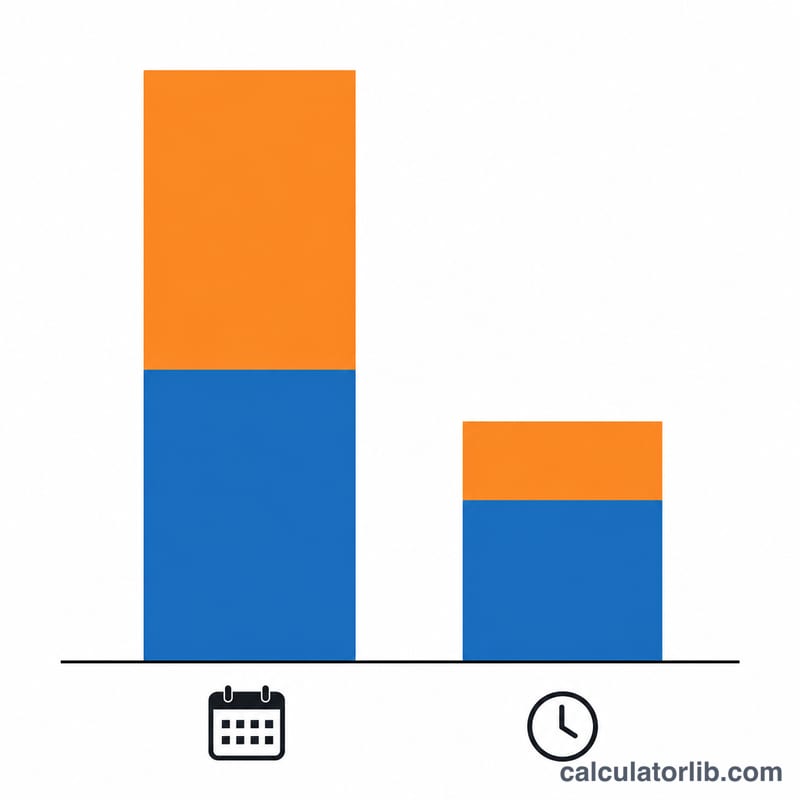
Enter your loan amount, the annual interest rate, and the loan term in years. The tool first computes the standard amortized monthly payment, then simulates a bi-weekly schedule where you pay half that amount every two weeks. It reports your total interest under each plan, the dollars saved, and how many years sooner you'd be debt-free.
The Formula Explained
The monthly payment uses the classic amortization formula $$M = P\cdot\frac{r\,(1+r)^{n}}{(1+r)^{n}-1}$$ where \(P\) is the principal, \(r\) is the monthly interest rate, and \(n\) is the number of months. For the bi-weekly plan we apply the periodic rate (annual rate \(\div\) 26) to a half-payment made 26 times per year, looping until the balance reaches zero. Total interest for each plan equals total payments minus principal, and the savings is the difference.
Worked Example
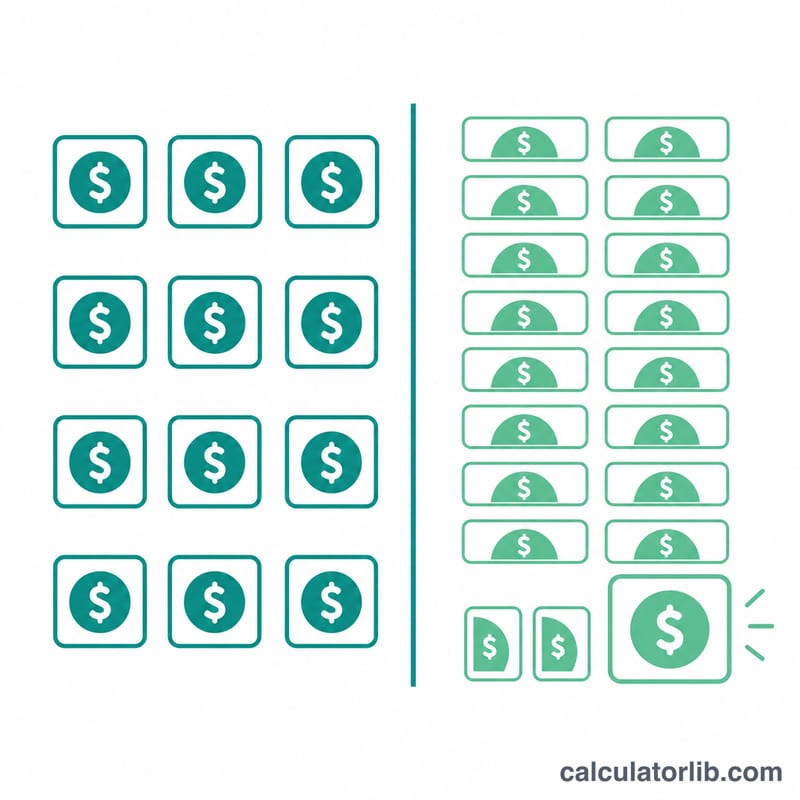
On a $300,000 loan at 6% for 30 years, the monthly payment is about $1,798.65, producing roughly $347,514 in interest over 360 months. Paying $899.33 every two weeks pays the loan off in about 24.9 years and trims tens of thousands in interest — a substantial saving for the same household budget.
Key Terms Explained
- Principal (P)
- The amount you originally borrow — the loan balance before any interest is added. In the formula above this is the "Loan Amount" you enter.
- Annual interest rate
- The yearly cost of borrowing, expressed as a percentage. On a mortgage this is the nominal annual rate before compounding.
- Periodic interest rate (r)
- The annual rate divided by the number of payment periods per year. For monthly payments, \(r = \frac{\text{rate}}{1200}\) (the rate as a percent divided by 12 months and by 100).
- Amortization
- The process of paying off a loan through regular equal payments. Early payments are mostly interest; over time a larger share goes to principal until the balance reaches zero.
- Bi-weekly payment
- A schedule where you pay half your monthly amount every two weeks. Because there are 52 weeks in a year, you make 26 half-payments — equal to 13 full monthly payments rather than 12.
- Prepayment
- Any payment applied to principal beyond the required scheduled amount. The bi-weekly plan works precisely because the 13th payment each year acts as an annual prepayment.
- Term (n)
- The total length of the loan, usually in years. In the monthly formula the number of payments is \(n = 12 \times \text{Years}\).
- Total interest
- The sum of all interest paid over the life of the loan: total payments minus principal, or \(M \cdot n - P\) for a monthly schedule.
Interpreting Your Result
The interest savings shown by this calculator come from a single, simple mechanism: a bi-weekly schedule makes 26 half-payments per year, which equals 13 full monthly payments. That extra payment is applied directly to principal, so you owe less, accrue less interest, and reach a zero balance sooner.
A few important caveats when reading your result:
- Fixed rate, no fees. The figures assume a constant interest rate for the entire term and ignore lender setup fees, servicing charges, escrow for taxes and insurance, and any prepayment penalties. Some lenders charge to enroll in a bi-weekly program — if so, weigh that cost against the savings.
- You can replicate it yourself for free. The same effect is achieved by adding one-twelfth of your monthly payment to each monthly check. For example, on a $1,800 payment, adding about $150 per month makes one extra full payment over the year — the same principal reduction without enrolling in a formal bi-weekly plan.
- The biggest gains come with high rates and long terms. Loans with more interest to begin with (higher rate, longer 30-year term) see the largest dollar savings and the most years trimmed.
- Estimates, not exact statements. Real lender amortization may round differently, and the timing of payments affects the precise outcome. Treat these numbers as close approximations for planning.
This is general educational information, not financial advice. Before changing how you pay your mortgage, confirm the details with your loan servicer and consider whether other goals — such as paying down higher-interest debt or building an emergency fund — should take priority.
FAQ
Is bi-weekly the same as paying twice a month? No. Twice-monthly is 24 payments a year; true bi-weekly is 26, which is what creates the extra annual payment.
Does my lender have to allow this? Some lenders charge for formal bi-weekly programs. You can often replicate the benefit yourself by adding 1/12 of your payment to principal each month.
Are there prepayment penalties? Check your loan terms. Most modern mortgages allow extra principal payments without penalty, but always confirm first.