
What Is a Mortgage Interest Calculator?
A mortgage interest calculator shows how much interest you will pay over the entire life of a home loan. While the monthly payment tells you the short-term cost, the total interest reveals the true long-term price of borrowing. On long fixed-rate mortgages the interest can rival or even exceed the amount you originally borrowed, so understanding it helps you compare loans, evaluate refinancing, and decide whether to make extra payments.
How to Use It
Enter three values: the loan amount (the principal you borrow), the annual interest rate as a percentage, and the loan term in years. The calculator converts the annual rate to a monthly rate and the term to a number of months, then computes the fixed monthly payment and the total interest paid.
The Formula Explained
The standard amortization payment is \( PMT = P \cdot \dfrac{r}{1-(1+r)^{-n}} \), where \(P\) is the principal, \(r\) is the monthly interest rate (annual rate \(\div 12 \div 100\)), and \(n\) is the total number of monthly payments (years \(\times 12\)). Total interest is simply all the payments added together minus the original loan: $$\text{Total Interest} = (PMT \times n) - P$$
Worked Example
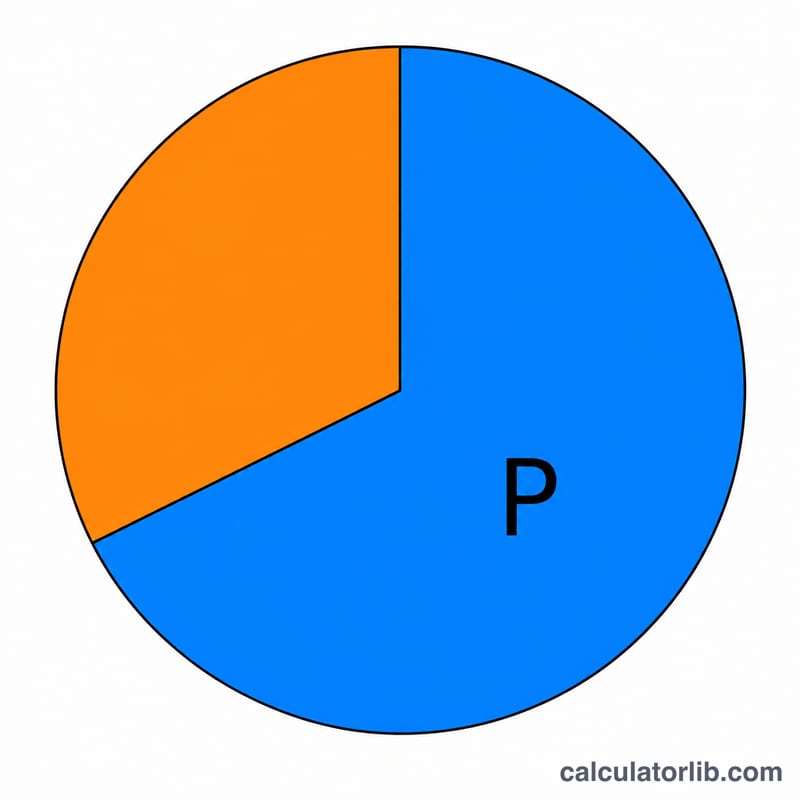
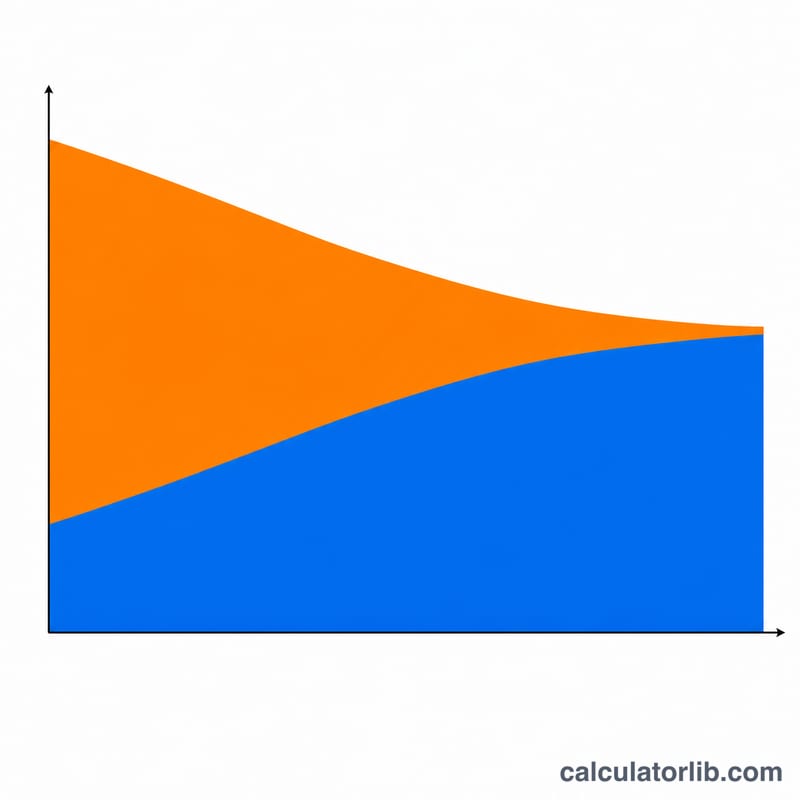
Suppose you borrow $300,000 at 6.5% annual interest over 30 years. The monthly rate is \( 0.065/12 \approx 0.00541667 \) and \( n = 360 \). The monthly payment works out to about $1,896.20. Total payments are \( \$1{,}896.20 \times 360 \approx \$682{,}633 \), so total interest is roughly $382,633 — more than the original loan amount.
FAQ
Does this include taxes and insurance? No. It calculates principal-and-interest only. Property taxes, homeowners insurance, and PMI are separate.
Can I lower the total interest? Yes — a shorter term, a lower rate, or extra principal payments all reduce total interest.
What if the rate is 0%? With a 0% rate there is no interest, and the monthly payment is simply the loan amount divided by the number of months.