What is a Payday Loan Calculator?
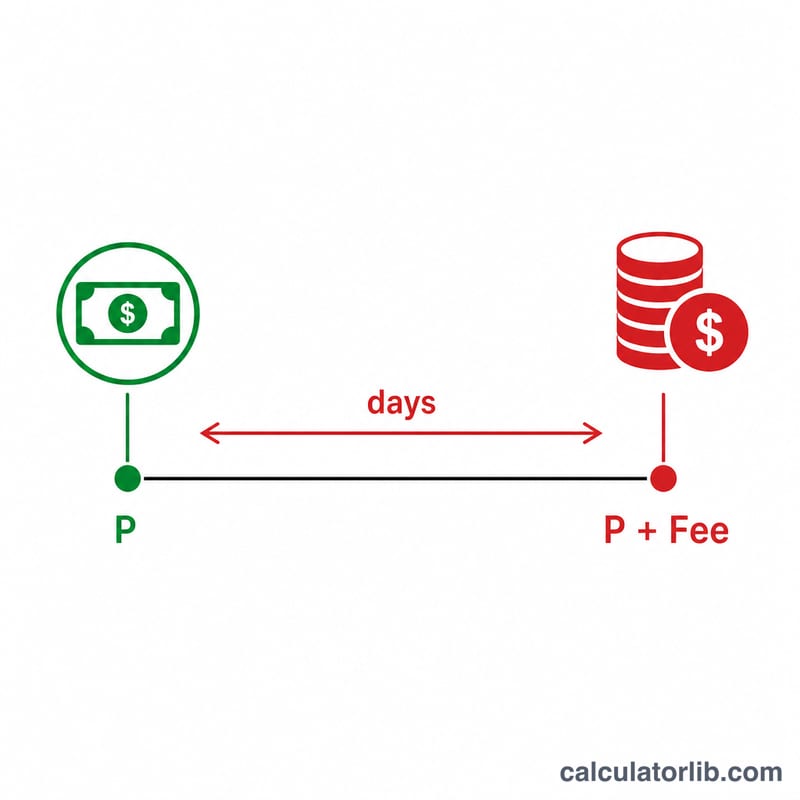
A payday loan is a small, short-term cash advance that is typically repaid on your next payday. While the fee may look small in dollar terms, the very short term makes the effective annual cost extremely high. This calculator shows you both the total amount you must repay and the APR (annual percentage rate, the US measure), plus the effective annual rate used in the EU, so you can compare the true cost against other forms of credit.
How to use it
Enter three numbers: the loan amount (principal) you intend to borrow, the total fee or finance charge the lender applies, and the loan term in days (often around 14 days). The calculator instantly returns the total repayment and the annualized APR.
The formula explained
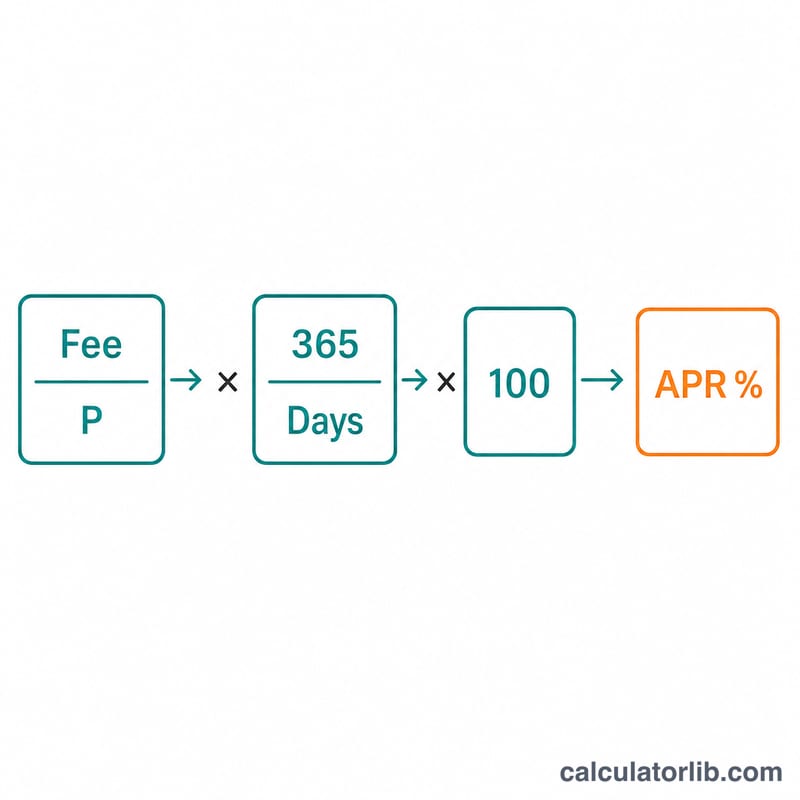
The total repayment is simply Principal + Fee. The APR takes the fee as a fraction of the principal, then scales it up to a full year using the ratio 365 / Days, and converts to a percentage: $$\text{APR} = \frac{\text{Fee}}{P} \times \frac{365}{\text{Days}} \times 100$$ Because payday terms are short, dividing 365 by a small number of days produces a large multiplier.
Worked example
Borrow $500 with a $75 fee for 14 days. Total repayment = \(500 + 75 =\) $575. APR: $$\text{APR} = \frac{75}{500} \times \frac{365}{14} \times 100 = 0.15 \times 26.07 \times 100 \approx 391.07\%$$ The $75 fee equates to nearly 400% APR — far higher than a typical credit card.
Interpreting Your APR Result
The calculator reports two numbers that answer different questions. Total repayment (loan amount + fee) is the actual dollar amount you pay back for one term. APR is the fee expressed as a yearly rate so that short-term loans can be compared with long-term credit. APR is an annualized measure, not money you pay: a 14-day loan does not cost you 391% of the amount borrowed, it costs the fee for that single term.
The common $15 per $100 convention
In the United States, many payday lenders charge a flat fee of about $15 for every $100 borrowed on a roughly 14-day loan. The APR for that fee is:
$$\text{APR} = \frac{15}{100} \times \frac{365}{14} \times 100\% \approx 391.07\%$$
For a $100 loan, a $15 fee and a 14-day term, the calculator gives an APR of about 391.07%, with a total repayment of $115. The same fee rate applied to $500 means a $75 fee and $575 due, still about 391% APR.
How to compare your result
- Credit cards: typical card APRs are roughly 15% to 30%, depending on the issuer and the borrower's credit.
- Personal loans: rates vary widely with credit and lender, from single digits up to about 36% for many borrowers.
- 36% cap: 36% is a commonly cited ceiling for consumer loans. In the United States, the Military Lending Act limits the Military Annual Percentage Rate (MAPR) to 36% on most credit extended to active-duty servicemembers and their covered dependents. Many individual US states also set their own limits on small-loan rates. These rules are specific to the US and may not apply elsewhere.
An APR in the hundreds of percent is many times higher than any of these benchmarks, which reflects the very short term and the flat fee. Remember that the shorter the term for a given fee, the higher the APR becomes.
Rollovers multiply the fees
If a loan is rolled over or renewed, a new fee is charged for each extension while the original amount is still owed. For example, a $100 loan with a $15 fee that is rolled over three times costs $15 × 4 = $60 in fees over about 56 days, and the $100 principal is still outstanding. The per-term APR stays the same, but the dollar cost grows with every renewal, so total repayment across all terms is the figure to watch.
This is general information about how to read the calculator's output, not financial advice. Rules and fee limits differ by country and by state or region.
Central bank policy rates today
The latest official policy rates of major central banks, updated automatically — the benchmark that bank deposit and loan rates follow.
- Federal Reserve · United States
- 3.75–4.00%
- As of
- 2026-11-13
- Change in 1 year
- 0 pp
Latest change Up +25 bp Federal Reserve changed its rate on 2026-09-17: from 3.50–3.75% to 3.75–4.00%.
| Central bank | Policy rate | As of | Change in 1 year |
|---|---|---|---|
| Banco Central do Brasil (Selic) · Brazil | 13.75% | 2026-11-16 | −1.25 pp |
| Banco de México · Mexico | 6.25% | 2026-11-10 | −1.00 pp |
| Federal Reserve · United States | 3.75–4.00% | 2026-11-13 | 0 pp |
| ECB | 2.50% | 2026-11-16 | +0.50 pp |
| Sveriges Riksbank · Sweden | 2.00% | 2026-11-16 | +0.25 pp |
| Saudi Central Bank (SAMA) · Saudi Arabia | 4.50% | 2026-10-29 | 0 pp |
| Reserve Bank of Australia · Australia | 4.60% | 2026-10-31 | +1.00 pp |
| Central Bank of the Republic of Türkiye · Türkiye | 36.00% | 2026-11-06 | −3.50 pp |
| Bank of Russia · Russia | 14.00% | 2026-11-10 | −2.50 pp |
| People’s Bank of China · China | 3.00% | 2026-11-10 | 0 pp |
| Bank of Canada · Canada | 2.50% | 2026-11-13 | +0.25 pp |
| Reserve Bank of India · India | 5.50% | 2026-10-19 | 0 pp |
| Bank of England · United Kingdom | 4.00% | 2026-11-16 | 0 pp |
| Bank of Japan · Japan | 1.25% | 2026-11-10 | +0.75 pp |
| Bank of Korea · South Korea | 3.00% | 2026-11-02 | +0.50 pp |
Federal Reserve: key rates and overnight market rates
The rates that frame monetary policy and the overnight market rate they steer, each with the date of its latest published value.
| Rate | Level | As of | Change in 1 year |
|---|---|---|---|
| Federal funds target range | 3.75–4.00% | 2026-11-13 | 0 pp |
| Effective federal funds rate (EFFR) | 3.88% | 2026-11-13 | 0 pp |
| Secured Overnight Financing Rate (SOFR) | 3.90% | 2026-11-13 | −0.10 pp |
Each rate keeps the date of its own latest published value; overnight market rates are published on the next business day.
Latest figure: 2026-11-13 Data last updated 2026-11-16 · current
Source: Banco Central do Brasil ODbL; Bank for International Settlements (BIS) Terms of permitted use of BIS statistics; Federal Reserve Bank of New York New York Fed Terms of Use; Board of Governors of the Federal Reserve System Public domain (U.S. government work); European Central Bank ECB reuse policy; Sveriges Riksbank Riksbank open data terms; The World Bank Group CC BY 4.0; Reserve Bank of Australia 2026 RBA copyright terms (Cash Rate); Bank of Canada Bank of Canada terms of use; Bank of England Open Government Licence v3.0
The one-year change is computed by CalculatorLib from these data. The EFFR and SOFR are subject to the Terms of Use posted at newyorkfed.org. The New York Fed is not responsible for publication of the EFFR and SOFR by CalculatorLib, does not sanction or endorse any particular republication, and has no liability for your use.
Source details and methodology
- Banco Central do Brasil
- Bank for International Settlements (BIS) — Central bank policy rates
- Federal Reserve Bank of New York — Reference rates (EFFR, SOFR)
- Board of Governors of the Federal Reserve System
- European Central Bank
- Sveriges Riksbank
- The World Bank Group — World Development Indicators (FR.INR.LEND, FR.INR.RINR)
- Reserve Bank of Australia 2026
- Bank of Canada
- Bank of England
FAQ
Why is the APR so high? APR annualizes a cost that you only pay for a couple of weeks, so a modest fee becomes a large percentage when stretched over a full year.
Does this include rollovers? No. This models a single loan term. Rolling the loan over repeatedly adds new fees and dramatically increases the total cost.
Is the fee the same as interest? Lenders often state a flat fee rather than interest. This calculator treats the entire fee as the cost of borrowing for the term.