
What this calculator does
The Savings Withdrawal Duration Calculator tells you how long a lump sum of savings will last if you withdraw a fixed amount every month while the remaining balance keeps earning interest. It answers the everyday retirement and budgeting question: "If I have this much saved and take out this much each month, when does it run out?"
How to use it
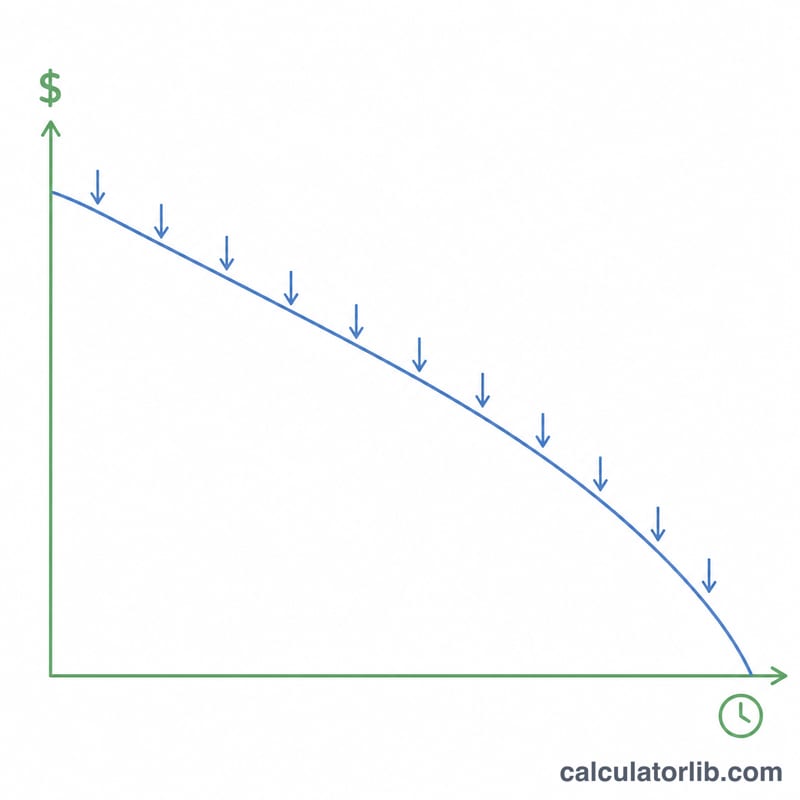
Enter your current savings balance, the amount you plan to withdraw each month, and the annual interest rate your account earns. The calculator converts the annual rate to a monthly rate, applies the annuity-depletion formula, and reports the result in both months and years. If the interest earned each month is equal to or greater than your withdrawal, the balance never falls — the tool reports that your savings last indefinitely.
The formula explained
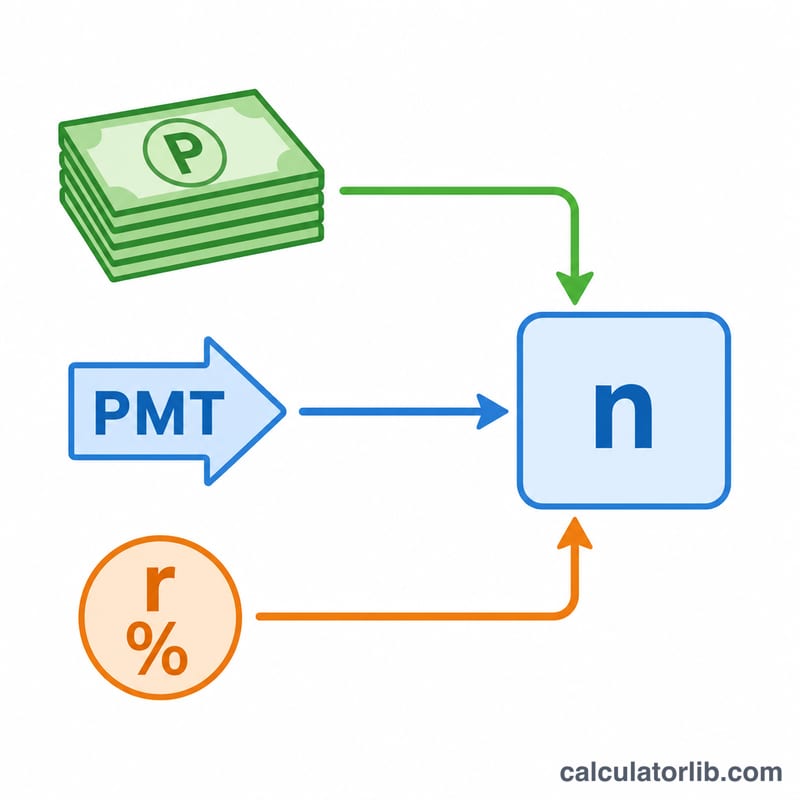
With a positive monthly rate \(r\), the number of withdrawals is $$n = \frac{-\ln\!\left(1 - \dfrac{r \cdot P}{\text{PMT}}\right)}{\ln(1 + r)},$$ where \(P\) is the starting balance and \(\text{PMT}\) is the monthly withdrawal. The term \(rP\) is the first month's interest; if \(\text{PMT}\) exceeds it, the balance shrinks and the logarithm is defined. When the rate is zero, the formula simplifies to $$n = \frac{P}{\text{PMT}}.$$
Worked example
Suppose you have $100,000, withdraw $1,000 per month, and earn 4% annually. The monthly rate is \(0.04 / 12 = 0.0033333\). First-month interest is \(100{,}000 \times 0.0033333 = \$333.33\), which is less than $1,000, so the balance depletes. Plugging in: $$n = \frac{-\ln(1 - 0.0033333 \times 100{,}000 / 1{,}000)}{\ln(1.0033333)} = \frac{-\ln(0.66667)}{0.0033278} \approx \frac{0.405465}{0.0033278} \approx 121.8 \text{ months},$$ or about 10.2 years.
FAQ
What if my withdrawal is small? If your monthly withdrawal is less than or equal to the monthly interest, the principal grows or stays flat, so the calculator shows your savings last indefinitely.
Does it account for inflation or taxes? No. It assumes a constant rate, constant withdrawals, and ignores taxes and inflation. Real results may be shorter once those are considered.
When are withdrawals assumed to occur? At the end of each period (ordinary annuity), with interest credited monthly.