

What Is the HSA Tax Savings Calculator?
This calculator applies to the United States. A Health Savings Account (HSA) is a tax-advantaged account available to people enrolled in a qualifying High-Deductible Health Plan (HDHP). Contributions are tax-deductible (or pre-tax if made through payroll), grow tax-free, and can be withdrawn tax-free for qualified medical expenses — the rare "triple tax advantage." This tool estimates how much you reduce your tax bill in a single year based on the amount you contribute and your tax rates. Figures use 2024 FICA rates (Social Security 6.2% + Medicare 1.45% = 7.65%).
How to Use It
Enter your planned annual HSA contribution, your marginal federal income tax rate, and your state income tax rate (use 0% if your state has no income tax or doesn't tax HSA contributions). Then indicate whether you contribute through payroll deduction. Payroll (cafeteria plan) contributions also escape the 7.65% FICA payroll tax, which direct contributions do not.
The Formula Explained
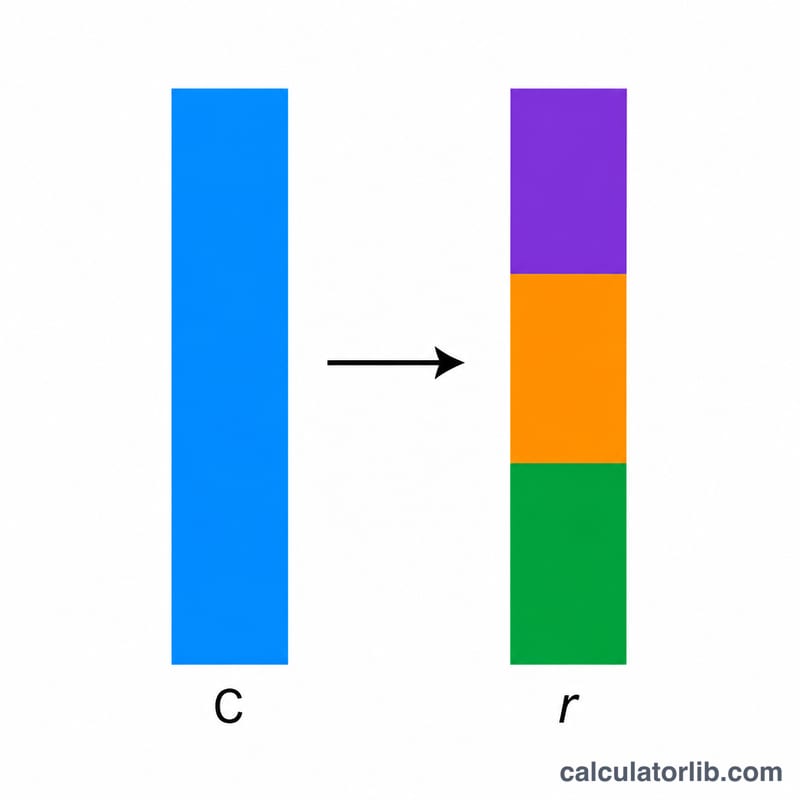
The core equation is $$\text{Savings} = \text{Contribution} \times (\text{federal rate} + \text{state rate} + \text{FICA rate})$$ Your marginal rate is the rate on your last dollar of income, since the HSA deduction reduces taxable income from the top down. The FICA rate of 7.65% is included only when the box is set to payroll, because employer-sponsored pre-tax contributions are excluded from FICA wages.
Worked Example
Suppose you contribute $4,150 (the 2024 self-only limit), are in the 22% federal bracket, have a 5% state rate, and contribute via payroll. Federal savings = \(\$4{,}150 \times 0.22 = \$913\). State = \(\$4{,}150 \times 0.05 = \$207.50\). FICA = \(\$4{,}150 \times 0.0765 = \$317.48\). Total savings ≈ $1,437.98, so your net cost is about $2,712.02.
FAQ
Does everyone save FICA? No — only contributions made through your employer's payroll system avoid FICA. Contributions you make directly and deduct on your tax return save income tax but not FICA.
Which states tax HSA contributions? Most follow federal rules, but a few (such as California and New Jersey) do not allow the deduction. Enter 0% for the state field if your state doesn't recognize HSA deductions.
Is this the same as actual money in my pocket? It's the tax you avoid this year. The contribution itself remains your money in the HSA, growing tax-free for future medical costs.