
What Is a Savings Goal Calculator?
This calculator tells you how much you need to deposit each month to reach a target savings amount by a future date, given an annual interest rate compounded monthly. It is useful for planning a down payment, an emergency fund, a vacation, or any future expense.
How to Use It
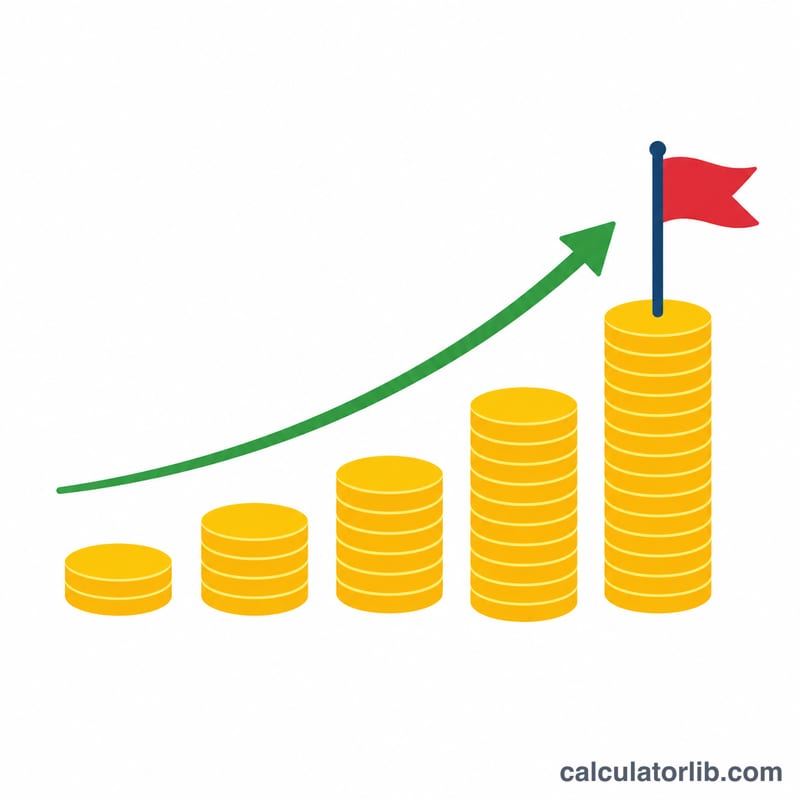
Enter your savings goal (the future value you want to reach), the annual interest rate your account earns, and the number of years you have to save. The calculator returns the required monthly deposit, the total amount you will deposit, and the interest your savings will earn along the way.
The Formula Explained
The tool uses the future value of an ordinary annuity formula, solved for the payment:
$$PMT = FV \times \frac{r/12}{(1 + r/12)^{n} - 1}$$
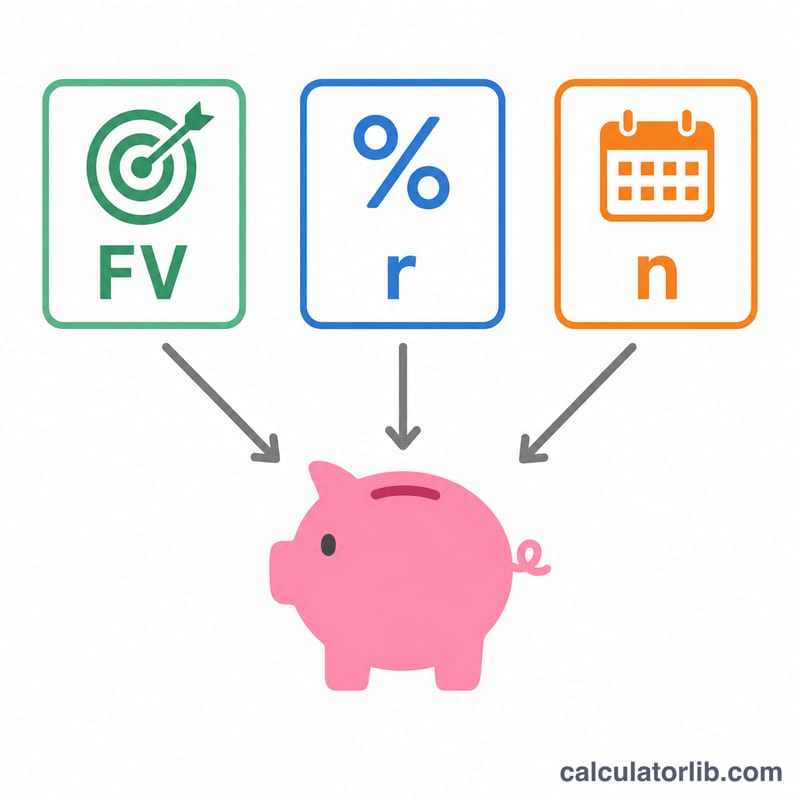
where FV is your goal, r is the annual rate as a decimal, and n is the total number of monthly deposits (years \(\times\) 12). When the interest rate is zero, the required deposit is simply FV divided by n.
Worked Example
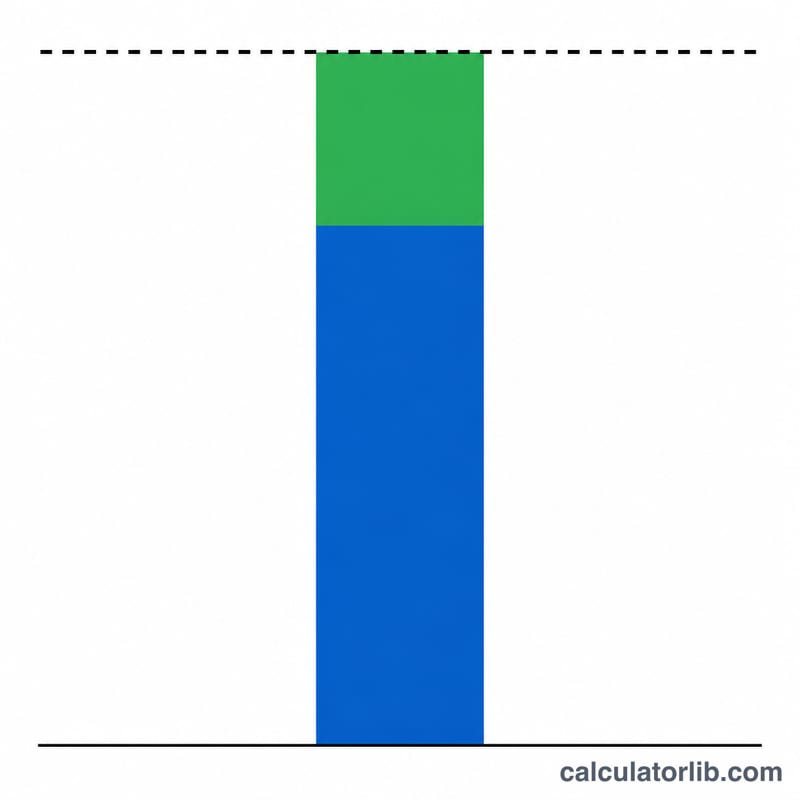
Suppose you want $10,000 in 5 years at a 5% annual rate. Then \(r/12 = 0.0041667\) and \(n = 60\). $$PMT = 10000 \times \frac{0.0041667}{(1.0041667)^{60} - 1} = 147.0457 \text{ per month}$$ Over 60 months you deposit about $8,822.74, so the interest earned is roughly $1,177.26.
Key Terms Explained
- Future value (FV)
- The target amount you want your savings to reach at the end of the time frame — your savings goal. In the formula this is the value the accumulated deposits plus interest grow to.
- Required monthly deposit (PMT)
- The fixed amount you must contribute each month so that, with interest, the balance equals the goal by the end of the term. It is the unknown the calculator solves for.
- Annual interest rate
- The yearly rate of return on your savings, entered as a percentage (for example, 5 means 5%). A higher rate means interest does more of the work, lowering the deposit you need.
- Monthly rate (i = r/12)
- The annual rate divided by 12, expressed as a decimal — the rate applied to your balance each month. For a 5% annual rate, \(i = 0.05/12 \approx 0.004167\).
- Number of periods (n)
- The total count of monthly deposits, equal to \(12 \times \text{years}\). A 10-year plan has \(n = 120\) periods.
- Ordinary annuity
- A series of equal payments made at the end of each period. This calculator assumes an ordinary annuity, the most common convention for savings deposit problems.
- Compounding
- The process by which earned interest is added to the balance and itself earns interest in later periods. Here interest compounds monthly, in step with the deposits.
Interpreting Your Result
The calculator returns three figures. The required monthly deposit is the steady amount to set aside each month to hit your goal on schedule — treat it as a budgeting target. The total deposited is that monthly amount multiplied by the number of months (\(PMT \times n\)); it represents money that comes out of your own pocket. The interest earned is the gap between your goal and what you contributed (\(FV - PMT \times n\)) — the portion the account earns for you rather than you funding it.
Two levers reduce the deposit you need. A higher interest rate means each dollar you contribute grows faster, so interest covers more of the goal and your required deposit falls. A longer time frame spreads the goal over more months and gives early deposits more time to compound, which lowers the monthly amount even further. In the scenarios above, raising a $5,000 / 10-year plan from 0% to 5% cuts the deposit from about $41.67 to $32.20, and stretching a fixed goal from 3 to 10 years cuts it dramatically.
These results rest on two assumptions: a fixed interest rate for the whole term and consistent monthly contributions of the same amount, each made at the end of the month. Real-world rates can change, and a missed or smaller deposit will leave you short, so revisit the plan if your rate or budget changes. This is general educational information, not financial advice; consult a qualified professional for guidance on your specific situation.
FAQ
Does this assume deposits earn interest? Yes — each monthly deposit earns interest until the goal date, which is why total deposits are less than your goal.
Is interest compounded monthly? Yes, the model compounds at the same monthly cadence as the deposits.
What if my rate is 0%? The calculator divides your goal evenly across all months with no interest earned.