What this calculator does
This tool multiplies two factors and then verifies the answer using the complete fact family that links multiplication and division. Given two numbers a and b, it computes the product p and then shows the four related number sentences so you can confirm the result is correct.
How to use it
Enter the first factor (a) and the second factor (b), then read the product at the top. The table below lists the matching division facts. If p ÷ a gives back b and p ÷ b gives back a, your multiplication is correct.
The formula explained
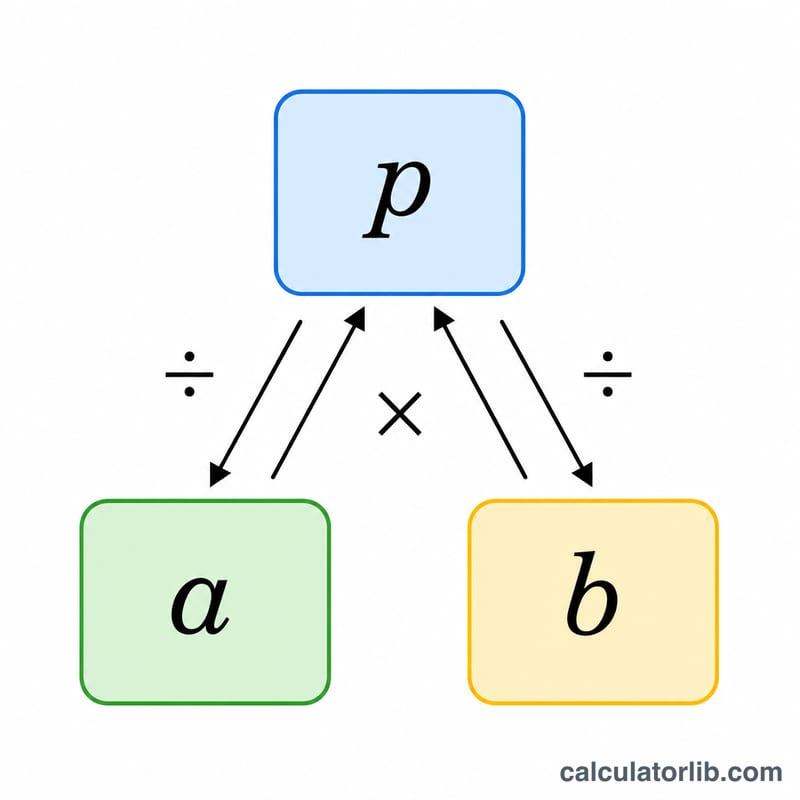
Multiplication and division are inverse operations. If a × b = p, then dividing the product by one factor must return the other: \(p \div a = b\) and \(p \div b = a\). Multiplication is also commutative, so \(a \times b = b \times a\). Together these four sentences form a fact family.
$$P = \text{a} \times \text{b} \qquad \frac{P}{\text{a}} = \text{b}, \quad \frac{P}{\text{b}} = \text{a}$$
Worked example
Take a = 6 and b = 7. The product is $$6 \times 7 = 42.$$ To check: \(42 \div 6 = 7\) (returns b) and \(42 \div 7 = 6\) (returns a). Both checks succeed, so 42 is the correct product.
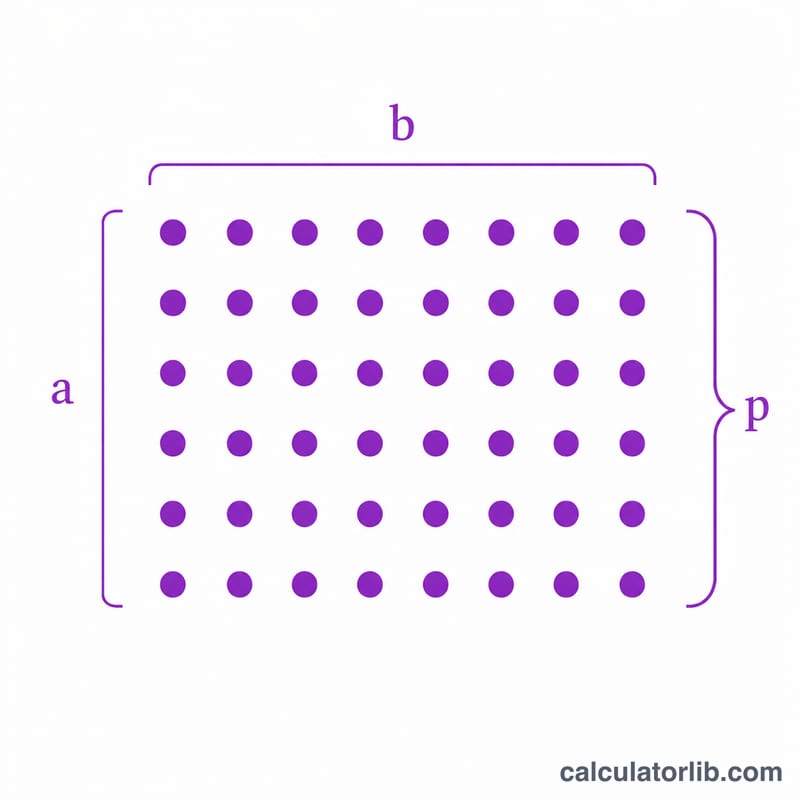
Key Terms: Factor, Product, Fact Family and Inverse Operation
- Factor: a number being multiplied. In \(a \times b\), both a and b are factors.
- Product: the result of multiplying the factors. In \(7 \times 8 = 56\), 56 is the product.
- Dividend: the number being divided. When checking, the product is the dividend.
- Divisor: the number you divide by. When checking, each factor takes a turn as the divisor.
- Quotient: the result of a division. A correct check gives a quotient equal to the other factor.
- Fact family: the related multiplication and division facts that use the same three numbers, such as \(7 \times 8 = 56\), \(8 \times 7 = 56\), \(56 \div 7 = 8\) and \(56 \div 8 = 7\).
- Commutative property: the order of the factors does not change the product, so \(a \times b = b \times a\).
- Inverse operation: an operation that undoes another. Division undoes multiplication, so dividing the product by one factor returns the other.
- Remainder: the amount left over when a whole-number division does not come out even. A correct product divides by each of its factors with remainder 0. A nonzero remainder signals that the product, or one of the factors, is wrong.
FAQ
Why use a division check? Reversing the operation catches arithmetic slips — if the division doesn't return the original factor, the product was wrong.
Does order matter? No. Because multiplication is commutative, \(6 \times 7\) and \(7 \times 6\) give the same product, 42.
Can I use decimals? Yes. The calculator works with whole numbers and decimals alike; the division facts still hold.