
What is the Scientific Notation Multiplication Calculator?
This tool multiplies two numbers written in scientific notation — each in the form \(a \times 10^m\) — and returns the product in clean, normalized scientific notation, along with the equivalent standard decimal value. Scientific notation is the standard way scientists, engineers and students express very large or very small numbers, and multiplying them by hand can be error-prone. This calculator handles the coefficient multiplication, exponent addition and normalization for you.
How to use it
Enter the four parts of your problem: coefficient a and exponent m for the first number, and coefficient b and exponent n for the second. Coefficients can be any decimal (including negatives); exponents should be whole numbers. Press calculate to see the normalized product, the raw coefficient product, the exponent sum and the full decimal expansion.
The formula explained
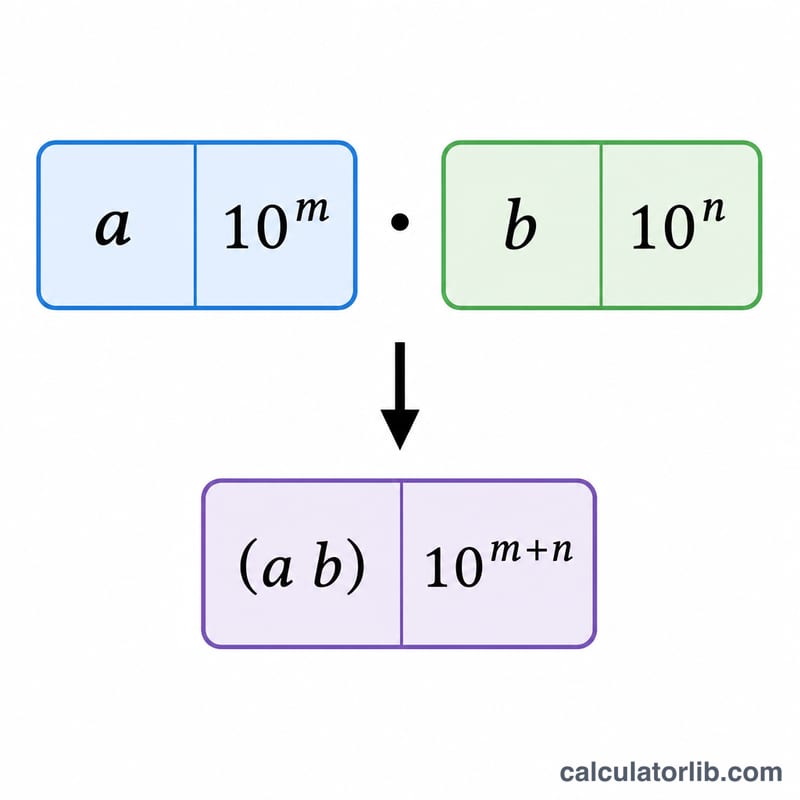
Multiplication of numbers in scientific notation relies on two rules. First, multiply the coefficients: \(a \cdot b\). Second, apply the laws of exponents to add the powers of ten: \(10^m \times 10^n = 10^{m+n}\). Together this gives $$\left(a \times 10^m\right)\left(b \times 10^n\right) = \left(a \cdot b\right) \times 10^{\,m+n}$$ The result is then normalized so the coefficient lies between 1 and 10 (in absolute value), shifting the exponent up or down as needed.
Worked example
Multiply \((3 \times 10^4)\) by \((2 \times 10^5)\). Coefficients: \(3 \times 2 = 6\). Exponents: \(4 + 5 = 9\). So the product is $$6 \times 10^9 = 6{,}000{,}000{,}000$$ Because 6 is already between 1 and 10, no normalization is needed.
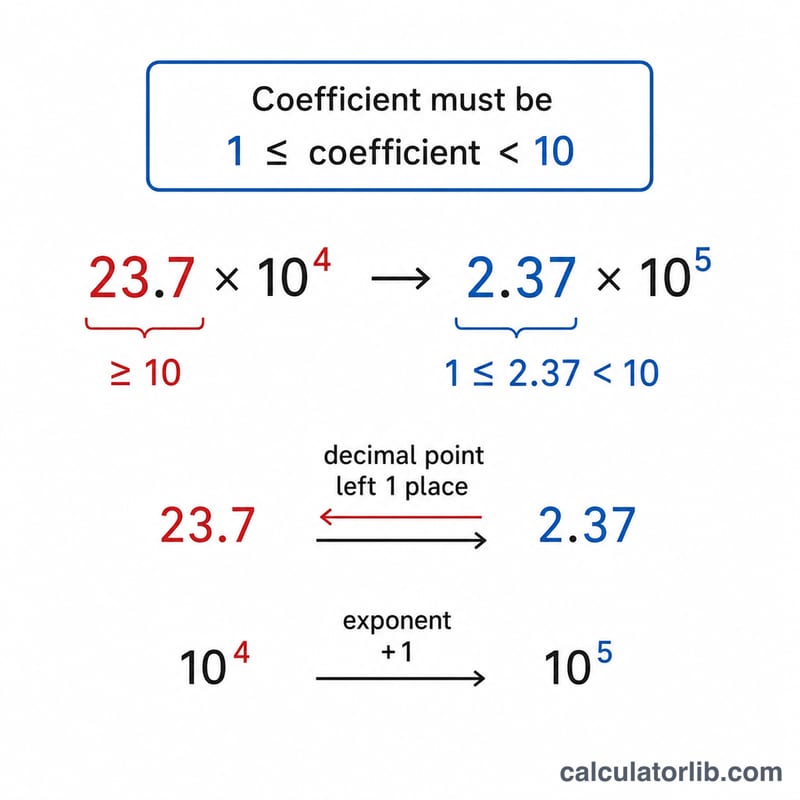
Now try \((4 \times 10^3)(5 \times 10^2)\): coefficients give 20, exponents give 5, so the raw result is \(20 \times 10^5\). Normalizing 20 to 2.0 increases the exponent by one, giving $$2 \times 10^6 = 2{,}000{,}000$$
FAQ
Can the coefficients be negative? Yes. The sign carries through the multiplication; normalization works on the absolute value while keeping the sign.
What if a coefficient is zero? If either coefficient is 0 the product is 0, which has no meaningful exponent.
Does this work for division? No — this calculator multiplies. For division you would subtract the exponents \((m - n)\) and divide the coefficients.