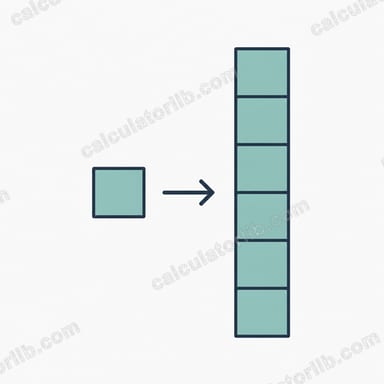

What is repeated multiplication?
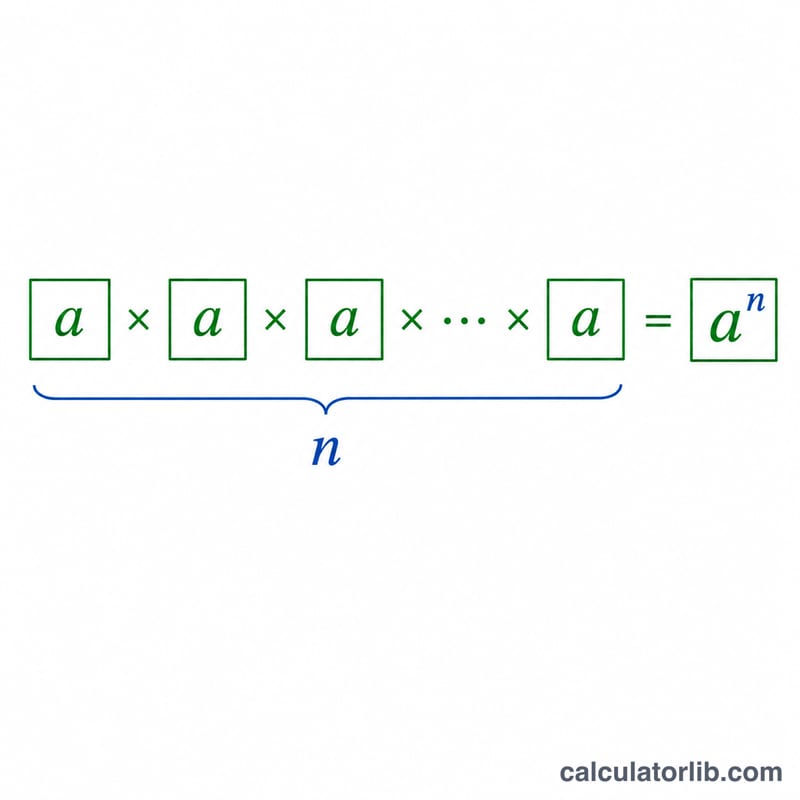
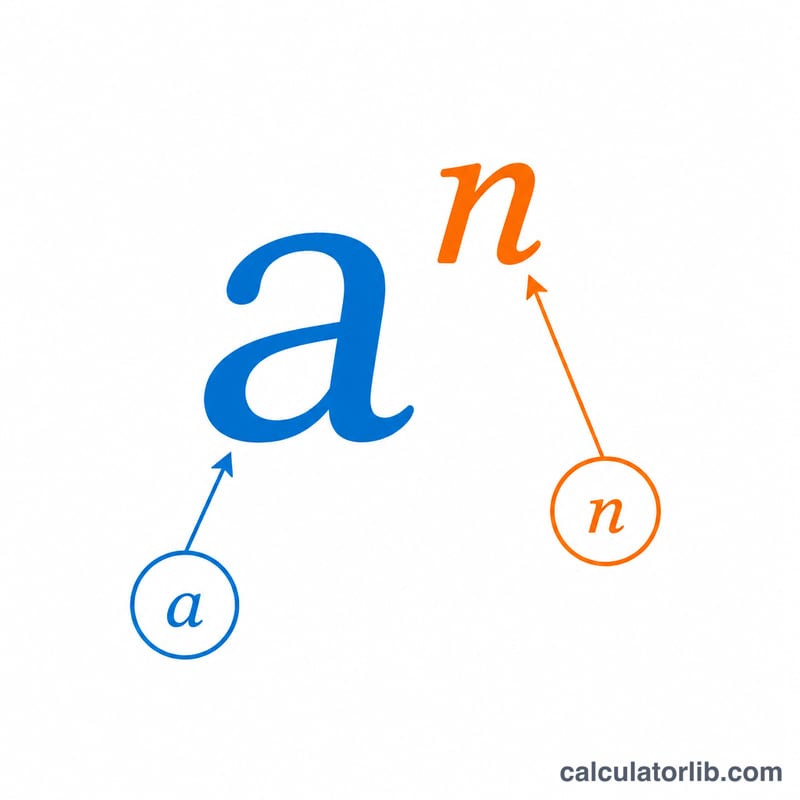
Exponentiation is a shorthand for repeated multiplication. Writing \(a^n\) means you multiply the base a by itself n times. The number being multiplied is called the base, and the number of times you multiply it is the exponent (or power). This calculator computes \(a^n\) for any real base and exponent, including negative and fractional values.
How to use the calculator
Enter the base (\(a\)) and the exponent (\(n\)), then read the result. For whole-number exponents the answer is the base multiplied by itself that many times. A negative exponent returns a reciprocal, and a fractional exponent returns a root (for example, an exponent of 0.5 gives the square root of the base).
The formula explained
The core definition is:
$$a^n = a \times a \times \ldots \times a \quad (n \text{ times})$$
Special cases worth remembering: any nonzero number to the power 0 equals 1, \(a^1\) equals the base itself, and \(a^{-n} = 1 \div a^n\).
Worked example
Suppose \(a = 2\) and \(n = 10\). Then $$2^{10} = 2 \times 2 \times 2 \times 2 \times 2 \times 2 \times 2 \times 2 \times 2 \times 2 = 1{,}024.$$ This is why a kilobyte (\(2^{10}\) bytes) equals 1,024 bytes.
FAQ
What does a negative exponent mean? It means take the reciprocal: \(2^{-3} = 1 \div 2^3 = 1 \div 8 = 0.125\).
What is anything to the power of 0? Any nonzero base raised to 0 equals 1.
Can the exponent be a fraction? Yes. A fractional exponent represents a root — for example \(9^{0.5} = \sqrt{9} = 3\).