
What is lattice multiplication?
Lattice multiplication, also called the gelosia or Napier's grid method, is a visual way to multiply two whole numbers. Instead of carrying digits in your head, you build a rectangular grid, fill each cell with a single-digit product split by a diagonal, then add along the diagonals to read off the answer. This calculator computes the product of any two whole numbers and draws the full lattice grid so you can follow every step — perfect for students learning the technique and teachers building worksheets.
How to use the calculator
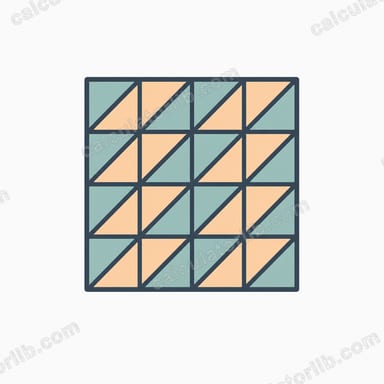
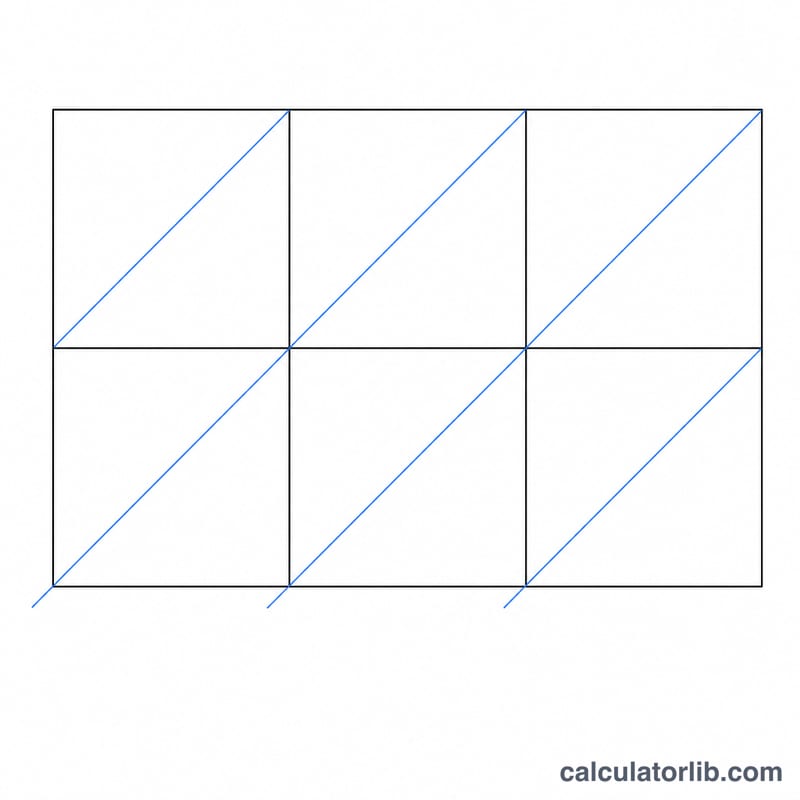
Enter the Multiplicand (the top number) and the Multiplier (the side number), then submit. The tool returns the product with thousands separators, a plain-language statement, and an \(m\times n\) lattice grid where \(m\) is the number of digits in the multiplicand and \(n\) is the number of digits in the multiplier. Each cell shows the two-digit product of the intersecting digits, with the tens digit in the upper-left triangle and the ones digit in the lower-right triangle.
The formula explained
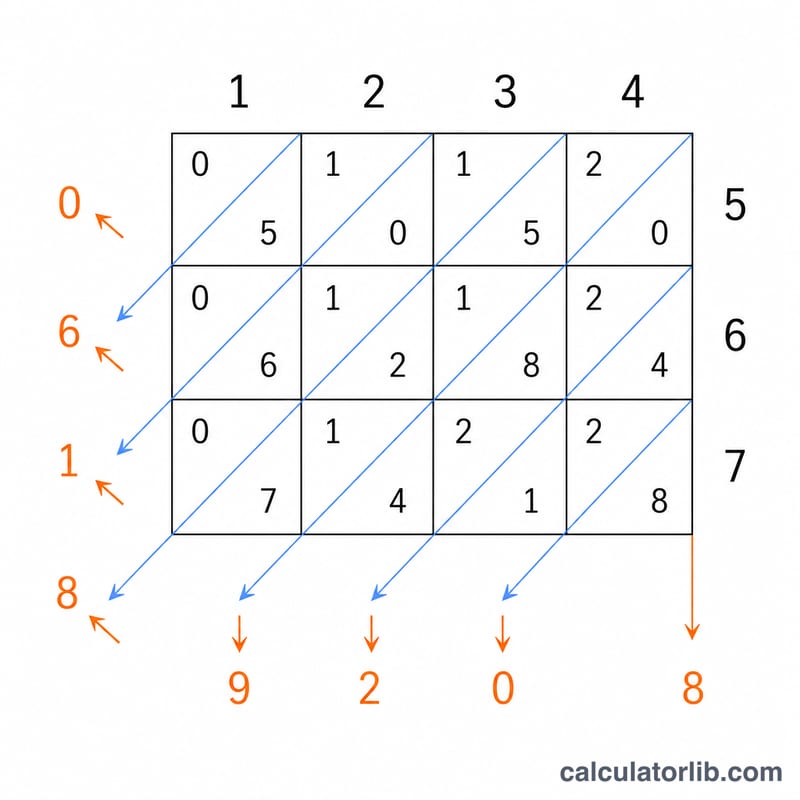
Place the multiplicand digits across the top and the multiplier digits down the right edge. In cell (row i, column j) write \(p = a\times b\), with \(\text{tens} = \lfloor p/10 \rfloor\) above the diagonal and \(\text{ones} = p \bmod 10\) below it. Sum the triangle digits along each diagonal from the bottom-right corner, carrying tens into the next diagonal up-left. Reading the boundary digits down the left side and along the bottom gives the product — which is exactly the ordinary integer product,
$$\text{Product} = \text{Multiplicand} \times \text{Multiplier}$$
Worked example: 785 × 1220
The digits 7, 8, 5 go across the top and 1, 2, 2, 0 go down the right. Filling the cells (for example \(7\times 2 = 14\) becomes 1\4) and adding the diagonals yields boundary digits 0, 9, 5, 7 down the left and 7, 0, 0 across the bottom, which read as 957700. The numeric check confirms
$$785 \times 1220 = 957{,}700$$
FAQ
Does it work for single-digit numbers? Yes. A single-digit by single-digit calculation produces a \(1\times 1\) grid, such as \(7\times 8 = 56\) shown as 5\6.
What if I enter zero? If either input is 0 the product is 0 and the grid fills with 0\0 cells.
Is the diagonal sum the actual answer? Yes — the lattice is just a visualization. The reported product is the exact integer multiplication of the two numbers.