
What Is Cross Multiplication?
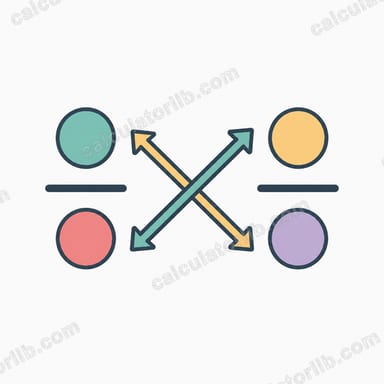
Cross multiplication is a simple algebraic technique for solving proportions — equations where two fractions are set equal to one another. When you have a proportion of the form \(a/b = c/x\) and need to find the unknown value \(x\), cross multiplication turns the problem into a single linear equation you can solve in one step. This calculator does that instantly for any numbers you enter.
How to Use the Calculator
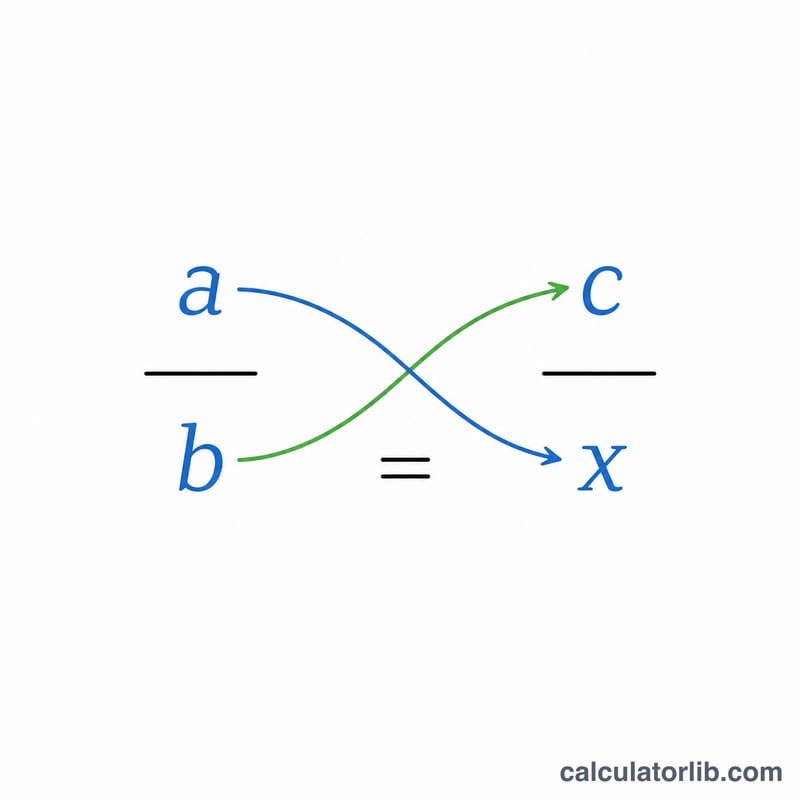
Enter the three known values from your proportion: a and b on the left side of the equation \(a/b\), and c on the right side of \(c/x\). The fourth term, \(x\), is the unknown. Press calculate and the tool returns the exact value of \(x\). All decimals and whole numbers are supported.
The Formula Explained
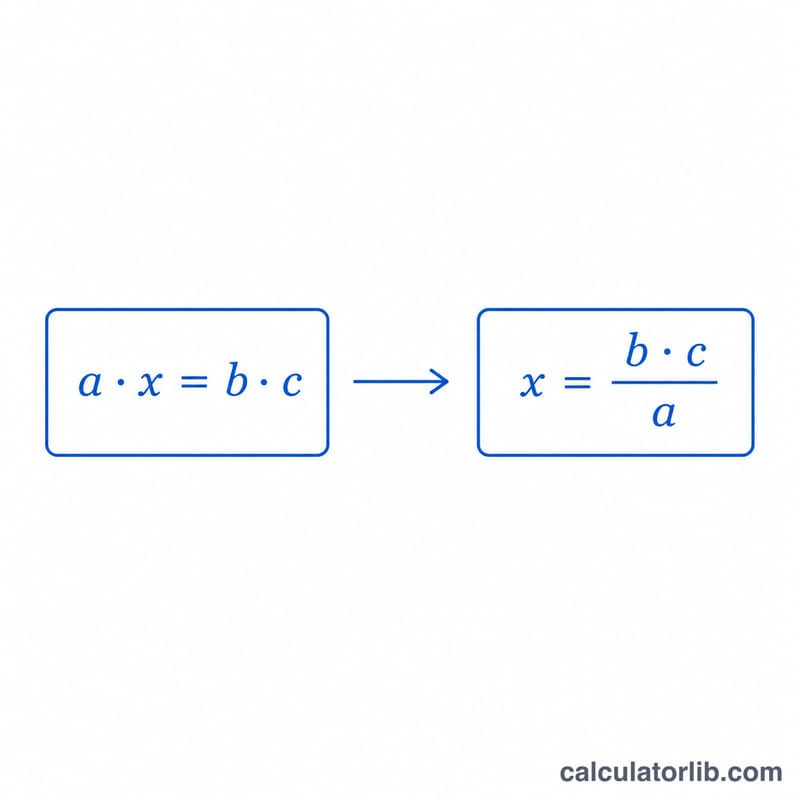
Starting from \(a/b = c/x\), multiply both sides by \(b\) and by \(x\) to clear the denominators. This gives \(a \cdot x = b \cdot c\) (the "cross" products). Dividing both sides by \(a\) isolates the unknown:
$$\frac{\text{a}}{\text{b}} = \frac{\text{c}}{\text{x}} \quad\Rightarrow\quad \text{x} = \frac{\text{b} \times \text{c}}{\text{a}}$$Because the value of \(a\) appears in the denominator, \(a\) must not be zero — if \(a = 0\) the proportion has no finite solution.
Worked Example
Suppose \(2/4 = 6/x\). Using the formula,
$$x = \frac{4 \times 6}{2} = \frac{24}{2} = 12$$You can verify: \(2/4 = 0.5\) and \(6/12 = 0.5\), so both sides match. The proportion is solved correctly.
FAQ
What if my unknown is in a different position? Rearrange your proportion so the unknown sits where \(x\) is (the bottom-right). Any proportion can be rewritten this way by swapping terms.
Can a, b, or c be negative or decimal? Yes. The calculator handles negative numbers and decimals. Only \(a\) being zero is invalid.
Is cross multiplication the same as scaling a recipe? Essentially yes — scaling ingredients, converting units, and finding map distances are all real-world proportion problems this method solves.