
What is the Cross Product?
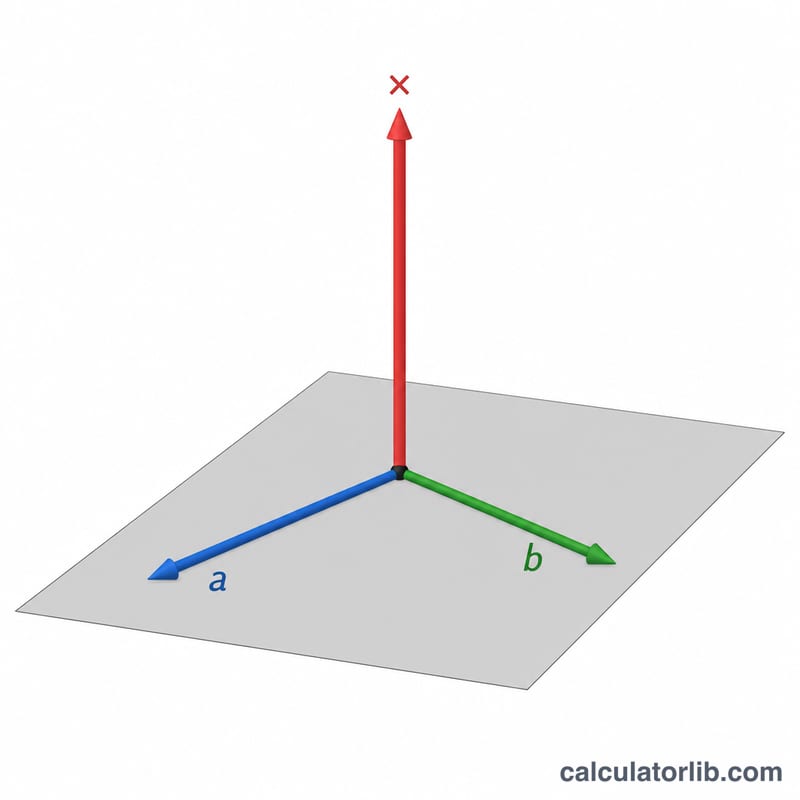
The cross product of two three-dimensional vectors A and B produces a third vector that is perpendicular (orthogonal) to both. It is widely used in physics, engineering, and computer graphics to find torque, angular momentum, surface normals, and rotational axes. Unlike the dot product, which yields a scalar, the cross product yields a vector.
How to Use This Calculator
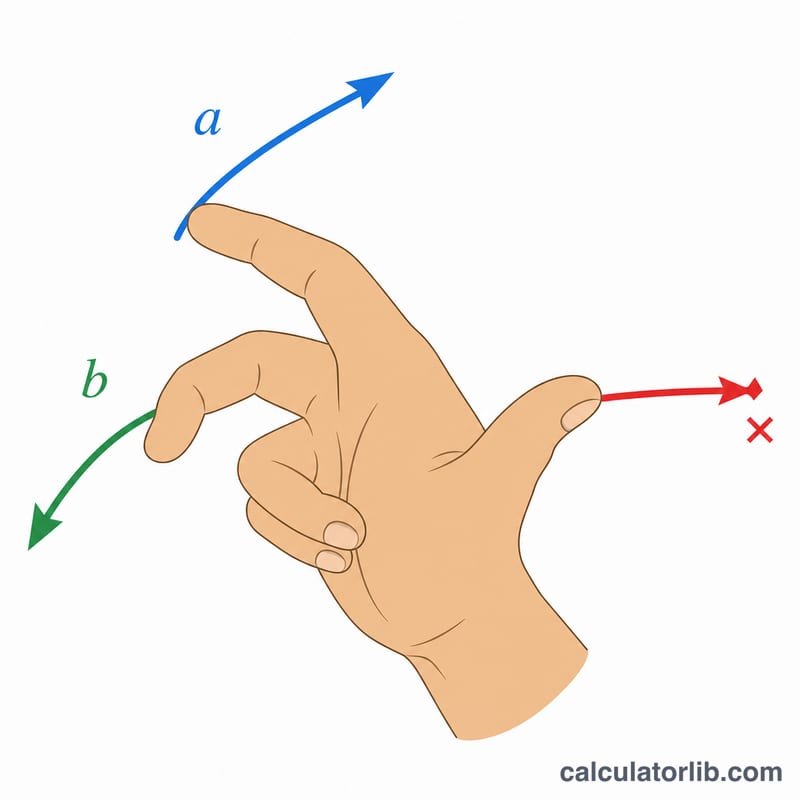
Enter the x, y, and z components of vector A and vector B. The calculator returns the three components of A \(\times\) B as well as the magnitude of the resulting vector. The result vector always points in the direction determined by the right-hand rule.
The Formula Explained
For A = (a₁, a₂, a₃) and B = (b₁, b₂, b₃):
$$\vec{A} \times \vec{B} = \begin{pmatrix} \text{A}_y\,\text{B}_z - \text{A}_z\,\text{B}_y \\[0.4em] \text{A}_z\,\text{B}_x - \text{A}_x\,\text{B}_z \\[0.4em] \text{A}_x\,\text{B}_y - \text{A}_y\,\text{B}_x \end{pmatrix}$$ The magnitude is $$\left\| \vec{A} \times \vec{B} \right\| = \sqrt{ C_x^{2} + C_y^{2} + C_z^{2} },$$ which also equals \(|A||B|\sin(\theta)\), the area of the parallelogram spanned by A and B.
Worked Example
Let A = (1, 2, 3) and B = (4, 5, 6).
$$c_x = 2\cdot6 - 3\cdot5 = 12 - 15 = -3$$ $$c_y = 3\cdot4 - 1\cdot6 = 12 - 6 = 6$$ $$c_z = 1\cdot5 - 2\cdot4 = 5 - 8 = -3$$
So A \(\times\) B = (−3, 6, −3) with magnitude \(\sqrt{9 + 36 + 9} = \sqrt{54} \approx 7.348\).
FAQ
Is the cross product commutative? No. \(\vec{A} \times \vec{B} = -(\vec{B} \times \vec{A})\); swapping the order reverses the direction.
What if the vectors are parallel? The cross product is the zero vector, because \(\sin(0) = 0\).
Does it work in 2D? The cross product is defined for 3D vectors. For 2D vectors, set the z components to 0; the result will have only a z component.