
What Is the Cross Product?
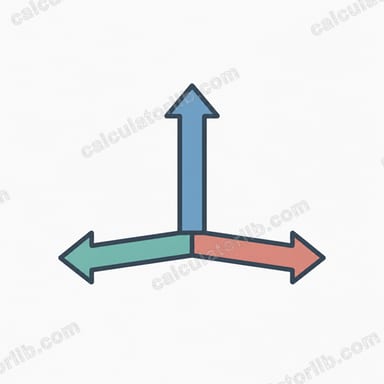
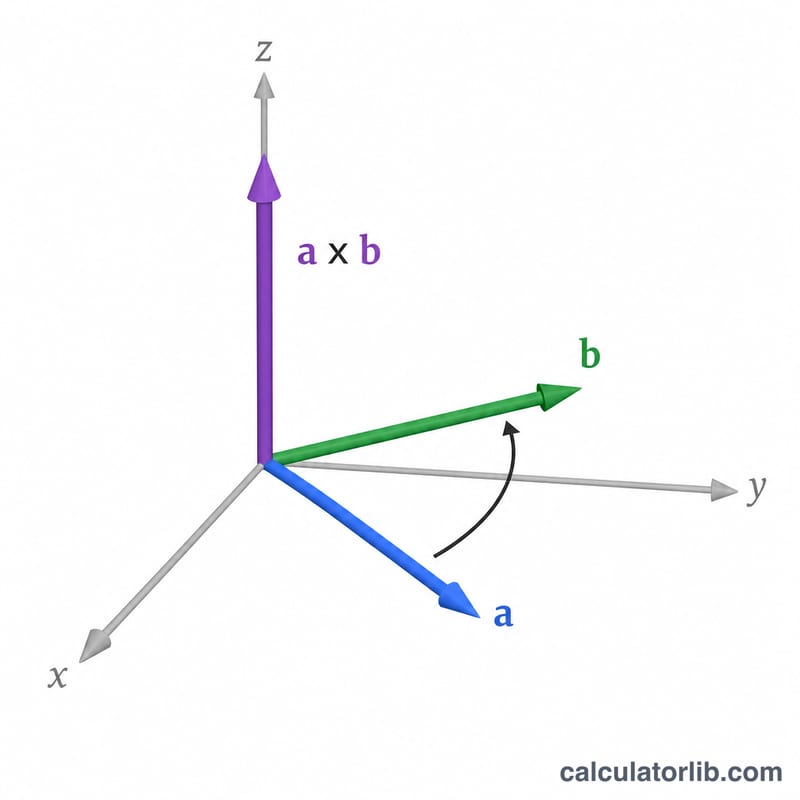
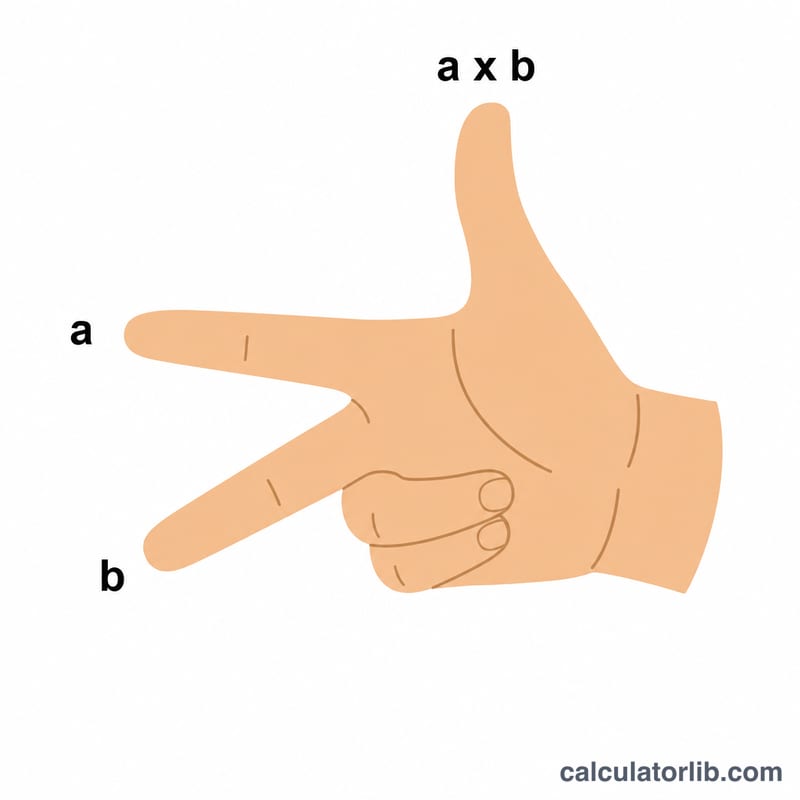
The cross product of two three-dimensional vectors a and b produces a new vector that is perpendicular (orthogonal) to both inputs. It is fundamental in physics and engineering for computing torque, angular momentum, magnetic force, and surface normals in 3D graphics. Unlike the dot product, which returns a single number, the cross product returns a vector.
How to Use This Calculator
Enter the three components of vector a (\(a_1\), \(a_2\), \(a_3\)) and vector b (\(b_1\), \(b_2\), \(b_3\)). The calculator returns the resulting vector \(\vec{a} \times \vec{b}\) as an ordered triple along with its magnitude. Values may be positive, negative, or decimal.
The Formula Explained
The cross product is defined component-wise as:
$$\vec{a} \times \vec{b} = \begin{pmatrix} \text{a}_2 \cdot \text{b}_3 - \text{a}_3 \cdot \text{b}_2 \\[0.4em] \text{a}_3 \cdot \text{b}_1 - \text{a}_1 \cdot \text{b}_3 \\[0.4em] \text{a}_1 \cdot \text{b}_2 - \text{a}_2 \cdot \text{b}_1 \end{pmatrix}$$
Each component is a \(2 \times 2\) determinant of the remaining coordinates. The magnitude equals the square root of the sum of the squared components, which also equals \(|a||b|\sin(\theta)\), the area of the parallelogram the two vectors span.
$$\left\lVert \vec{a} \times \vec{b} \right\rVert = \sqrt{c_x^{2} + c_y^{2} + c_z^{2}}$$
Worked Example
Let \(\vec{a} = (1, 2, 3)\) and \(\vec{b} = (4, 5, 6)\). Then:
$$c_x = 2 \cdot 6 - 3 \cdot 5 = 12 - 15 = -3$$
$$c_y = 3 \cdot 4 - 1 \cdot 6 = 12 - 6 = 6$$
$$c_z = 1 \cdot 5 - 2 \cdot 4 = 5 - 8 = -3$$
So \(\vec{a} \times \vec{b} = (-3, 6, -3)\), with magnitude \(\sqrt{9 + 36 + 9} = \sqrt{54} \approx 7.348\).
FAQ
Is the cross product commutative? No. \(\vec{a} \times \vec{b} = -(\vec{b} \times \vec{a})\); swapping the order reverses the direction of the result.
What if the vectors are parallel? The cross product is the zero vector \((0, 0, 0)\), because \(\sin(\theta) = 0\).
What does the magnitude represent? It equals the area of the parallelogram formed by the two vectors, and zero magnitude means they are linearly dependent (parallel or anti-parallel).