
What this calculator does
This tool solves the classic "river-flow" motion word problem, known in Japanese school mathematics as ryusui-zan (literally "flowing-water arithmetic"). The physics is universal and uses nothing more than distance = speed \times time, so the same method works anywhere in the world. Given how far a boat traveled upstream, how long that took, and the speed of the river current, it computes the boat's speed in still water, its real upstream and downstream speeds, and how long the return trip downstream over the same distance will take.
The core idea
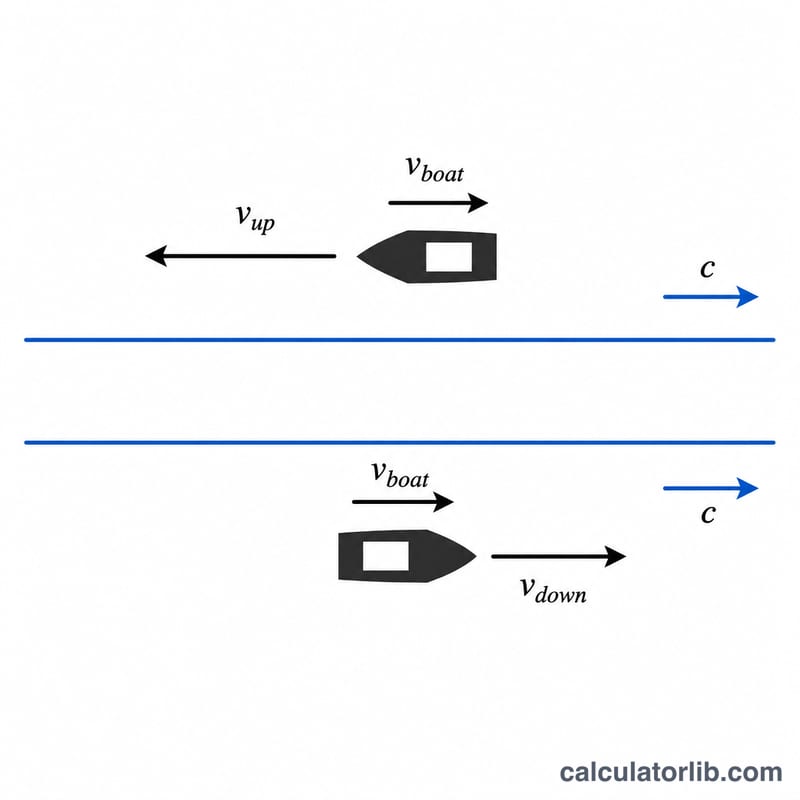
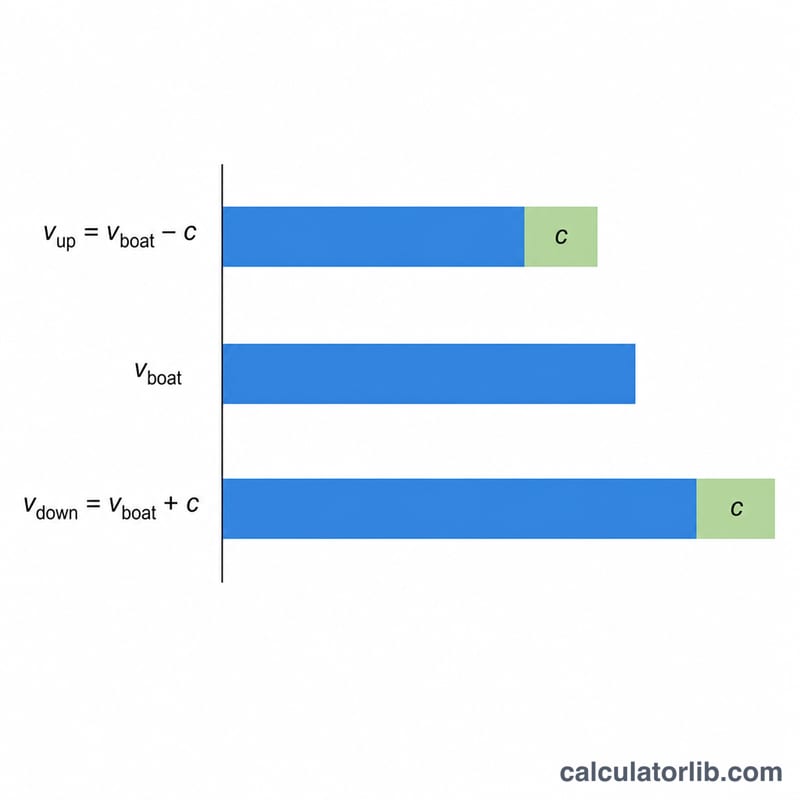
A boat moving on a river is helped or hindered by the current. Let B be the boat's speed in still water and C the current speed. Going against the current (upstream) the effective speed is \(B - C\); going with it (downstream) it is \(B + C\). From the upstream distance and time we recover the upstream speed (\(d \div t\)). Adding the current back gives the still-water speed, adding it once more gives the downstream speed, and dividing the distance by the downstream speed gives the return time.
How to use it
Enter the upstream distance (km or m), the time taken upstream (hours, minutes or seconds) and the current speed (km/h or m/s). The calculator converts everything internally to SI units, computes the answers, and shows speeds in both km/h and m/s plus the downstream time in hours, minutes and seconds.
Worked example
A boat travels 12 km upstream in 3 hours against a 1 km/h current. Upstream speed = $$12 \div 3 = 4 \text{ km/h}.$$ Still-water boat speed = $$4 + 1 = 5 \text{ km/h}.$$ Downstream speed = $$5 + 1 = 6 \text{ km/h}.$$ Return time = $$12 \div 6 = 2 \text{ hours}.$$ Check: 12 km upstream at 4 km/h takes 3 h, and 12 km downstream at 6 km/h takes 2 h — both consistent.
FAQ
Why add the current twice for downstream? Upstream speed is \(B - C\) and downstream is \(B + C\), a difference of \(2C\). So downstream speed = upstream speed + \(2 \cdot \text{current}\).
What if time is zero? Time must be greater than zero, otherwise the upstream speed is undefined; the calculator flags such input as invalid.
Must the boat be faster than the current? Yes — to make any upstream progress the boat's still-water speed must exceed the current. Because you supply a positive upstream distance and time, this is automatically satisfied.