
What this calculator does
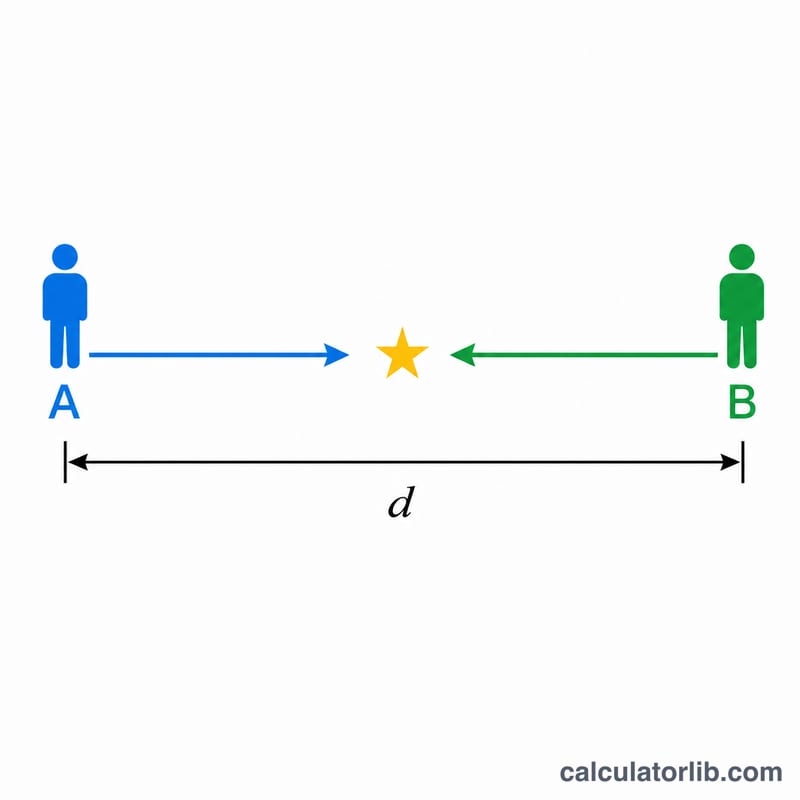
This tool solves the classic "travelers' problem" meeting case (in Japanese arithmetic, tabibito-zan): two people, A and B, start a known distance apart and walk toward each other at the same time. It tells you how long it takes for them to meet. The same math applies to any two objects closing in on each other, so it is universal physics, not just a school exercise.
The formula explained
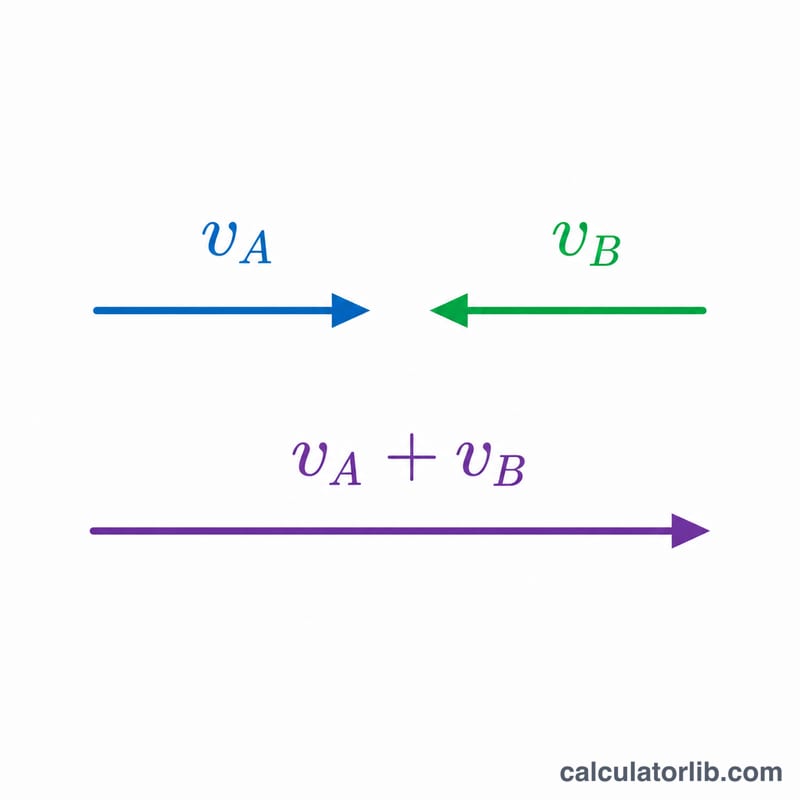
When two travelers move toward each other, the gap between them shrinks at a rate equal to the sum of their speeds. This sum is called the closing (relative) speed. The meeting time is simply the initial distance divided by the closing speed:
$$t = \frac{d}{v_A + v_B}$$
Before dividing, every input must be in consistent units. This calculator normalizes distance to kilometers and speeds to kilometers per hour, computes the time in hours, then breaks it down into hours, minutes and seconds.
How to use it
Enter the distance between the two people and pick its unit (meters or kilometers). Enter each person's speed and choose a unit such as m/min, m/sec, km/min, km/sec or km/hour. The result shows the meeting time as a clean h:m:s breakdown and as decimal hours, plus how far each person travels.
Worked example
Distance = 3400 m = 3.4 km. Speed A = 80 m/min = 4.8 km/h. Speed B = 60 m/min = 3.6 km/h. Closing speed = \(4.8 + 3.6 = 8.4\) km/h. Meeting time = $$\frac{3.4}{8.4} = 0.40476 \text{ hours} = 24 \text{ minutes } 17 \text{ seconds}.$$ Person A covers about 1.94 km and person B about 1.46 km, which sum back to 3.4 km.
FAQ
Why add the speeds instead of subtracting? Because both travelers shorten the gap at the same time, so their effects add together. Subtracting speeds applies to the overtaking (catch-up) variant, which is a different problem.
What if both speeds are zero? Then nobody moves and they never meet; the calculator reports that the closing speed is zero.
Can I mix units? Yes. You can give A in m/min and B in km/h, for example. Each input is converted internally before the calculation.