
What this calculator does
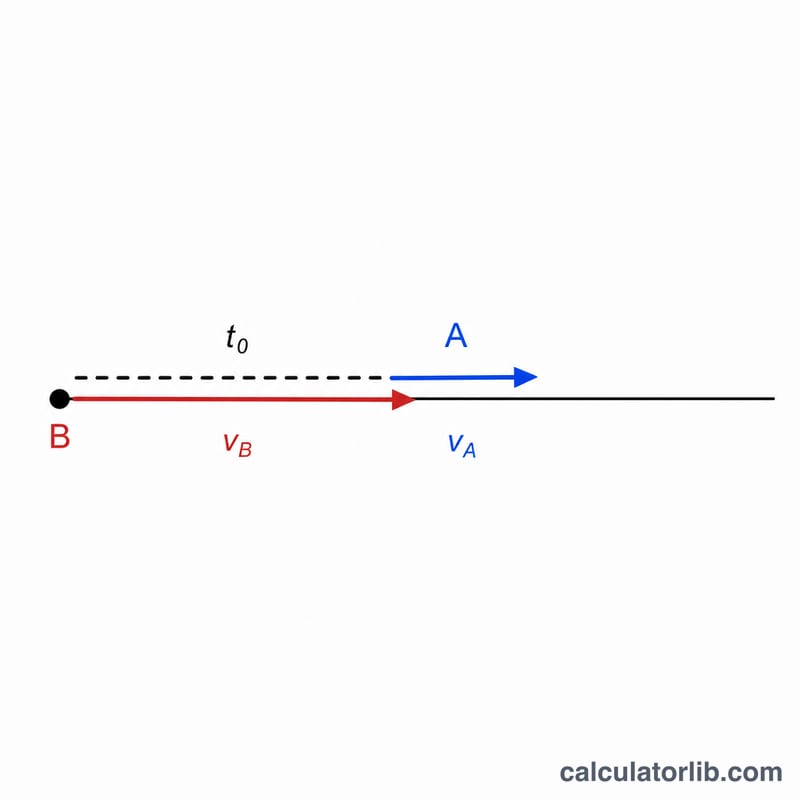
This is the classic "travelers' problem" (in Japanese arithmetic, the catch-up version of tabibito-zan), but the math is universal relative-speed motion. Person A leaves a starting point at speed vA. A head-start time later, Person B leaves the same point in the same direction at the faster speed vB. The tool computes how long B needs to catch A and how far from the start they meet.
How to use it
Enter A's speed, the head-start time (how much earlier A left than B), and B's speed. Each field has a unit dropdown — speeds support m/s, m/min, km/s, km/min and km/h, while the head-start time supports hours, minutes and seconds. The calculator converts everything to SI (meters and seconds), solves, then shows results in seconds with handy minute/hour and kilometer conversions.
The formula explained
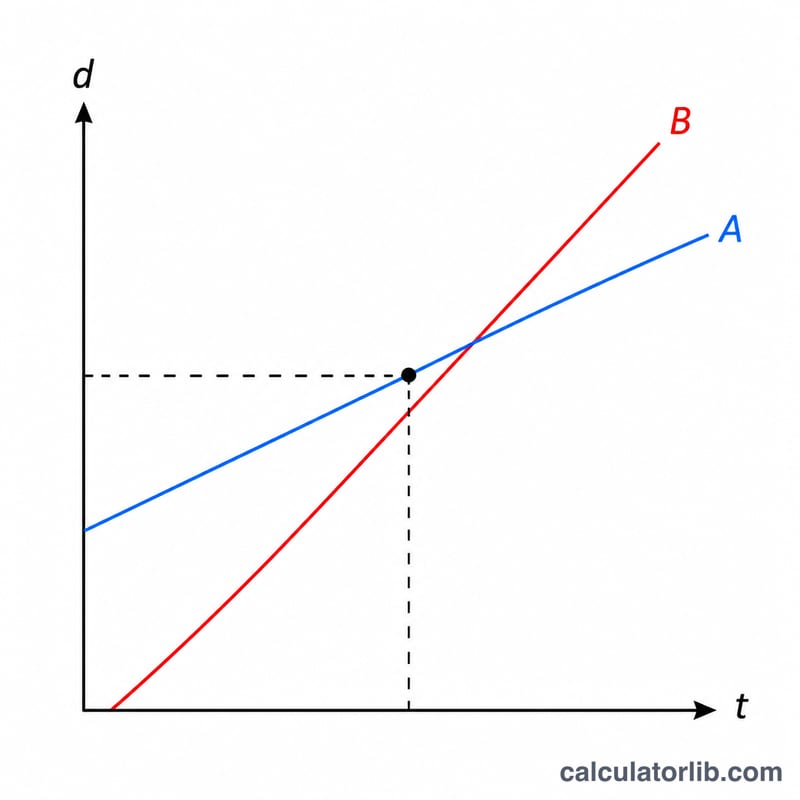
When B starts, A is already ahead by a head-start distance of \(d_0 = v_A \times t_0\). B closes that gap at the closing (relative) speed \(v_B - v_A\). So the catch-up time measured from the moment B starts is $$t = \frac{d_0}{v_B - v_A} = \frac{v_A \times t_0}{v_B - v_A}.$$ The meeting distance from the start is \(v_B \times t\), which also equals \(v_A \times (t_0 + t)\). If B is not faster than A, B can never catch up — the calculator reports this instead of dividing by zero.
Worked example
A walks at 80 m/min and leaves first. Twenty minutes later B chases at 120 m/min. Converting: \(v_A = 1.3333\ \text{m/s}\), \(v_B = 2.0\ \text{m/s}\), \(t_0 = 1200\ \text{s}\). The head-start distance is $$1.3333 \times 1200 = 1600\ \text{m}.$$ Closing speed is $$2.0 - 1.3333 = 0.6667\ \text{m/s}.$$ Catch-up time = $$\frac{1600}{0.6667} = 2400\ \text{s} = 40\ \text{minutes}.$$ They meet \(2.0 \times 2400 = 4800\ \text{m}\) (4.8 km) from the start, 60 minutes after A departed.
FAQ
What if both speeds are equal? The gap stays constant forever, so B never catches A — the closing speed is zero.
Is the catch-up time measured from A or from B? It is measured from the instant B starts. The "total time since A departed" output adds the head-start time back in.
Do I have to use the same unit for both speeds? No. Each input is converted independently, so you can mix km/h and m/min freely.