

What Is the Diamond Problem?
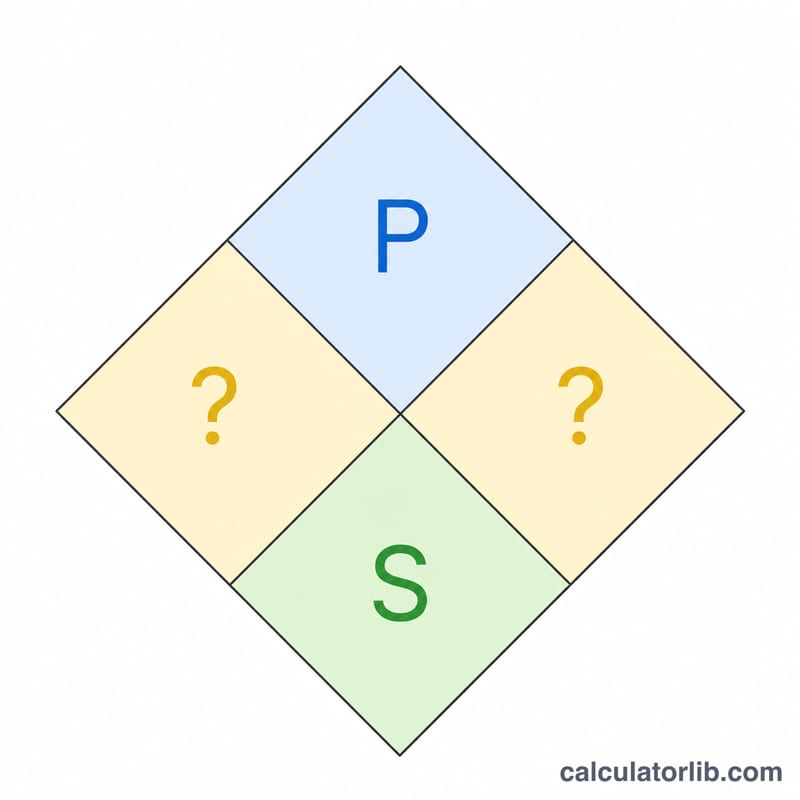
The diamond problem is a classic algebra exercise often used when learning to factor quadratic trinomials. A diamond shape holds a product (P) at the top and a sum (S) at the bottom. Your job is to find the two side numbers, a and b, that multiply to give P and add to give S. This calculator solves that puzzle instantly.
How to Use It
Enter the product P (the top number) and the sum S (the bottom number), then read off the two numbers a and b. The tool also reports the discriminant so you can tell when no real pair exists.
The Formula Explained
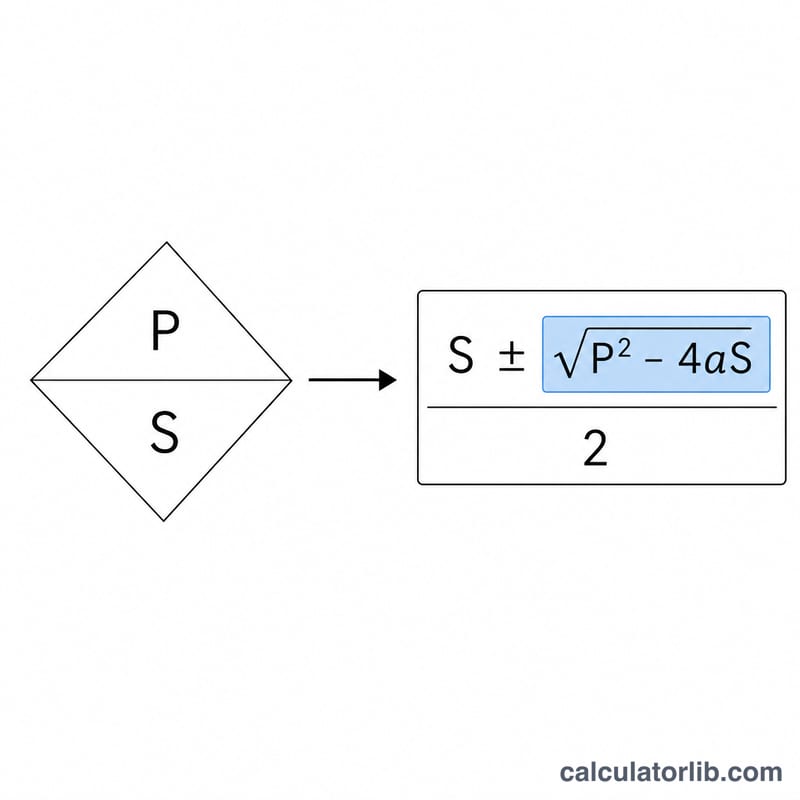
The two numbers are the roots of the quadratic \(x^2 - Sx + P = 0\). By the quadratic formula:
$$a,\,b = \frac{S \pm \sqrt{S^2 - 4P}}{2}$$
The expression under the root, \(\Delta = S^2 - 4P\), is the discriminant. If \(\Delta \ge 0\) the two numbers are real; if \(\Delta < 0\) there is no real solution (the numbers are complex).
Worked Example
Suppose the product is 12 and the sum is 7. Then $$\Delta = 7^2 - 4 \cdot 12 = 49 - 48 = 1,$$ and \(\sqrt{1} = 1\). So \(a = (7 + 1)/2 = 4\) and \(b = (7 - 1)/2 = 3\). Indeed \(4 \times 3 = 12\) and \(4 + 3 = 7\). The factored form is \((x + 3)(x + 4)\).
FAQ
Why might there be no solution? If \(S^2 < 4P\), the discriminant is negative and no two real numbers can satisfy both conditions.
Can the numbers be negative or decimals? Yes — the calculator handles any real inputs, including negative products and non-integer results.
Are a and b interchangeable? Yes. The order does not matter since both \(a+b\) and \(a \cdot b\) are symmetric.