
What is the Chebyshev Polynomial of the First Kind?
The Chebyshev polynomials of the first kind, written \(T_n(x)\), are a family of orthogonal polynomials that appear throughout numerical analysis, approximation theory, signal processing, and the design of digital filters. This calculator builds a table of \(T_n(x)\) values over a chosen range of \(x\) and an optional curve, given a degree \(n\), a starting \(x\), a step size, and a number of rows. It is a pure-mathematics tool and applies universally with no region-specific rules.
How to Use It
Enter the degree \(n\) (a non-negative integer such as 0, 1, 2, 3...). Set the initial value of \(x\) (the canonical domain is \(-1\) to \(1\), though the recurrence works for any real \(x\)). Choose the increment (step) added to \(x\) for each row, and the number of repetitions (rows) to generate. The default sweep of \(\text{initialX} = -1\), \(\text{step} = 0.02\), \(\text{rows} = 101\) walks \(x\) from \(-1.00\) to \(+1.00\) inclusive.
The Formula
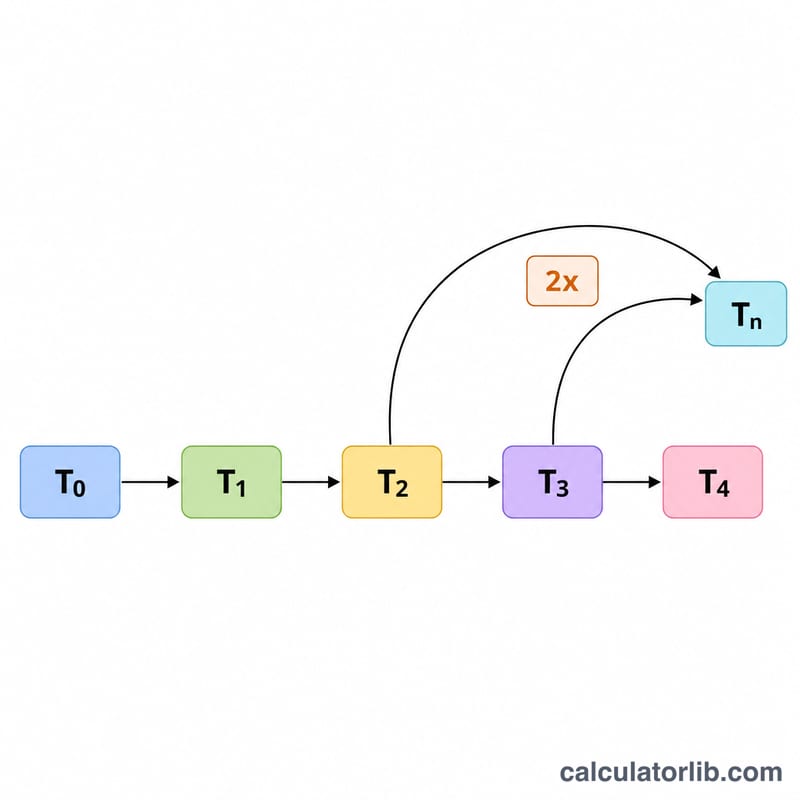
The robust method used here is the three-term recurrence:
$$T_0(x) = 1, \quad T_1(x) = x, \quad \text{and} \quad T_k(x) = 2x \cdot T_{k-1}(x) - T_{k-2}(x) \quad \text{for } k \ge 2.$$
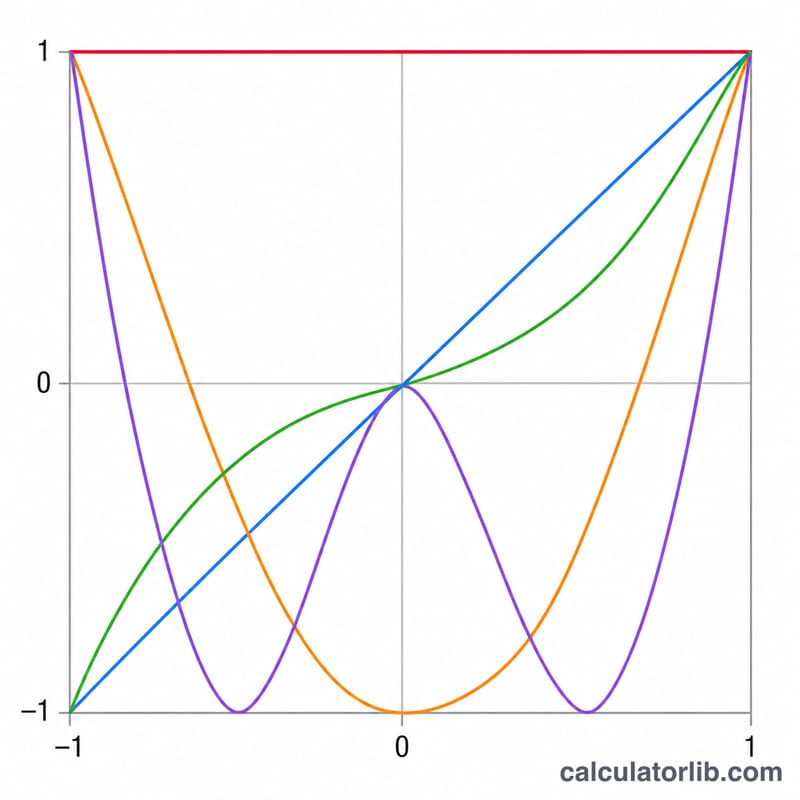
Equivalently, on the interval \(-1 \le x \le 1\) one has the trigonometric form $$T_n(x) = \cos(n \cdot \arccos x).$$ The first few explicit polynomials are \(T_2(x) = 2x^2 - 1\), \(T_3(x) = 4x^3 - 3x\), and \(T_4(x) = 8x^4 - 8x^2 + 1\). On \([-1, 1]\) the values always satisfy \(|T_n(x)| \le 1\); outside that band the magnitude grows quickly.
Worked Example
For \(n = 3\) the polynomial is \(T_3(x) = 4x^3 - 3x\). At \(x = -1\): $$4(-1) - 3(-1) = -1.$$ At \(x = -0.5\): $$4(-0.125) + 1.5 = 1.$$ At \(x = 0\): \(0\). At \(x = 0.5\): $$0.5 - 1.5 = -1.$$ At \(x = 1\): $$4 - 3 = 1.$$ So a table with \(\text{initialX} = -1\), \(\text{step} = 0.5\), \(\text{rows} = 5\) gives the sequence \(-1, 1, 0, -1, 1\).
FAQ
Can n be zero? Yes. \(T_0(x) = 1\) for every \(x\), so every row shows \(1\).
Can x go outside [-1, 1]? Yes — the recurrence still computes correct (possibly large) values; only the trigonometric form is restricted to \(|x| \le 1\).
What if the step is zero? Every row repeats the same \(x\) value, which is allowed but produces a constant table.