
What this calculator does
This tool tabulates the modified Bessel function of the first kind, written \(I_v(x)\), for a fixed real order \(v\) over a sequence of \(x\) values. You provide the order, an initial \(x\), an increment (step), and how many rows to generate; the calculator builds the list \(x_i = \text{start} + i\cdot\text{step}\) and evaluates \(I_v(x_i)\) at each point, returning both a table and a graph. It is a pure-mathematics special-function tool and applies universally (no regional rules or units).
The formula
The modified Bessel function \(I_v(x)\) solves the modified Bessel equation $$x^2 y'' + x y' - (x^2 + v^2)y = 0.$$ It is computed here from its power series:
$$I_{v}(x) = \sum_{k=0}^{\infty} \frac{1}{k!\;\Gamma(k+v+1)}\left(\frac{x}{2}\right)^{v+2k}.$$
The factorial and the Gamma function let \(v\) be any real number. For numerical stability each term is evaluated in log space using a Lanczos approximation of \(\ln\Gamma\), then summed until the terms are negligible.
How to use it
Enter Order v (e.g. 0, 1, or 2.5), the Initial value of x, the Increment added to \(x\) for each row, and the Number of repetitions (rows). Click calculate to get a two-column table of \(x\) and \(I_v(x)\) plus a graph over the same range.
Worked example
With \(v = 0\), start = 0, step = 0.5, count = 5 you get \(x = 0, 0.5, 1, 1.5, 2\) and:
$$I_{0}(0) = 1,\quad I_{0}(0.5) \approx 1.0634834,\quad I_{0}(1) \approx 1.2660658,\quad I_{0}(1.5) \approx 1.6467232,\quad I_{0}(2) \approx 2.2795853.$$ These match standard reference tables.
FAQ
Can the order be negative or non-integer? Yes. For negative integer order the identity \(I_{-n}(x) = I_{n}(x)\) is used. Non-integer \(v\) is supported for \(x \ge 0\); for \(x < 0\) with non-integer \(v\) the value is complex, so NaN is returned.
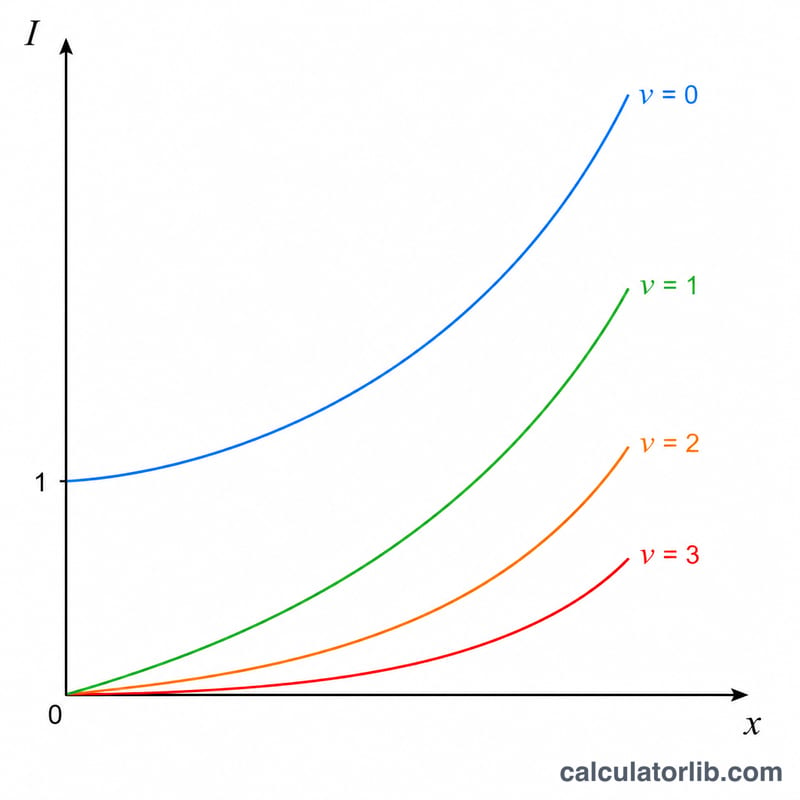
Why does \(I_v(x)\) grow so fast? Unlike the oscillating ordinary Bessel \(J_v\), the modified function grows roughly like \(e^{x}/\sqrt{2\pi x}\) for large \(x\), so large \(x\) may overflow to infinity.
What is \(I_v(0)\)? \(I_{0}(0) = 1\), and \(I_{v}(0) = 0\) for \(v > 0\).