
What is the Spherical Bessel Function of the Second Kind?
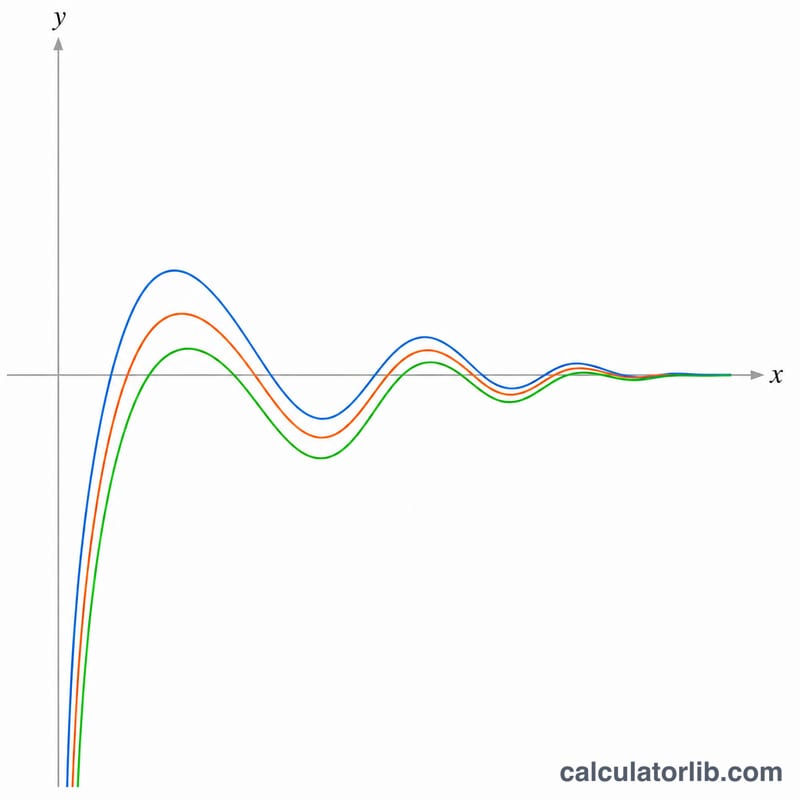
The spherical Bessel function of the second kind, written \(y_v(x)\), is a solution of the spherical Bessel differential equation \(x^2 w'' + 2x w' + (x^2 - v(v+1))w = 0\). It appears throughout physics — in scattering theory, quantum mechanics (the radial Schrodinger equation for a free particle), electromagnetic and acoustic wave problems with spherical symmetry. Unlike the first-kind function \(j_v(x)\), the second-kind \(y_v(x)\) diverges to negative infinity as \(x\) approaches 0.
How to Use This Calculator
Enter the order \(v\) (any real number; small non-negative integers are most common), the initial value of \(x\), the step between successive \(x\) values, and the number of rows to generate. The tool builds a table of \(x\) and \(y_v(x)\) and a plot of the result. Because \(x = 0\) is singular, any row with \(x \le 0\) is reported as "undefined".
The Formula
The function is defined from the cylindrical Bessel function of the second kind:
$$y_v(x) = \sqrt{\frac{\pi}{2x}}\; Y_{v+\frac{1}{2}}(x)$$For integer order the elementary closed forms apply, e.g. \(y_0(x) = -\cos(x)/x\) and \(y_1(x) = -\cos(x)/x^2 - \sin(x)/x\). Higher orders follow the forward recurrence
$$y_{v+1}(x) = \frac{2v+1}{x}\cdot y_v(x) - y_{v-1}(x)$$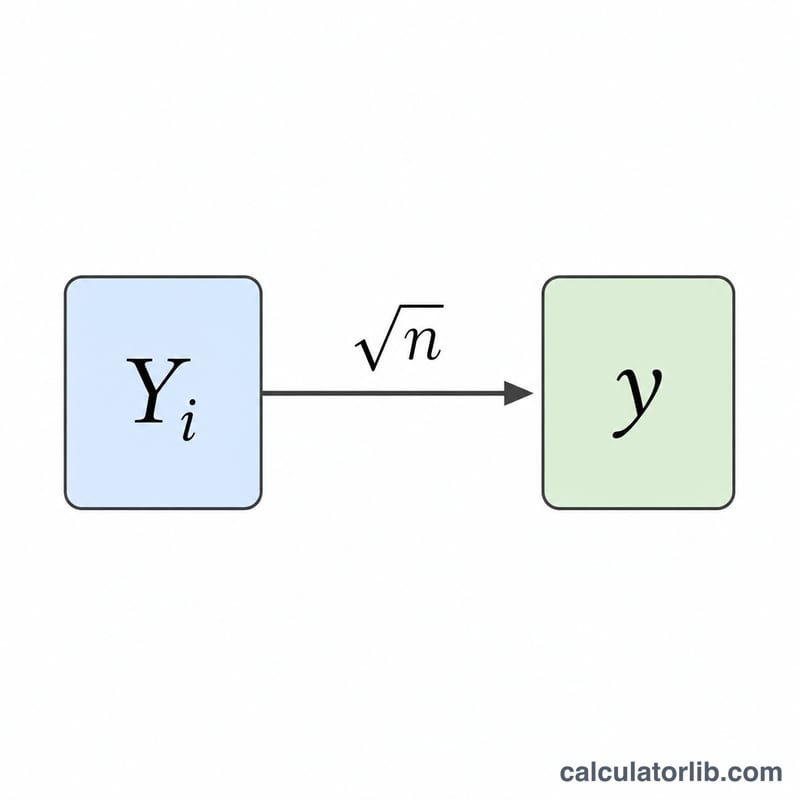
Worked Example
For order \(v = 1\), starting \(x = 2\):
$$y_1(2) = -\frac{\cos(2)}{4} - \frac{\sin(2)}{2} = -\frac{-0.4161468}{4} - \frac{0.9092974}{2} = 0.1040367 - 0.4546487 = -0.3506120$$For \(v = 0\) with \(x = 1, 2, 3\) you get \(-0.540302\), \(0.208073\), \(0.329998\).
FAQ
Why is \(x = 0\) undefined? The factor \(\sqrt{\pi/(2x)}\) and the \(1/x\) terms blow up, so \(y_v(0) = -\infty\).
Can \(x\) be negative? In the standard real convention \(y_v(x)\) is real only for \(x > 0\); negative \(x\) is reported as undefined.
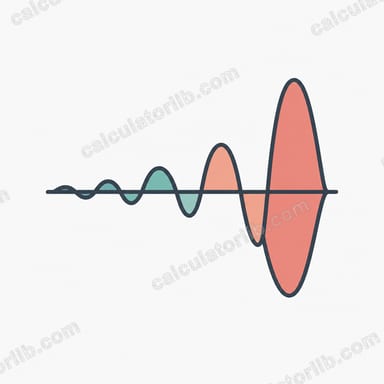
What happens for large \(x\)? The function oscillates with a decaying \(1/x\) envelope: \(y_v(x) \approx -\cos(x - (v+1)\pi/2)/x\).