通过MCP连接 →

输入计算

数学公式

广告

结果

First value yv(x) (order v = 0)
-4.900333
第二类球贝塞尔函数
x yv(x)
0.0000 undefined
0.2000 -4.900333
0.4000 -2.302652
0.6000 -1.375559
0.8000 -0.870883
1.0000 -0.540302
1.2000 -0.301965
1.4000 -0.121405
1.6000 0.018250
1.8000 0.126223
2.0000 0.208073
2.2000 0.267501
2.4000 0.307247
2.6000 0.329573
2.8000 0.336508
3.0000 0.329997
3.2000 0.311967
3.4000 0.284352
3.6000 0.249100
3.8000 0.208149
4.0000 0.163411
4.2000 0.116729
4.4000 0.069848
4.6000 0.024381
4.8000 -0.018229
5.0000 -0.056732
5.2000 -0.090099
5.4000 -0.117536
5.6000 -0.138494
5.8000 -0.152676
6.0000 -0.160028
6.2000 -0.160733
6.4000 -0.155185
6.6000 -0.143975
6.8000 -0.127853
7.0000 -0.107700
7.2000 -0.084493
7.4000 -0.059263
7.6000 -0.033061
7.8000 -0.006917
8.0000 0.018188
8.2000 0.041360
8.4000 0.061820
8.6000 0.078921
8.8000 0.092170
9.0000 0.101237
9.2000 0.105961
9.4000 0.106350
9.6000 0.102572
9.8000 0.094941
10.0000 0.083907

什么是第二类球贝塞尔函数?

第二类球贝塞尔函数记作 \(y_v(x)\),是球贝塞尔微分方程 \(x^2 w'' + 2x w' + (x^2 - v(v+1))w = 0\) 的一个解。它在物理学中应用广泛——常见于散射理论、量子力学(自由粒子的径向薛定谔方程),以及具有球对称性的电磁波和声波问题。与第一类函数 \(j_v(x)\) 不同,第二类函数 \(y_v(x)\) 在 \(x\) 趋近于 0 时会发散到负无穷。
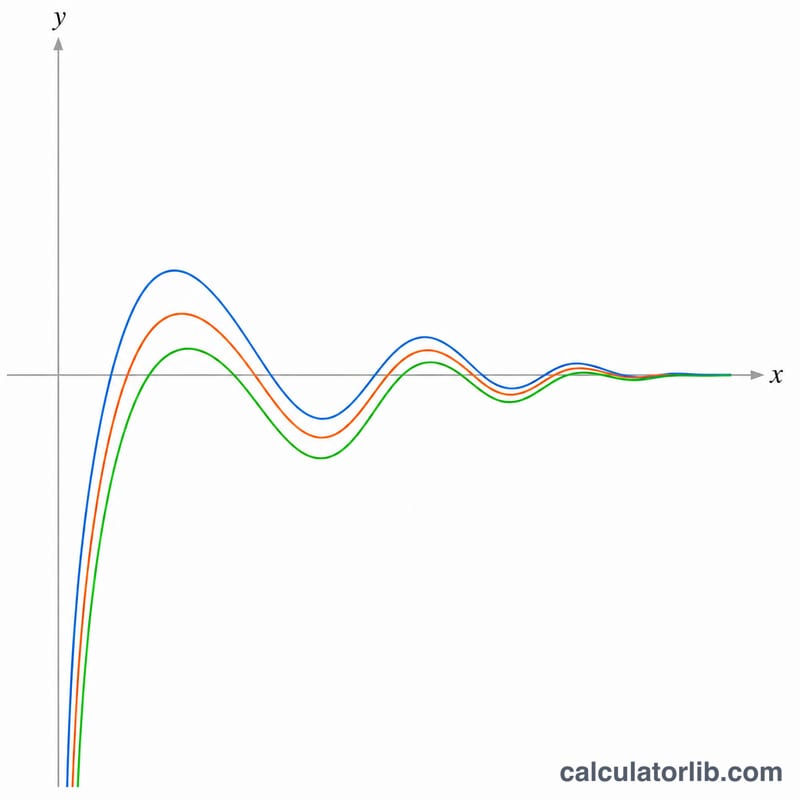
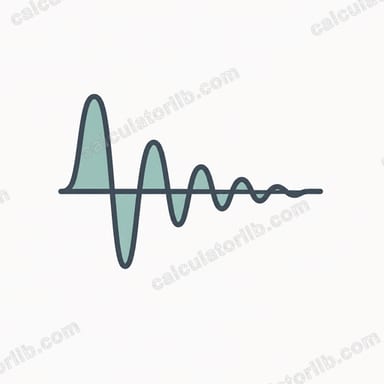
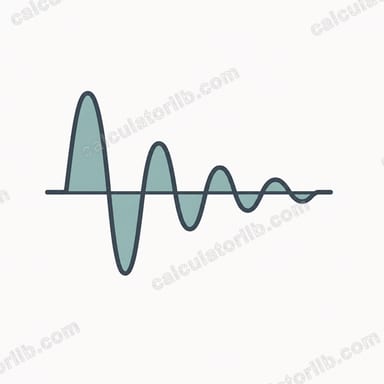
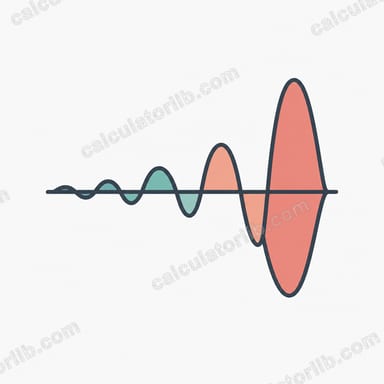
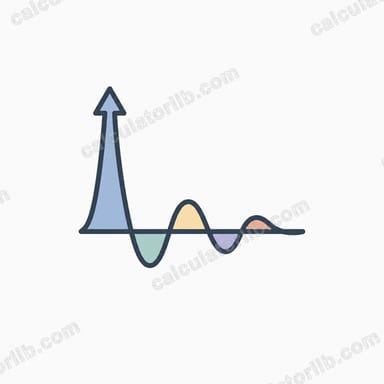
Oscillating decaying curves of spherical Bessel functions of the second kind diverging near x=0
Spherical Bessel functions of the second kind y_v(x) for orders v=0,1,2, showing the singularity as x approaches 0 and decaying oscillations.

如何使用本计算器

请输入阶数 \(v\)(可为任意实数,其中较小的非负整数最为常用)、\(x\) 的起始值、相邻 \(x\) 值之间的步长,以及要生成的行数。本工具会据此生成 \(x\) 与 \(y_v(x)\) 的对照表,并绘制相应图像。由于 \(x = 0\) 是奇点,任何 \(x \le 0\) 的行都会显示为"未定义"。

计算公式

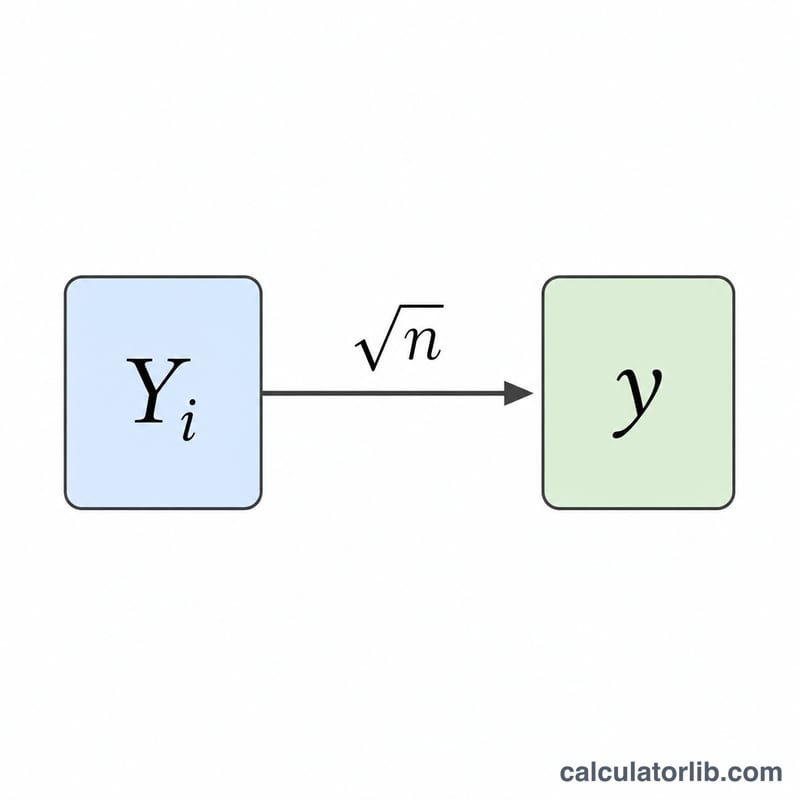
该函数由第二类柱贝塞尔函数定义:

$$y_v(x) = \sqrt{\frac{\pi}{2x}}\; Y_{v+\frac{1}{2}}(x)$$

当阶数为整数时,可使用初等闭式表达,例如 \(y_0(x) = -\cos(x)/x\),\(y_1(x) = -\cos(x)/x^2 - \sin(x)/x\)。更高阶数可通过向前递推公式求得:

$$y_{v+1}(x) = \frac{2v+1}{x}\cdot y_v(x) - y_{v-1}(x)$$
Advertisement
Relationship between spherical and cylindrical Bessel function of the second kind
The spherical function y_v(x) is obtained from the ordinary Bessel function Y of half-integer-shifted order times a scaling factor.

计算实例

取阶数 \(v = 1\),起始 \(x = 2\):

$$y_1(2) = -\frac{\cos(2)}{4} - \frac{\sin(2)}{2} = -\frac{-0.4161468}{4} - \frac{0.9092974}{2} = 0.1040367 - 0.4546487 = -0.3506120$$

再取 \(v = 0\),当 \(x = 1, 2, 3\) 时,结果分别为 \(-0.540302\)、\(0.208073\)、\(0.329998\)。

常见问题

为什么 \(x = 0\) 时未定义? 因式 \(\sqrt{\pi/(2x)}\) 和 \(1/x\) 项都会趋于无穷,所以 \(y_v(0) = -\infty\)。

\(x\) 可以取负值吗? 在标准实数约定下,只有当 \(x > 0\) 时 \(y_v(x)\) 才为实数;\(x\) 为负数时会显示为未定义。

当 \(x\) 很大时会怎样? 函数会以 \(1/x\) 的振幅衰减并持续振荡:\(y_v(x) \approx -\cos(x - (v+1)\pi/2)/x\)。

最后更新: