这个计算器能做什么
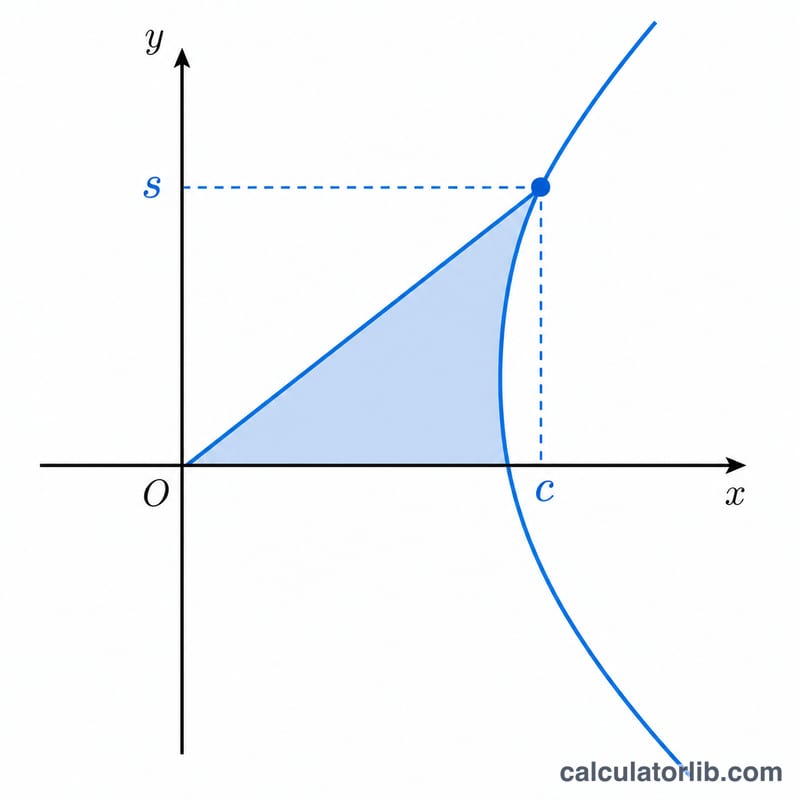
本工具用于计算实数(无量纲)x 的六个双曲函数:与正弦、余弦、正切相对应的 sinh、cosh、tanh,以及它们的倒数 csch(余割)、sech(正割)和 coth(余切)。这里的自变量 x 是一个纯数值,而非以「度」表示的角度,因此无需进行度到弧度的换算。双曲函数在物理与工程中随处可见:悬挂电缆的形状(悬链线)、狭义相对论、信号处理、传热分析,以及许多微分方程的求解都会用到它们。
如何使用
输入任意实数 x,并选择要显示的有效数字位数,计算器会一次性给出全部六个函数的结果。由于 cosh(x) 恒大于等于 1,因此 sech(x) 始终有定义。但是 sinh(0) = 0、tanh(0) = 0,所以 csch(0) 和 coth(0) 涉及除以零,会被标记为「未定义」。
公式解析
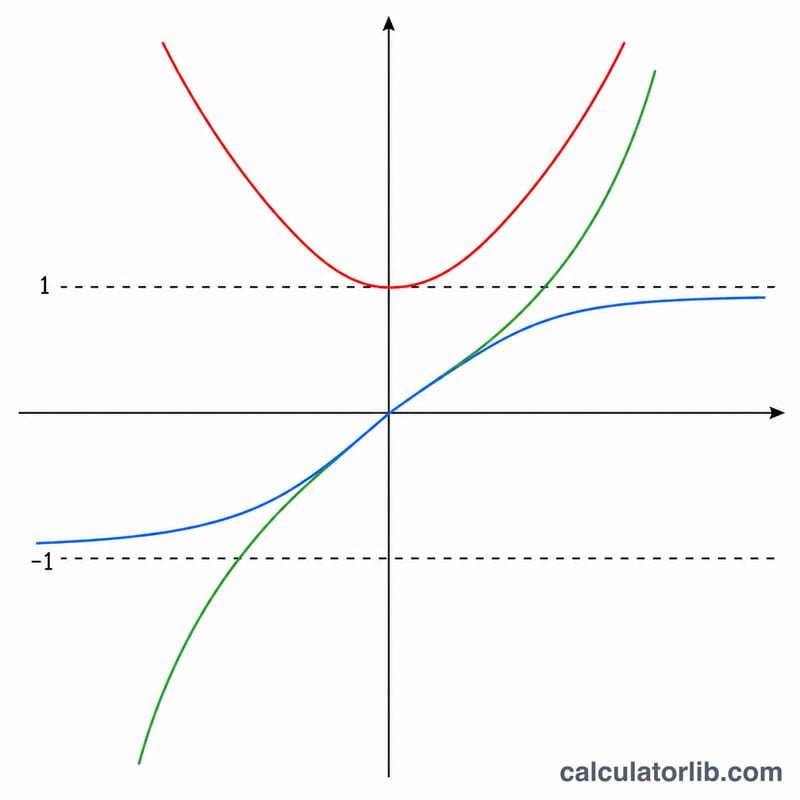
所有函数都由指数函数推导而来。设 ep = e^x,en = e^(-x):sinh(x) = (ep - en)/2 表示指数函数的奇部分,cosh(x) = (ep + en)/2 表示偶部分,而 tanh(x) = sinh(x)/cosh(x)。倒数关系也随之得到:csch = 1/sinh、sech = 1/cosh、coth = 1/tanh。一个恒成立的实用恒等式是 cosh²(x) - sinh²(x) = 1,它是勾股恒等式在双曲函数中的对应形式。
计算实例(x = 1)
取 e = 2.718281828…,e^(-1) = 0.367879441…:sinh(1) = (2.718281828 - 0.367879441)/2 = 1.175201194;cosh(1) = (2.718281828 + 0.367879441)/2 = 1.543080635;tanh(1) = 1.175201194 / 1.543080635 = 0.761594156。三个倒数分别为 csch(1) = 0.850918128、sech(1) = 0.648054274、coth(1) = 1.313035285。
常见 x 的双曲函数值
表中列出了选定非负 x 对应的 sinh、cosh 和 tanh,数值保留 6 位小数。负输入可由对称性得出:\(\sinh(-x) = -\sinh x\)、\(\tanh(-x) = -\tanh x\) 以及 \(\cosh(-x) = \cosh x\)。
| x | sinh x | cosh x | tanh x |
|---|---|---|---|
| 0 | 0.000000 | 1.000000 | 0.000000 |
| 0.5 | 0.521095 | 1.127626 | 0.462117 |
| 1 | 1.175201 | 1.543081 | 0.761594 |
| 2 | 3.626860 | 3.762196 | 0.964028 |
| 3 | 10.017875 | 10.067662 | 0.995055 |
| 5 | 74.203211 | 74.209949 | 0.999909 |
例如,当 x = −1 时:sinh = −1.175201,cosh = 1.543081,tanh = −0.761594。
极限行为:当 \(|x|\) 增大时,\(\tanh x\) 趋近于 +1(x 为正时)或 −1(x 为负时)。同时,\(\sinh x\) 和 \(\cosh x\) 都按 \(e^{|x|}/2\) 的规律增长,二者之差相对于其大小逐渐缩小(当 x = 5 时,二者仅相差约 0.0067)。
关键双曲恒等式与反函数
| 性质 | 公式 |
|---|---|
| 奇偶性 | \(\sinh(-x) = -\sinh x\)、\(\tanh(-x) = -\tanh x\)(奇函数);\(\cosh(-x) = \cosh x\)(偶函数) |
| 基本恒等式 | \(\cosh^2 x - \sinh^2 x = 1\) |
| tanh / sech | \(1 - \tanh^2 x = \operatorname{sech}^2 x\) |
| coth / csch | \(\coth^2 x - 1 = \operatorname{csch}^2 x\)(x ≠ 0) |
| 倒数关系 | \(\operatorname{csch} x = 1/\sinh x\)、\(\operatorname{sech} x = 1/\cosh x\)、\(\coth x = \cosh x/\sinh x\) |
| 和差公式(sinh) | \(\sinh(a \pm b) = \sinh a \cosh b \pm \cosh a \sinh b\) |
| 和差公式(cosh) | \(\cosh(a \pm b) = \cosh a \cosh b \pm \sinh a \sinh b\) |
| 倍角公式 | \(\sinh 2x = 2 \sinh x \cosh x\);\(\cosh 2x = \cosh^2 x + \sinh^2 x\) |
| 导数 | \(\dfrac{d}{dx}\sinh x = \cosh x\);\(\dfrac{d}{dx}\cosh x = \sinh x\);\(\dfrac{d}{dx}\tanh x = \operatorname{sech}^2 x\) |
| 反双曲正弦 | \(\operatorname{asinh} x = \ln\left(x + \sqrt{x^2 + 1}\right)\),对所有实数 x 成立 |
| 反双曲余弦 | \(\operatorname{acosh} x = \ln\left(x + \sqrt{x^2 - 1}\right)\),x ≥ 1(主值,非负分支) |
| 反双曲正切 | \(\operatorname{atanh} x = \tfrac{1}{2}\ln\dfrac{1 + x}{1 - x}\),|x| < 1 |
常见问题
x 是以「度」为单位的角度吗? 不是。双曲函数接受的是普通实数,没有角度模式,也不做任何换算。
为什么 csch(0) 和 coth(0) 是未定义的? 因为它们都要除以 sinh(0) = 0,而除以零没有定义。计算器会对此加以标记,而不是返回无穷大。
哪些函数是偶函数、哪些是奇函数? sinh、tanh、csch 和 coth 是奇函数(f(-x) = -f(x));cosh 和 sech 是偶函数(f(-x) = f(x))。