この計算ツールでできること
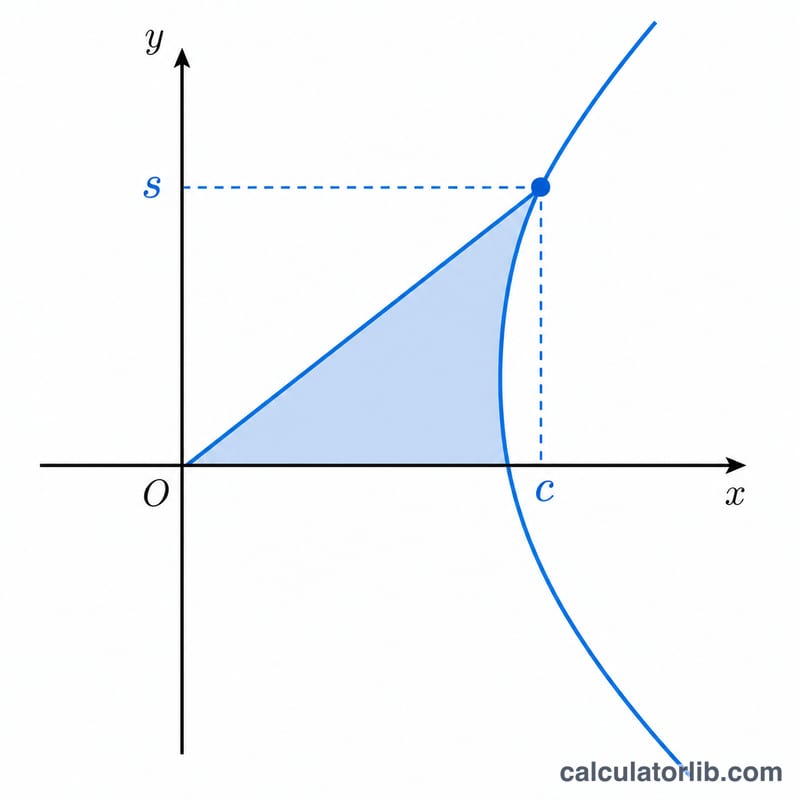
無次元の実数 x について、6 つの双曲線関数をまとめて求めます。三角関数の sin・cos・tan に対応する sinh(ハイパボリックサイン)・cosh(ハイパボリックコサイン)・tanh(ハイパボリックタンジェント)と、それぞれの逆数である csch・sech・coth です。引数 \(x\) は純粋な数値であり、度(°)で表した角度ではありません。そのため、度からラジアンへの変換は一切行われません。双曲線関数は物理学や工学のさまざまな場面で登場します。たとえば、たわんで垂れ下がるケーブルの形(懸垂線・カテナリー)、特殊相対性理論、信号処理、熱伝導、そして多くの微分方程式の解などです。
使い方
\(x\) に任意の実数を入力し、表示する有効桁数を選ぶだけです。6 つの関数の値が一度に表示されます。\(\cosh(x)\) は常に 1 以上になるため、\(\operatorname{sech}(x)\) は必ず定義されます。一方で \(\sinh(0) = 0\)、\(\tanh(0) = 0\) となるため、\(\operatorname{csch}(0)\) と \(\coth(0)\) は 0 での除算となり、「定義されない(undefined)」と表示されます。
計算式の解説
すべての関数は指数関数から導かれます。\(e_p = e^x\)、\(e_n = e^{-x}\) とすると、\(\sinh(x) = (e_p - e_n)/2\) は指数関数の奇関数部分を、\(\cosh(x) = (e_p + e_n)/2\) は偶関数部分を表します。そして \(\tanh(x) = \sinh(x)/\cosh(x)\) です。逆数の関数はそのまま、\(\operatorname{csch} = 1/\sinh\)、\(\operatorname{sech} = 1/\cosh\)、\(\coth = 1/\tanh\) となります。 $$\sinh x = \dfrac{e^{x} - e^{-x}}{2}, \quad \cosh x = \dfrac{e^{x} + e^{-x}}{2}, \quad \tanh x = \dfrac{\sinh x}{\cosh x}$$ $$\operatorname{csch} x = \dfrac{1}{\sinh x}, \quad \operatorname{sech} x = \dfrac{1}{\cosh x}, \quad \coth x = \dfrac{1}{\tanh x}$$ さらに、常に成り立つ便利な恒等式として \(\cosh^2(x) - \sinh^2(x) = 1\) があります。これは三角関数のピタゴラスの恒等式に対応するものです。
計算例(x = 1 のとき)
\(e = 2.718281828\ldots\)、\(e^{-1} = 0.367879441\ldots\) を用いると、 $$\sinh(1) = \dfrac{2.718281828 - 0.367879441}{2} = 1.175201194$$ $$\cosh(1) = \dfrac{2.718281828 + 0.367879441}{2} = 1.543080635$$ $$\tanh(1) = 1.175201194 \div 1.543080635 = 0.761594156$$ となります。逆数はそれぞれ \(\operatorname{csch}(1) = 0.850918128\)、\(\operatorname{sech}(1) = 0.648054274\)、\(\coth(1) = 1.313035285\) です。
代表的な x に対する双曲線関数の値
この表は、選ばれた非負の x について、6 桁に丸めた sinh、cosh、tanh の値を示しています。負の入力は対称性から導かれます:\(\sinh(-x) = -\sinh x\)、\(\tanh(-x) = -\tanh x\)、\(\cosh(-x) = \cosh x\)。
| x | sinh x | cosh x | tanh x |
|---|---|---|---|
| 0 | 0.000000 | 1.000000 | 0.000000 |
| 0.5 | 0.521095 | 1.127626 | 0.462117 |
| 1 | 1.175201 | 1.543081 | 0.761594 |
| 2 | 3.626860 | 3.762196 | 0.964028 |
| 3 | 10.017875 | 10.067662 | 0.995055 |
| 5 | 74.203211 | 74.209949 | 0.999909 |
例えば x = −1 のとき:sinh = −1.175201、cosh = 1.543081、tanh = −0.761594 です。
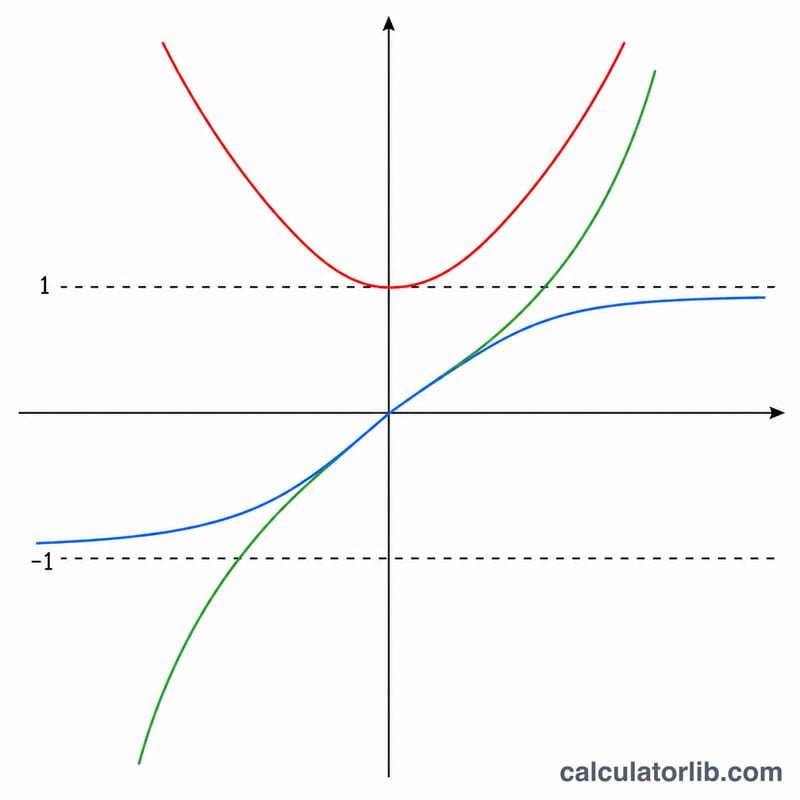
極限的な振る舞い:|x| が大きくなると、tanh x は(x が正のとき)+1、(x が負のとき)−1 に近づきます。一方、sinh x と cosh x はどちらも \(e^{|x|}/2\) のように増加し、その差は両者の大きさに比べて小さくなります(x = 5 のとき、差はわずか約 0.0067 です)。
主要な双曲線恒等式と逆関数
| 性質 | 式 |
|---|---|
| 偶奇性 | \(\sinh(-x) = -\sinh x\)、\(\tanh(-x) = -\tanh x\)(奇関数);\(\cosh(-x) = \cosh x\)(偶関数) |
| 基本恒等式 | \(\cosh^2 x - \sinh^2 x = 1\) |
| tanh / sech | \(1 - \tanh^2 x = \operatorname{sech}^2 x\) |
| coth / csch | \(\coth^2 x - 1 = \operatorname{csch}^2 x\)(x ≠ 0) |
| 逆数 | \(\operatorname{csch} x = 1/\sinh x\)、\(\operatorname{sech} x = 1/\cosh x\)、\(\coth x = \cosh x/\sinh x\) |
| 加法定理(sinh) | \(\sinh(a \pm b) = \sinh a \cosh b \pm \cosh a \sinh b\) |
| 加法定理(cosh) | \(\cosh(a \pm b) = \cosh a \cosh b \pm \sinh a \sinh b\) |
| 2 倍角 | \(\sinh 2x = 2 \sinh x \cosh x\);\(\cosh 2x = \cosh^2 x + \sinh^2 x\) |
| 導関数 | \(\dfrac{d}{dx}\sinh x = \cosh x\);\(\dfrac{d}{dx}\cosh x = \sinh x\);\(\dfrac{d}{dx}\tanh x = \operatorname{sech}^2 x\) |
| 逆 sinh | \(\operatorname{asinh} x = \ln\left(x + \sqrt{x^2 + 1}\right)\)、すべての実数 x |
| 逆 cosh | \(\operatorname{acosh} x = \ln\left(x + \sqrt{x^2 - 1}\right)\)、x ≥ 1(主値、非負の分枝) |
| 逆 tanh | \(\operatorname{atanh} x = \tfrac{1}{2}\ln\dfrac{1 + x}{1 - x}\)、|x| < 1 |
よくある質問
x は度で表した角度ですか? いいえ。双曲線関数の引数は単なる実数です。度モードや角度の変換はありません。
なぜ csch(0) と coth(0) は定義されないのですか? どちらも \(\sinh(0) = 0\) で割る形になり、計算できないためです。この計算ツールでは無限大を返す代わりに「定義されない」と明示します。
偶関数・奇関数はどれですか? sinh・tanh・csch・coth は奇関数(\(f(-x) = -f(x)\))、cosh・sech は偶関数(\(f(-x) = f(x)\))です。