
What this calculator does
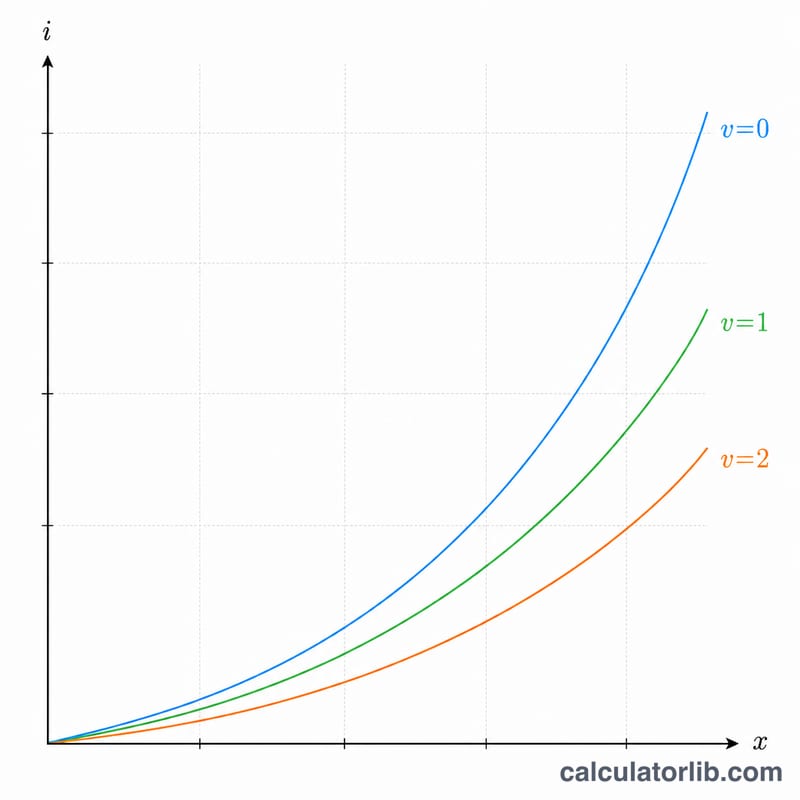
This tool tabulates and graphs the modified spherical Bessel function of the first kind, \(i_v(x)\), for a fixed order \(v\) over a sequence of \(x\) values. Starting from an initial \(x\), it adds a fixed step a chosen number of times, producing rows \(x_k = \text{initialX} + k \cdot \text{stepX}\) for \(k = 0, 1, \dots, \text{loopCount}-1\), and evaluates \(i_v(x_k)\) for each.
The formula explained
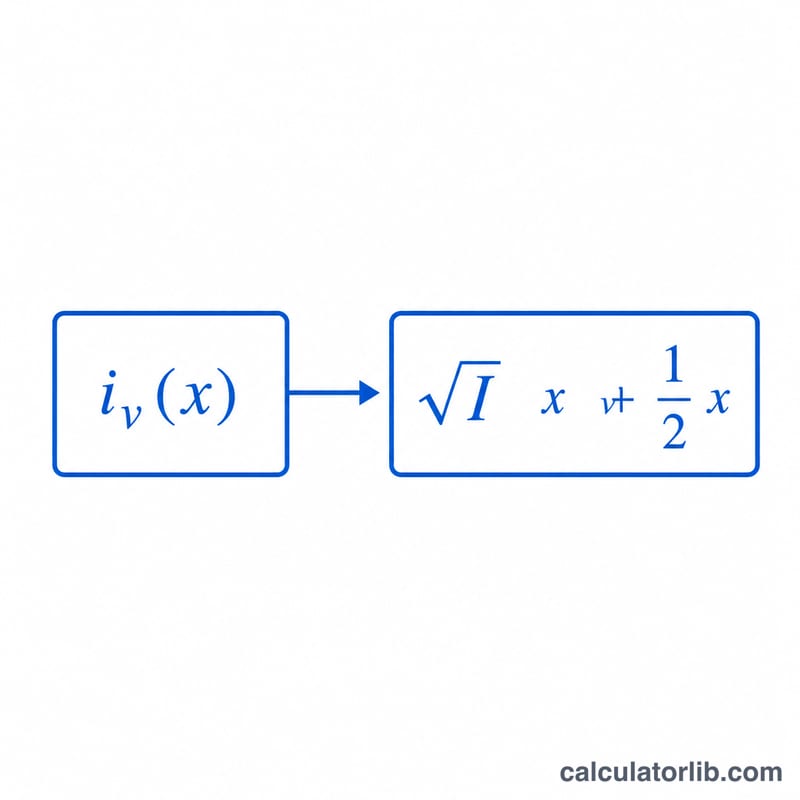
The modified spherical Bessel function is defined through the modified (cylindrical) Bessel function of the first kind \(I\) by $$i_v(x) = \sqrt{\frac{\pi}{2x}}\, I_{v+\frac{1}{2}}(x).$$ For low non-negative integer orders there are convenient hyperbolic closed forms: \(i_0(x) = \frac{\sinh(x)}{x}\), \(i_1(x) = \frac{x \cosh x - \sinh x}{x^2}\), \(i_2(x) = \frac{(x^2+3) \sinh x - 3x \cosh x}{x^3}\). Higher integer orders follow the recurrence \(i_{n+1}(x) = i_{n-1}(x) - \frac{2n+1}{x} i_n(x)\). For general real \(v\) the calculator evaluates \(I_{v+\frac{1}{2}}(x)\) from its power series using the Gamma function.
How to use it
Enter the order \(v\) (for example 0, 1 or a half-integer like 0.5), the initial \(x\) value, the increment, and how many rows you want. The result shows a two-column table of \(x\) and \(i_v(x)\); the first value is highlighted at the top. Use a small step such as 0.1 for a smooth curve.
Worked example
With \(v = 0\), \(\text{initialX} = 0\), \(\text{stepX} = 0.1\), \(\text{loopCount} = 51\), the function \(i_0(x) = \frac{\sinh(x)}{x}\) is used. The first row at \(x = 0\) gives the limiting value 1. At \(x = 1\), $$\frac{\sinh(1)}{1} = 1.17520119.$$ At \(x = 5\) (the last row), $$\frac{\sinh(5)}{5} = 14.84064212,$$ so the curve rises smoothly from 1 to about 14.84.
FAQ
What happens at \(x = 0\)? The \(\sqrt{\frac{\pi}{2x}}\) form is singular there, so the calculator returns the limit: \(i_0(0) = 1\) and \(i_v(0) = 0\) for \(v > 0\).
Can the order be a half-integer? Yes. Any real order is allowed; non-integer orders are computed via the series for \(I_{v+\frac{1}{2}}(x)\).
Can x be negative? Integer-order closed forms are defined for negative \(x\), but the general-order branch is restricted to \(x \geq 0\) because principal-branch sqrt of a negative argument would be complex.