
What this calculator does
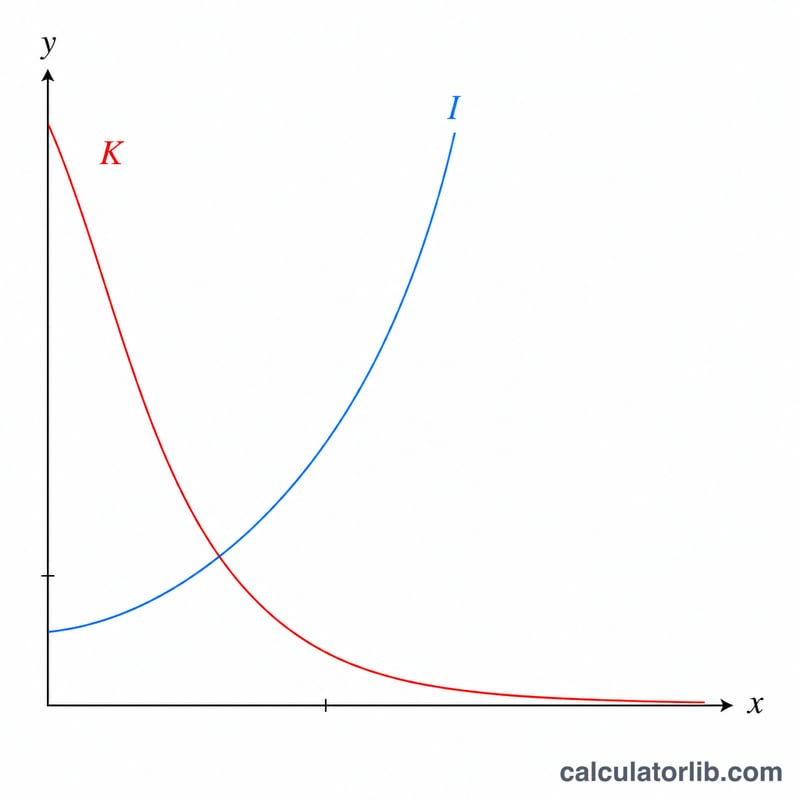
This tool evaluates the modified Bessel functions of the first kind, \(I_v(x)\), and second kind, \(K_v(x)\), together with their first derivatives \(I'_v(x)\) and \(K'_v(x)\). These functions are the two independent solutions of the modified Bessel equation \(x^2 y'' + x y' - (x^2 + v^2)y = 0\). They appear throughout physics and engineering: heat conduction in cylinders, diffusion, transmission-line and waveguide theory, and statistics. This is pure mathematics, so the result is the same everywhere — no regional rules apply.
How to use it
Enter the order v (any real number) and the argument x. \(I_v(x)\) is computed for all real x when v is an integer and for x ≥ 0 otherwise. \(K_v(x)\) requires x > 0 because it diverges as x → 0+; for x ≤ 0 it is reported as undefined (NaN).
The formula explained
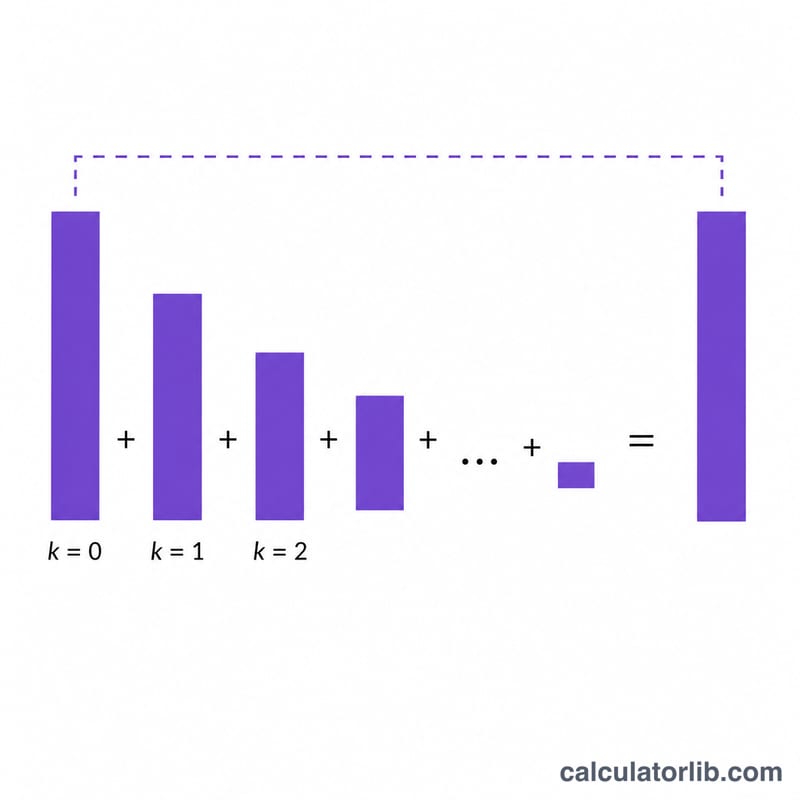
\(I_v(x)\) is summed from its power series using a Lanczos approximation for the Gamma function:
$$I_{v}(x) = \sum_{k=0}^{\infty} \frac{1}{k!\,\Gamma(k + v + 1)} \left(\frac{x}{2}\right)^{2k + v}$$\(K_v(x)\) is found by numerically integrating \(K_v(x) = \int_0^\infty e^{-x\cdot\cosh t}\cdot\cosh(vt)\,dt\), which is stable for both integer and non-integer order. The derivatives use the symmetric recurrences \(I'_v(x) = \tfrac{1}{2}(I_{v-1}(x) + I_{v+1}(x))\) and \(K'_v(x) = -\tfrac{1}{2}(K_{v-1}(x) + K_{v+1}(x))\), which avoid any division by x.
Worked example (v = 0, x = 1)
The series gives \(I_0(1) = 1 + 0.25 + 0.015625 + \ldots \approx 1.26606588\). The integral gives \(K_0(1) \approx 0.42102444\). Because \(I_{-1} = I_1\), the symmetric form yields \(I'_0(1) = I_1(1) \approx 0.56515910\), and \(K'_0(1) = -K_1(1) \approx -0.60190723\).
FAQ
Why does K_v(x) show as undefined? \(K_v(x)\) is only defined for x > 0; at and below zero it diverges.
Can I use a fractional order? Yes. Both functions accept any real order, including non-integer and negative values.
How accurate is it? Results use double precision (about 12–15 significant digits) and match standard reference tables for moderate x.