
What Is Direct Variation?
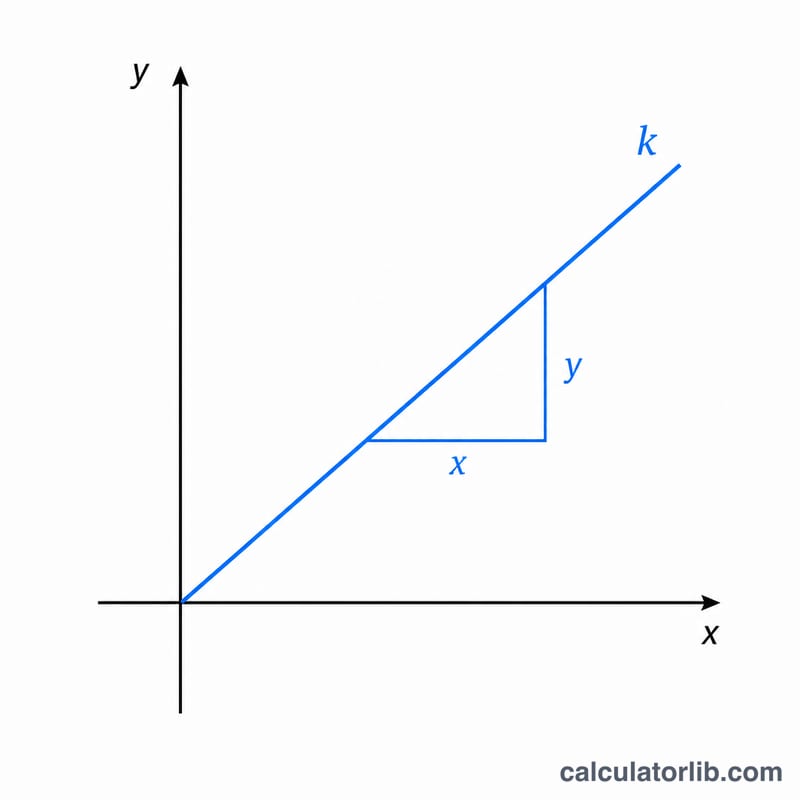
Two quantities are in direct variation when one is a constant multiple of the other. As x increases, y increases proportionally, and the ratio y/x always equals the same number — the constant of variation, written k. The relationship is expressed by the equation \(y = kx\). This calculator finds k from a known pair of values and then predicts y for any other x.
How to Use the Calculator
Enter a known x value and its matching y value. The calculator computes the constant of variation \(k = y/x\). Optionally, type a new x value in the "Find y at x" box to predict the corresponding y using \(y = kx\). Leave it blank or at zero if you only need k.
The Formula Explained
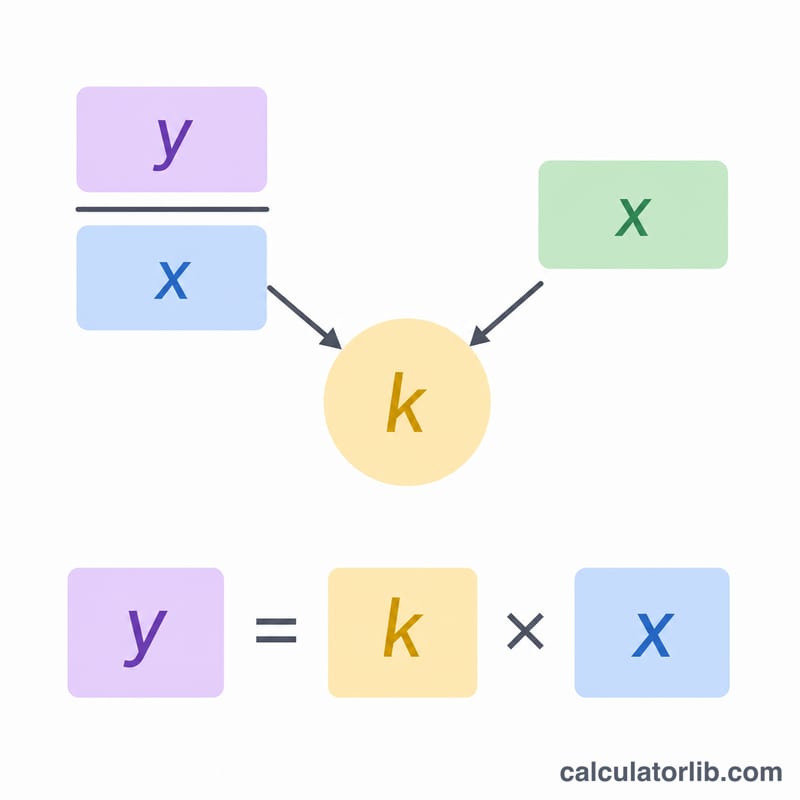
Because y varies directly with x, dividing any y by its x gives the same k:
$$k = \frac{\text{y value}}{\text{x value}}$$Once k is known, multiply it by any new x to get the matching y:
$$y = k \cdot \text{x}$$If x is 0, k cannot be determined because division by zero is undefined.
Worked Example
Suppose \(y = 12\) when \(x = 4\). Then
$$k = 12 \div 4 = 3$$so the relationship is \(y = 3x\). To find y when \(x = 10\), multiply:
$$y = 3 \times 10 = 30$$The calculator returns \(k = 3\) and a predicted y of 30.
FAQ
What is the constant of variation? It is the fixed ratio k between two directly proportional quantities, found with \(k = y/x\).
How is direct variation different from inverse variation? In direct variation \(y = kx\) (y rises as x rises); in inverse variation \(y = k/x\) (y falls as x rises).
Can k be negative? Yes. If y and x have opposite signs, k is negative and the line slopes downward.