
What is the Direction of a Vector?
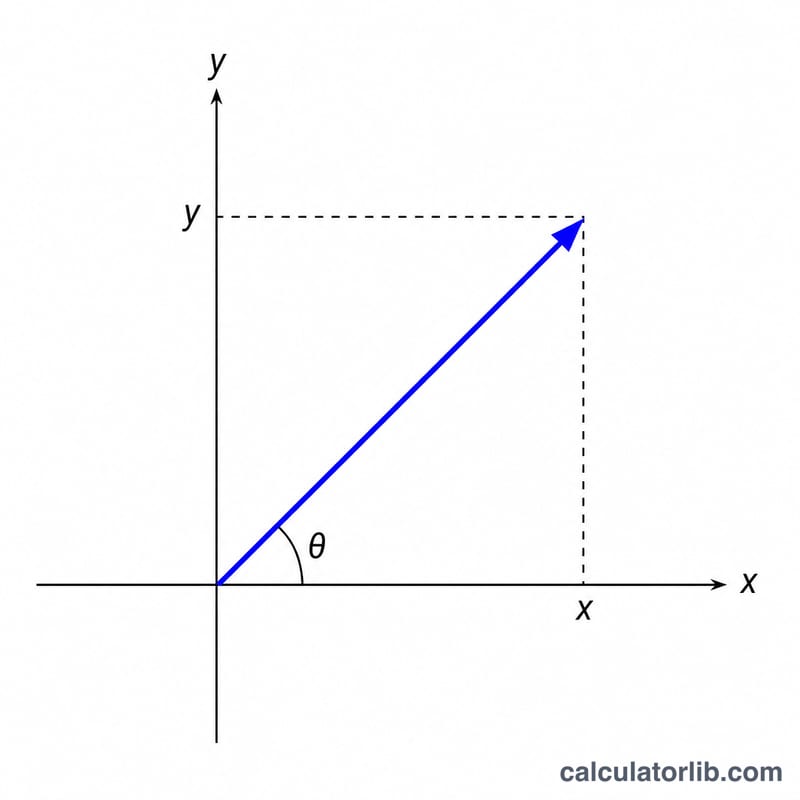
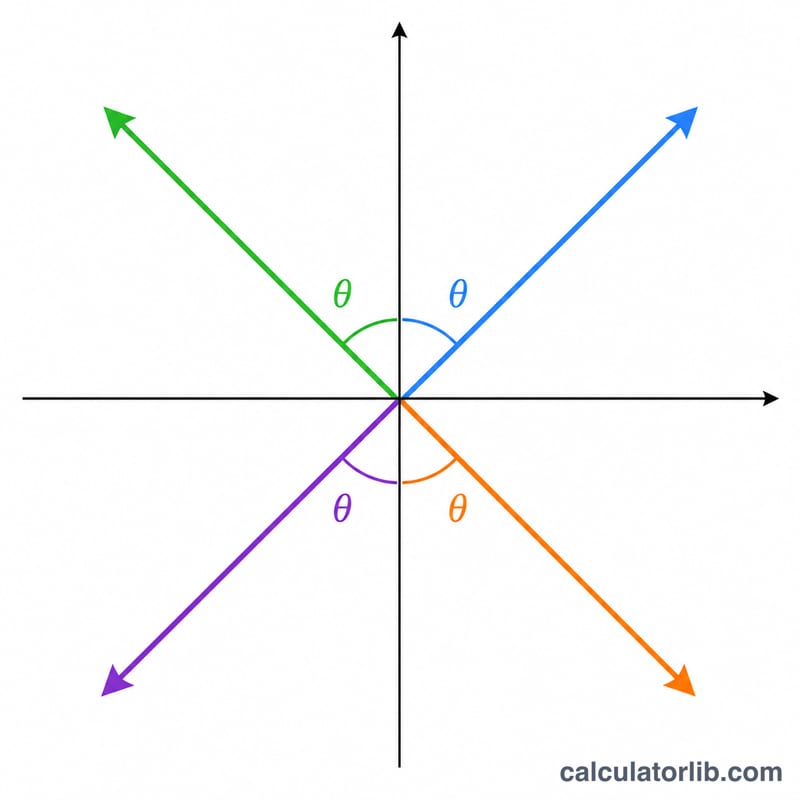
The direction of a two-dimensional vector is the angle it makes with the positive X-axis, measured counterclockwise. Given a vector with horizontal component x and vertical component y, this calculator returns that angle in degrees and radians, along with the vector's magnitude (length).
How to Use This Calculator
Enter the X component and the Y component of your vector. The tool computes the direction angle using the atan2 function, which correctly handles all four quadrants and returns a result normalized to the range 0° to 360°. The magnitude is also displayed so you have a full polar description of the vector.
The Formula Explained
The direction is calculated as $$\theta = \operatorname{atan2}(y,\ x)$$ Unlike the basic arctan(y/x), the two-argument atan2 uses the signs of both x and y to place the angle in the correct quadrant and avoids division by zero. The magnitude follows the Pythagorean theorem: $$|v| = \sqrt{x^2 + y^2}$$
Worked Example
For the vector (3, 4): $$\operatorname{atan2}(4, 3) \approx 0.9273 \text{ radians} \approx 53.13°$$ The magnitude is $$\sqrt{3^2 + 4^2} = \sqrt{25} = 5$$ So the vector points about \(53.13°\) above the positive X-axis with a length of \(5\).
FAQ
Why use atan2 instead of arctan? Plain arctan cannot distinguish between opposite quadrants (e.g. (1,1) vs (−1,−1)) and breaks when x = 0. atan2 resolves both problems.
What if both components are zero? A zero vector has no defined direction; the result defaults to 0°.
How do I convert the answer to radians? The radians value is shown in the results table; multiply degrees by \(\pi/180\) to convert manually.