
What Is a Vector Magnitude Calculator?
A vector magnitude calculator finds the length of a vector from its individual components. Whether you are working with a simple 2D position vector or a higher-dimensional vector in physics, machine learning, or data analysis, this tool computes the magnitude (also called the norm or modulus) instantly. It supports vectors from 2D up to 5D, so you can enter X and Y values, then add optional Z, W, and V components as needed.
How to Use the Calculator
- Select the number of dimensions you need (2D, 3D, 4D, or 5D).
- Enter the X and Y components.
- If you chose more dimensions, fill in Z, W, and V as required.
- Read off the magnitude — the calculator returns the result automatically.
You can use positive or negative values for any component; the magnitude is always zero or positive.
The Formula Explained
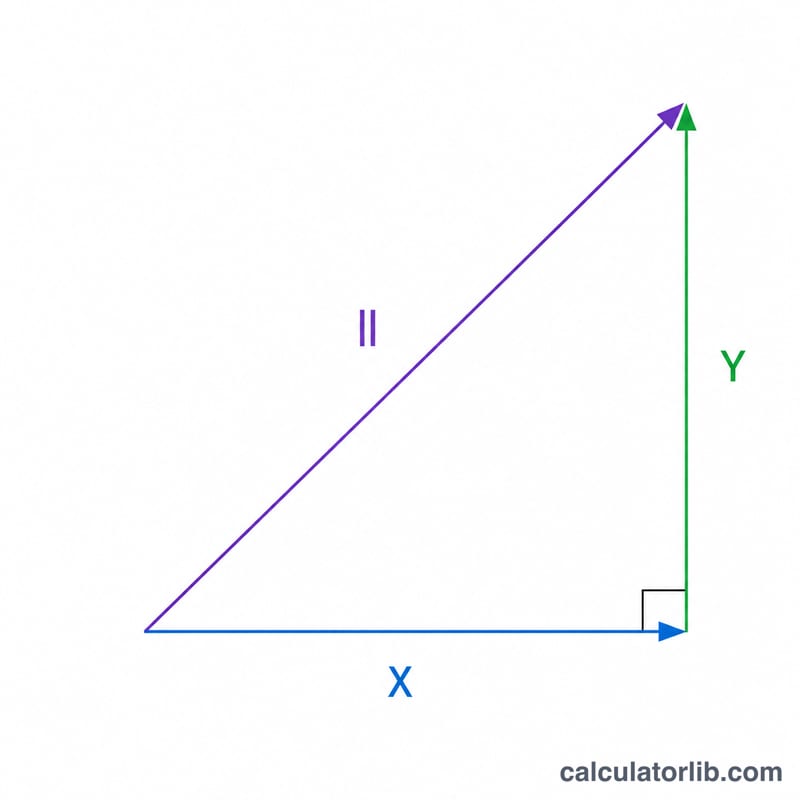
The magnitude of a vector is the square root of the sum of the squares of its components. This is a direct extension of the Pythagorean theorem into any number of dimensions:
- 2D: \(\|\vec{v}\| = \sqrt{x^{2} + y^{2}}\)
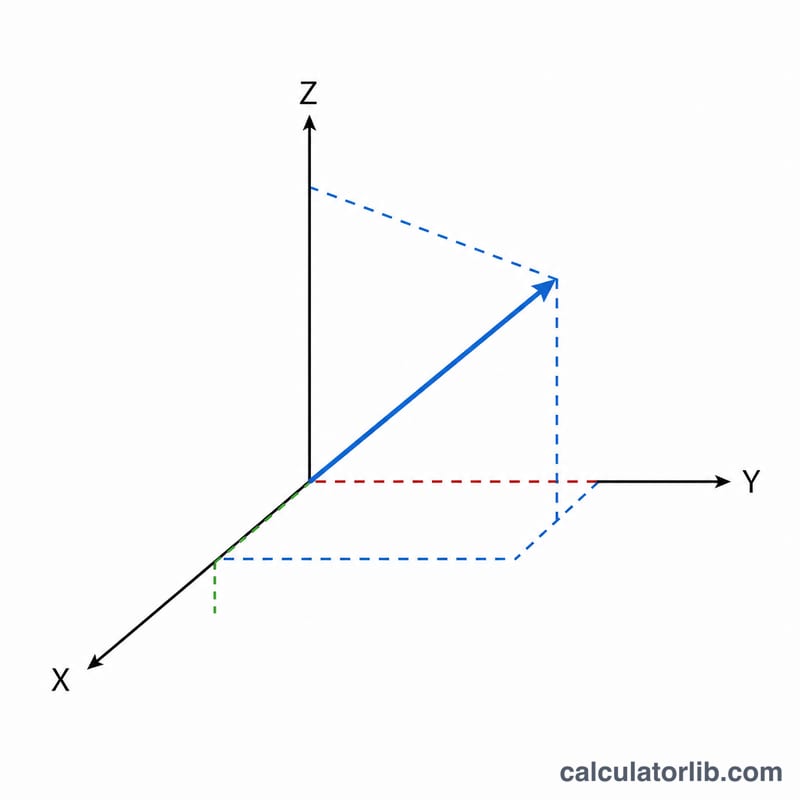
- 3D: \(\|\vec{v}\| = \sqrt{x^{2} + y^{2} + z^{2}}\)
- nD: \(\|\vec{v}\| = \sqrt{x_{1}^{2} + x_{2}^{2} + \dots + x_{n}^{2}}\)
Each extra dimension simply adds another squared term inside the square root, which is why the same logic scales cleanly from 2D to 5D.
Worked Example
Suppose you have a 3D vector with components X = 3, Y = 4, and Z = 12. Squaring each gives 9, 16, and 144. Adding them produces 169. The square root of 169 is 13, so the vector's magnitude is exactly 13. This neat result is a well-known Pythagorean quadruple.
$$\|\vec{v}\| = \sqrt{3^{2} + 4^{2} + 12^{2}} = \sqrt{9 + 16 + 144} = \sqrt{169} = 13$$
Frequently Asked Questions
What does vector magnitude represent? It represents the straight-line length of the vector — the distance from its tail (origin) to its head, regardless of direction.
Can magnitude be negative? No. Because each component is squared before summing, the result under the square root is never negative, so the magnitude is always zero or positive.
What if all components are zero? The magnitude is zero. This is called the zero vector, which has length but no defined direction.
Why support up to 5D? Higher-dimensional vectors are common in machine learning, statistics, and engineering, where data points often have many features. The same formula works in any dimension.