
What Is the Monthly Savings Calculator?
The Monthly Savings Calculator shows how much your money will grow when you make regular monthly deposits into an account that earns compound interest. Whether you're building an emergency fund, saving for a house deposit, or planning a holiday, this tool projects your future balance, the total you contribute, and the interest you earn along the way. It works with any currency, so it's useful no matter which country you live in.
How to Use It
Enter a few simple details and the calculator does the rest:
- Starting balance — any amount you already have saved (enter 0 if none).
- Monthly deposit — the fixed amount you plan to add each month.
- Annual interest rate — the yearly rate your account pays, as a percentage.
- Number of years — how long you'll keep saving.
Hit calculate and you'll see your projected final balance, total deposits, total interest earned, and the effective annual rate after compounding.
The Formula Explained
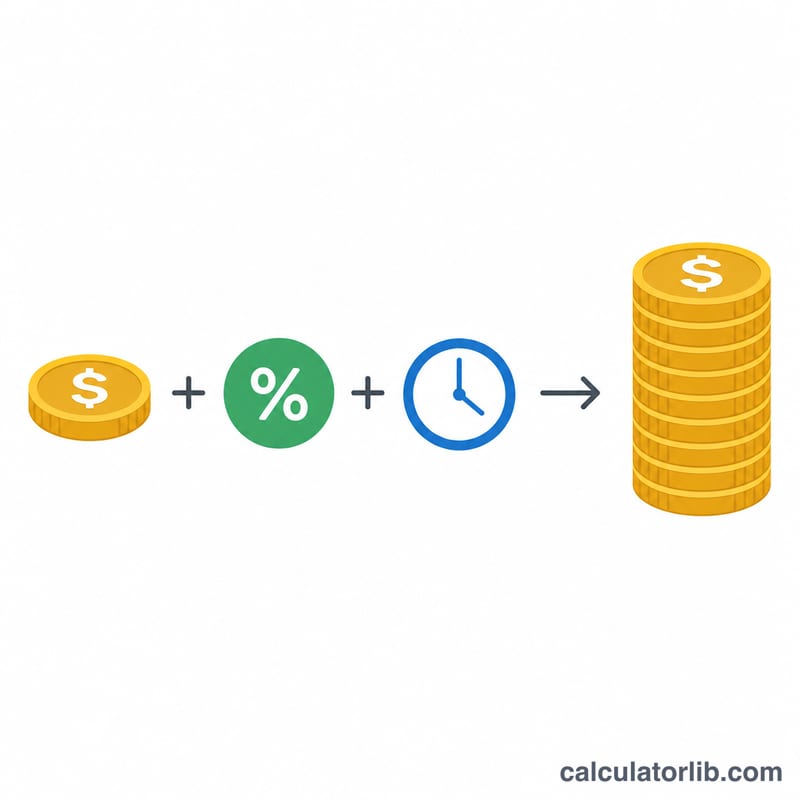
The calculator combines two parts: the growth of your starting balance and the growth of your stream of monthly deposits (an "annuity"). With a monthly interest rate \(i = \text{annual rate} \div 12\) and \(n\) total months, the future value is:
$$FV = P \times (1 + i)^{n} + PMT \times \left[\frac{(1 + i)^{n} - 1}{i}\right]$$
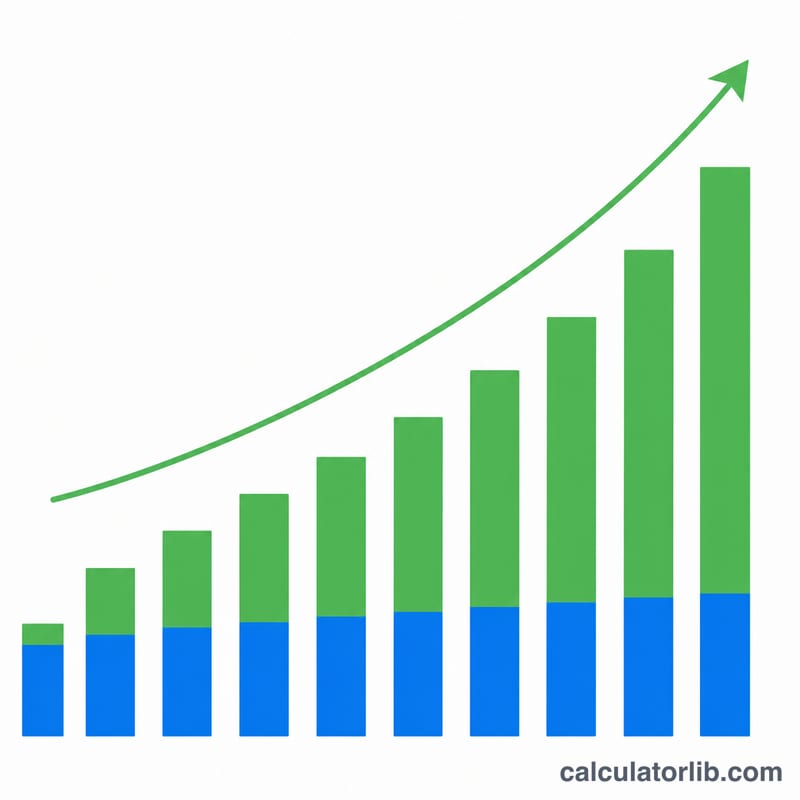
Here \(P\) is the starting balance and \(PMT\) is the monthly deposit. Compounding means you earn interest on your interest, which is why savings accelerate over time.
Worked Example
Suppose you start with 1,000, deposit 200 each month at a 5% annual rate for 10 years (120 months). The monthly rate is \(0.4167\%\). After 10 years your balance grows to roughly 32,712. You contributed 24,000 (1,000 start plus 24,000 in deposits — actually 25,000 total), and the rest — about 7,700 — is interest earned for free. Stretch the same plan to 20 years and the balance jumps past 84,000, showing the power of time.
Frequently Asked Questions
Does the calculator assume deposits at the start or end of the month? It assumes deposits are made at the end of each month, the standard convention. Depositing at the start earns slightly more interest.
What if interest rates change? The tool uses a single fixed rate. For variable rates, run several scenarios with optimistic and conservative estimates.
Is interest taxed? Possibly, depending on your country and account type. The results show gross interest before any tax, so check your local rules.