
What is the Savings Account Monthly Interest Calculator?
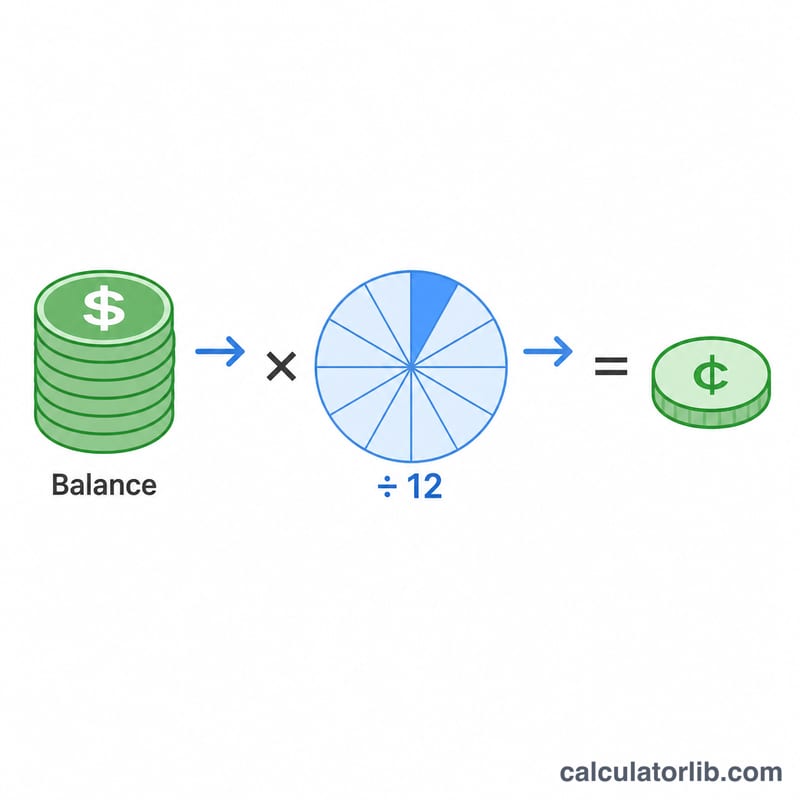
This calculator estimates how much interest a savings account earns in a single month, based on your current balance and the account's annual interest rate (APR). Banks usually advertise an annual rate, but they often credit interest monthly — so dividing the annual rate by 12 gives the monthly periodic rate applied to your balance.
How to use it
Enter your current account balance and the annual interest rate quoted by your bank (for example, 3 for 3%). The calculator instantly shows the interest you would earn this month, the equivalent monthly periodic rate, the simple annual interest, and your balance after one month's interest is added.
The formula explained
The core formula is: $$\text{Monthly Interest} = \text{Balance} \times \frac{\text{Annual Rate}}{12}$$ where the annual rate is expressed as a decimal. For instance, a 6% APR becomes 0.06, and the monthly rate is \(0.06 \div 12 = 0.005\) (0.5%). This is a simple-interest, single-period estimate; it does not compound month over month, so use it as a quick snapshot rather than a long-term projection.
Worked example
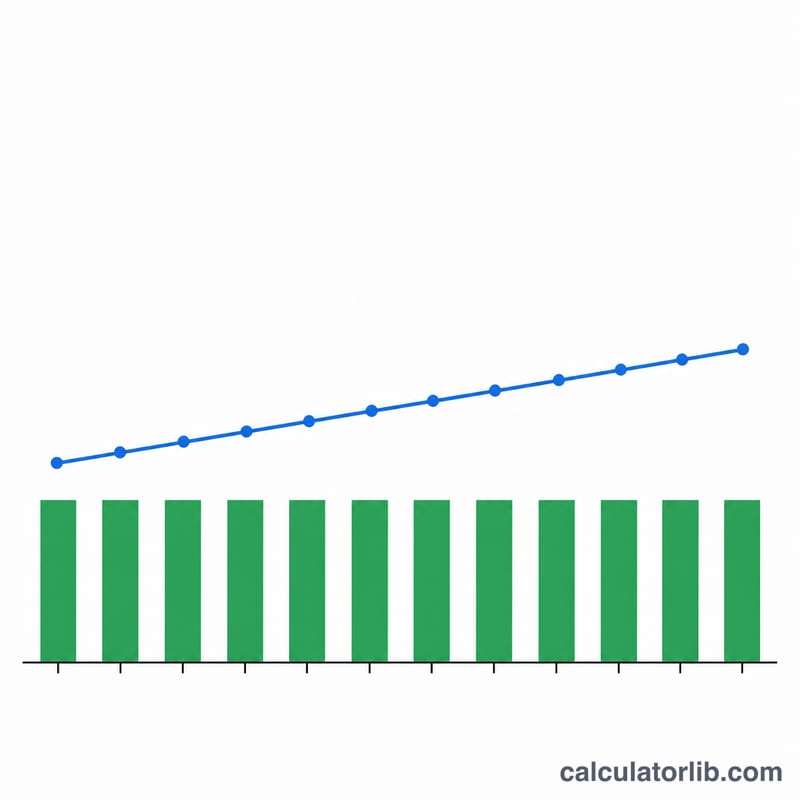
Suppose you have a balance of $10,000 in an account paying 3% APR. The monthly rate is \(3\% \div 12 = 0.25\%\). Your monthly interest is $$\$10{,}000 \times 0.0025 = \$25.00$$ Over a full year (simple), that's \(\$10{,}000 \times 0.03 = \$300\), and after one month your balance would be $10,025.
FAQ
Does this account for compounding? No — it's a single-month simple-interest estimate. With compounding, later months earn slightly more as interest is added to the balance.
What rate should I enter? Use the APR (annual percentage rate / nominal yearly rate) your bank quotes, not the APY, for the cleanest division by 12.
Why divide by 12? There are 12 months in a year, so the annual rate is split evenly across each month to find the monthly periodic rate.