
What This Calculator Does
This tool tells you how much interest, in dollars, accrues on a loan in a single month based on its current balance and annual interest rate (APR). It is useful for credit cards, personal loans, lines of credit, and mortgages where interest is applied monthly on the outstanding principal.
How to Use It
Enter the current loan balance and the annual percentage rate (APR). The calculator divides the APR by 12 to find the monthly periodic rate, then multiplies it by your balance to show the interest charged this month. It also estimates the simple annual interest for context.
The Formula Explained
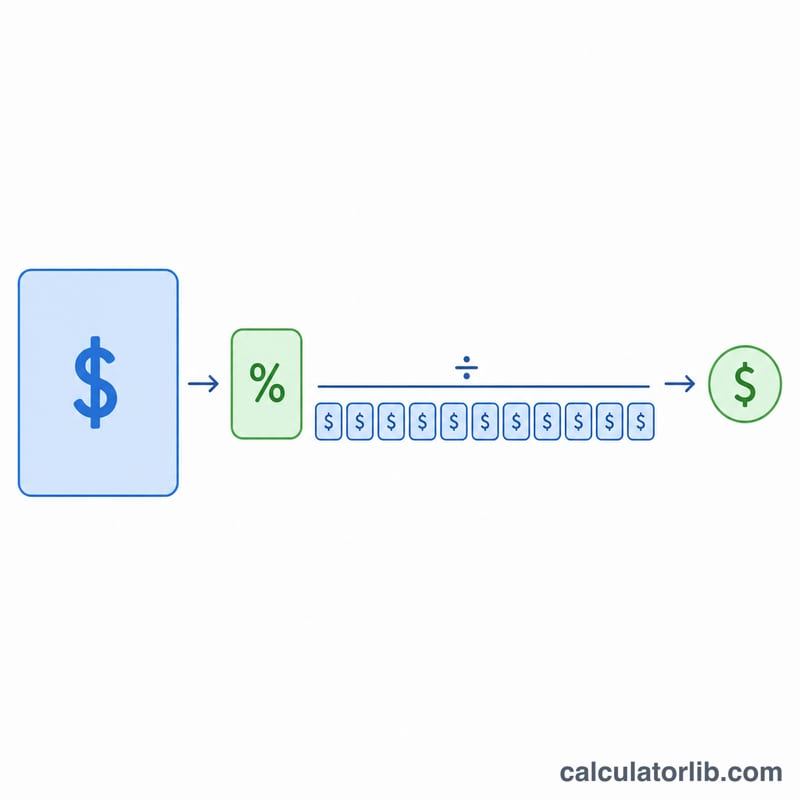
The core equation is $$\text{Monthly Interest} = \text{Balance} \times \left(\text{APR} \div 12 \div 100\right)$$ The APR is divided by 100 to convert a percentage into a decimal, and by 12 to convert an annual rate into a monthly one. Multiplying by the balance gives the dollar amount of interest for that month. This is a simple-interest, single-period view — it does not compound future months or include principal payments.
Worked Example
Suppose you owe $10,000 at an 18% APR. The monthly periodic rate is \(18 \div 12 = 1.5\%\), or \(0.015\) as a decimal. Multiply by the balance: $$10{,}000 \times 0.015 = \$150$$ of interest this month. Over a full year at simple interest that is roughly \(10{,}000 \times 0.18 = \$1{,}800\).
FAQ
Does this account for compounding? No. It calculates interest for one month on the entered balance. As you pay down or carry the balance, recompute with the new balance each month.
What is APR vs. monthly rate? APR is the annual rate. The monthly rate is \(\text{APR} \div 12\). A 12% APR equals a 1% monthly periodic rate.
Why does my statement differ slightly? Lenders may use average daily balance, daily compounding, or a 365-day count, which can shift the figure a little from this monthly estimate.