

What Is the Medical Expense Deduction?
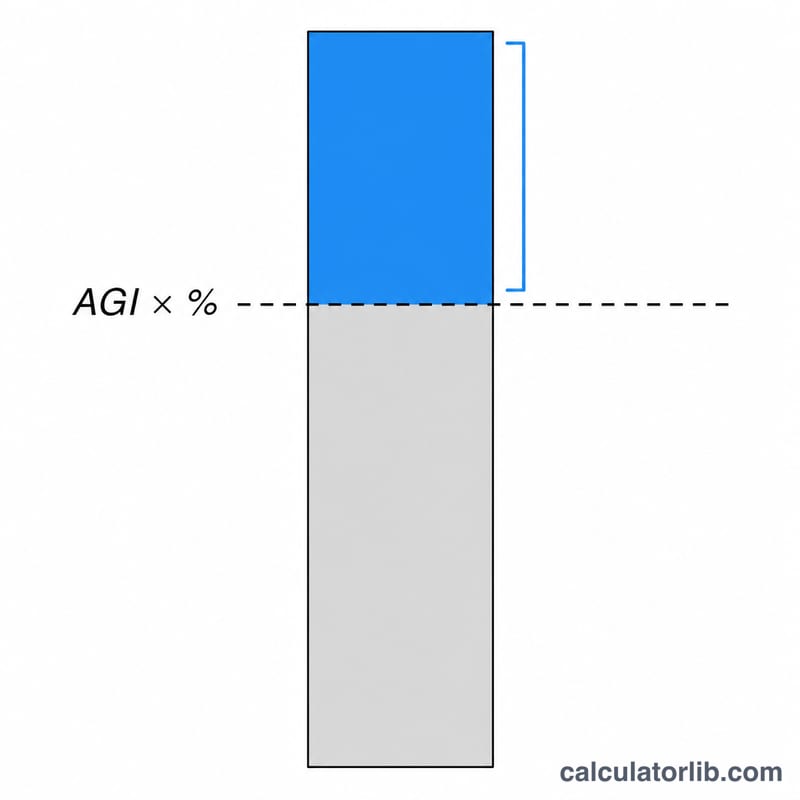
This calculator applies to United States federal income tax for tax years 2017 and later, where the IRS sets the medical expense deduction floor at 7.5% of adjusted gross income (AGI). If you itemize deductions on Schedule A (Form 1040), you may deduct unreimbursed qualified medical and dental expenses, but only the amount that exceeds 7.5% of your AGI. Expenses below that threshold are not deductible.
How to Use the Calculator
Enter your adjusted gross income (line 11 of Form 1040) and the total of your qualified, unreimbursed medical expenses for the year. The tool multiplies your AGI by 7.5% to find the threshold, subtracts it from your expenses, and shows the deductible amount. If your expenses are below the threshold, the deduction is $0.
The Formula Explained
The deduction is calculated as $$\text{Deduction} = \max\left(0,\; \text{Medical Expenses} - 0.075 \times \text{AGI}\right)$$ The max(0, …) ensures the result never goes negative — you cannot deduct more than you spent above the floor, and there is no deduction at all if you fall short of it.
Worked Example
Suppose your AGI is $60,000 and you paid $8,000 in qualified medical expenses. The 7.5% threshold is \(0.075 \times 60{,}000 = \$4{,}500\). Subtracting: $$\$8{,}000 - \$4{,}500 = \$3{,}500$$ That $3,500 is the amount you could include in your itemized deductions.
FAQ
What counts as a qualified medical expense? Costs like doctor visits, prescriptions, dental and vision care, certain insurance premiums, and travel for care — see IRS Publication 502 for the full list.
Should I itemize to claim this? The medical deduction only helps if your total itemized deductions exceed your standard deduction. Compare both before deciding.
Are reimbursed expenses included? No. Only out-of-pocket, unreimbursed amounts count toward the deduction.