
What is the ACB Savings Account Interest Calculator?
This calculator estimates the simple interest you earn on a savings account balance over a chosen number of days. It uses the standard simple-interest formula based on your principal, the annual interest rate, and the time period expressed in days (using a 365-day year). It works for any savings or deposit product that pays simple interest and is useful for quick "what-if" comparisons.
How to use it
Enter your principal balance (the amount in the account), the annual interest rate as a percentage, and the number of days the money is held. The calculator returns the interest earned plus your total balance at the end of the period.
The formula explained
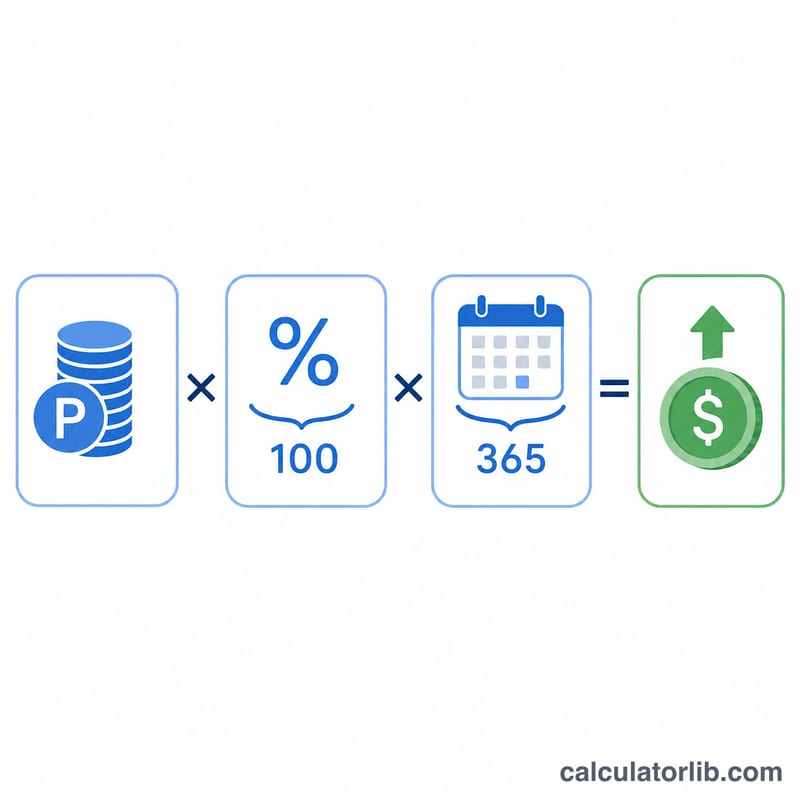
The interest is computed as $$\text{Interest} = \text{Principal} \times \frac{\text{AnnualRate}}{100} \times \frac{\text{Days}}{365}$$ Dividing the rate by 100 converts the percentage into a decimal, and dividing days by 365 prorates the annual rate for the actual time the money was held. Multiplying the three together gives the dollar interest.
Worked example
Suppose you keep $10,000 in an account at 4.5% annual interest for 365 days. $$\text{Interest} = 10{,}000 \times \frac{4.5}{100} \times \frac{365}{365} = 10{,}000 \times 0.045 \times 1 = \mathbf{\$450}$$ Your total balance becomes $10,450.
Key Terms Explained
- Principal
- The starting amount of money in the account on which interest is calculated. In the formula it is the base figure multiplied by the rate and time fraction. A larger principal earns proportionally more interest at the same rate.
- Annual interest rate (nominal / APR)
- The stated yearly rate of interest, expressed as a percentage (e.g. 4.5%). It is “nominal” because it does not account for compounding within the year. In the formula the rate is divided by 100 to convert the percentage to a decimal.
- Simple interest vs compound interest
- Simple interest is calculated only on the original principal, so the interest earned each period stays constant. Compound interest is calculated on the principal plus any interest already accrued, so earnings grow faster over time. This calculator uses simple interest; for compounding scenarios use a compound interest tool.
- Day-count basis (365 vs 360)
- The convention for the number of days assumed in a year. This calculator uses a 365-day basis (actual/365), common for consumer savings accounts. Some institutions and money-market instruments use a 360-day basis (actual/360), which produces slightly higher daily interest for the same annual rate. Always confirm which basis your account uses.
- Ending / total balance
- The principal plus the interest earned over the chosen number of days: \(\text{Ending balance} = \text{Principal} + \text{Interest}\). It represents the total amount in the account at the end of the period.
This is general educational information, not professional financial advice. Confirm the exact rate, day-count basis, and compounding terms with your financial institution.
FAQ
Does this include compounding? No — this is simple interest. For interest that accrues on previously earned interest, use a compound interest calculator.
Why divide by 365? Most savings products quote an annual rate and prorate it daily over a 365-day year. Some institutions use 360 days; check your terms.
Can I use it for shorter periods? Yes. Enter any number of days, such as 30 for a month or 90 for a quarter, to estimate partial-year interest.