
What Is the Rent-to-Income Ratio?
The rent-to-income ratio measures how much of your gross monthly income goes toward rent. It is one of the most widely used affordability checks by landlords, property managers and budget-conscious renters. A lower ratio means more of your income is available for savings, food, transport and other living costs.
How to Use This Calculator
Enter your monthly rent and your gross (pre-tax) monthly income. The calculator instantly returns the percentage of your income spent on rent, the recommended maximum rent under the popular 30% rule, and how much income is left after paying rent.
The Formula Explained
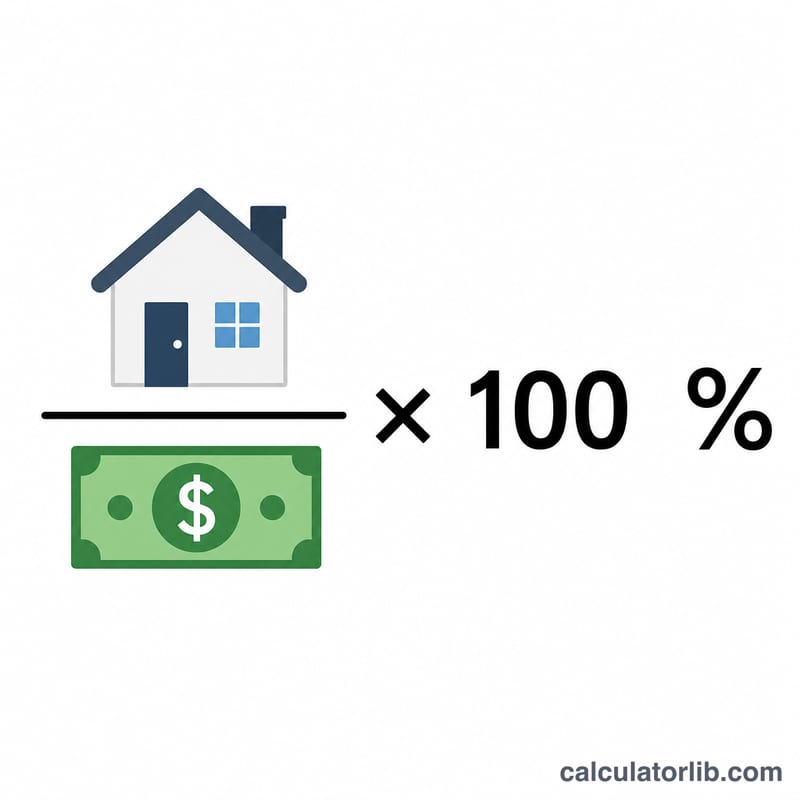
The core formula is simple:
$$\text{Ratio} = \frac{\text{Monthly Rent}}{\text{Monthly Income}} \times 100$$
The 30% rule suggests keeping rent at or below 30% of gross income, so the recommended ceiling is \(\text{Income} \times 0.30\). Many landlords prefer tenants whose rent is 30% or less, and some require income to be at least three times the rent.
Worked Example
Suppose your rent is $1,500 per month and your gross income is $5,000 per month. The ratio is $$\frac{1{,}500}{5{,}000} \times 100 = 30\%$$ The recommended maximum rent is \(5{,}000 \times 0.30 = \$1{,}500\), so this rent sits exactly at the affordability threshold, leaving $3,500 of income after rent.
FAQ
What is a good rent-to-income ratio? A ratio at or below 30% is generally considered affordable, though high earners can often comfortably afford more.
Should I use gross or net income? Most landlords and the 30% rule use gross (pre-tax) income. For personal budgeting, comparing rent to net income gives a more realistic view.
What if my ratio is over 40%? A ratio above 40% is considered cost-burdened and may strain your budget. Consider a cheaper unit, a roommate, or boosting income.