
What Is the Rent-to-Income Ratio?
The rent-to-income ratio measures how much of your gross (pre-tax) monthly income goes toward rent. Landlords, property managers, and tenants use it to judge whether a rental is affordable. A widely used benchmark is the 30% rule: spending no more than 30% of gross income on rent. This calculator works in any currency — just enter consistent figures.
How to Use This Calculator
Enter your monthly rent and your gross monthly income (total earnings before taxes and deductions). The calculator returns your rent-to-income ratio as a percentage, an affordability label, and the recommended maximum rent at 30% of your income.
The Formula Explained
The math is simple division scaled to a percentage:
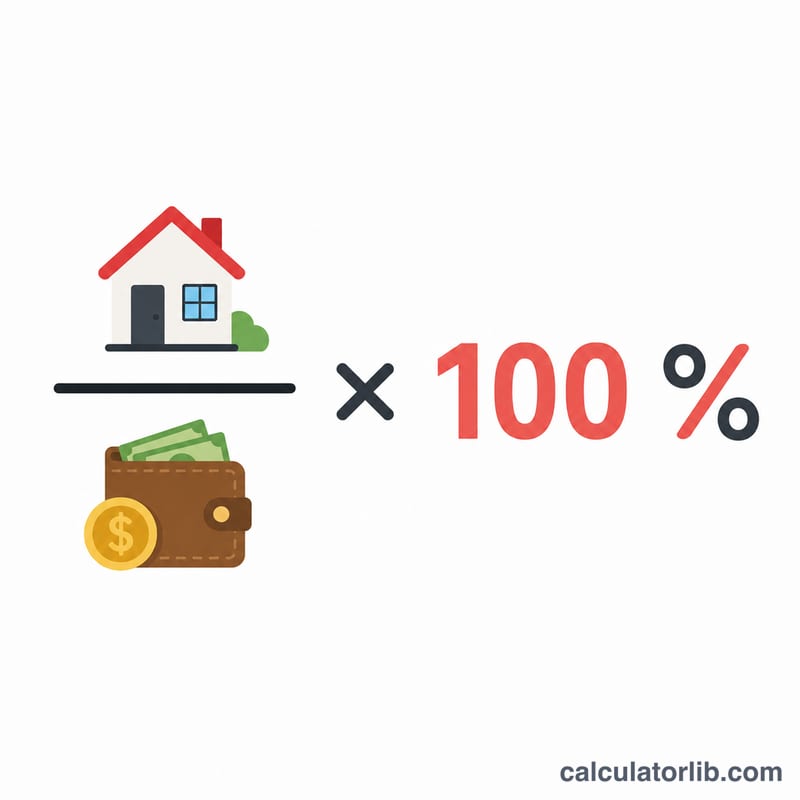
$$\text{Ratio (\%)} = \frac{\text{Monthly Rent}}{\text{Gross Monthly Income}} \times 100$$
If income is zero the ratio is undefined, so the calculator guards against that case. The affordability label is based on common lending and budgeting guidelines: 30% or below is Affordable, 30–40% is Stretched, and above 40% is Unaffordable.
Worked Example
Suppose your rent is $1,500 and your gross monthly income is $5,000. $$\text{Ratio} = \frac{1{,}500}{5{,}000} \times 100 = \mathbf{30\%}$$ That sits right at the recommended limit, and the maximum recommended rent at 30% would also be $1,500.
FAQ
Should I use gross or net income? Most landlords use gross (pre-tax) income, which is the standard for this calculator. Using net income gives a more conservative, real-world view of affordability.
Is the 30% rule strict? No. It's a guideline. In high-cost cities many people spend 40% or more, while in lower-cost areas you may spend far less.
What ratio do landlords prefer? Many require that rent be no more than about 30% of gross income, or equivalently that income be at least \(3\times\) the rent.