
What Is the Debt-to-Income Ratio?
Your debt-to-income (DTI) ratio is the share of your gross monthly income that goes toward paying recurring debts. Lenders rely heavily on this number when deciding whether to approve a mortgage, auto loan, or personal loan, because it signals how much room you have in your budget to take on new payments. A lower DTI means lower risk and usually translates into easier approvals and better interest rates.
How to Use This Calculator
Enter your total monthly debt payments — this includes mortgage or rent, car loans, student loans, minimum credit card payments, and any other fixed obligations. Then enter your gross monthly income, which is your income before taxes and deductions. The calculator divides debt by income and multiplies by 100 to give your DTI as a percentage, along with a category rating.
The Formula Explained
The math is simple:
$$\text{DTI} = \left( \frac{\text{Total Monthly Debt Payments}}{\text{Gross Monthly Income}} \right) \times 100$$If you pay $1,500 in monthly debts and earn $5,000 gross per month, your DTI is
$$\left( \frac{1500}{5000} \right) \times 100 = 30\%$$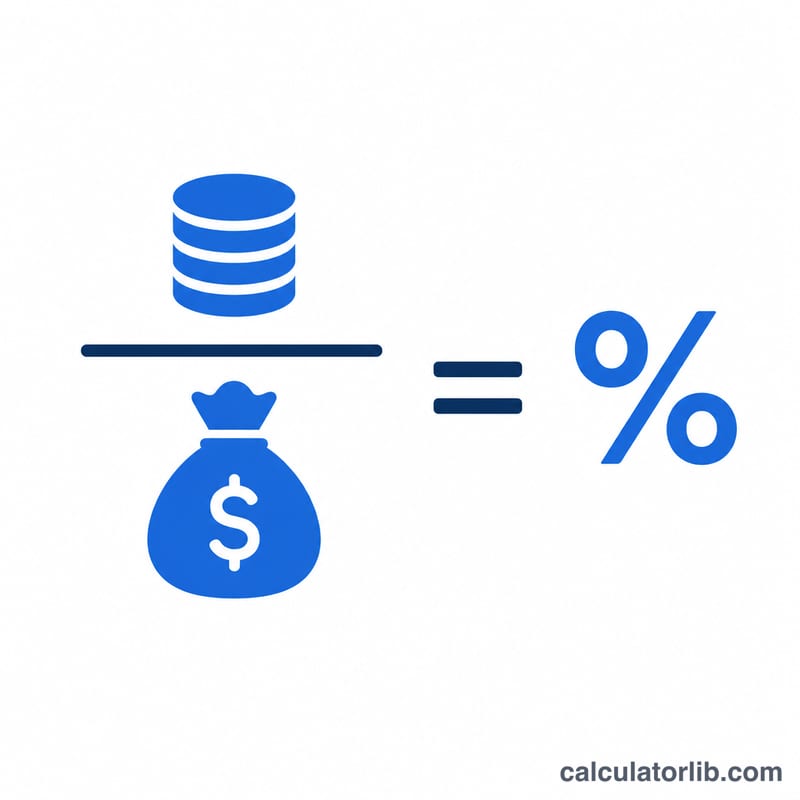
Worked Example
Suppose you have a $1,200 mortgage, a $300 car payment, and $100 in minimum credit card payments — that's $1,600 in total monthly debt. With a gross monthly income of $4,000, your DTI is
$$\left( \frac{1600}{4000} \right) \times 100 = 40\%$$That falls into the "Manageable" range but is above the 36% threshold many lenders prefer.
DTI Ratio Categories and Lender Thresholds
Your debt-to-income (DTI) ratio expresses your total monthly debt payments as a percentage of your gross monthly income. Lenders read this single number to gauge how much of your income is already committed before adding a new loan. The table below maps common DTI bands to the way lenders typically interpret them.
| DTI Range | Category | Lender Significance |
|---|---|---|
| 0% – 20% | Excellent | Very low debt burden. Strong borrowing capacity; minimal risk to lenders and ample room for new credit. |
| 21% – 36% | Good / Manageable | Debt is well within accepted limits. 36% is the classic conventional “back-end” ceiling for total debt under the 28/36 rule. |
| 37% – 43% | Caution | Debt is elevated but often still approvable. 43% is the upper limit for most Qualified Mortgages (QM) under federal lending standards. |
| 44% – 49% | High | Many lenders decline or require compensating factors (large down payment, high credit score, cash reserves). |
| 50% and above | Very High | Generally exceeds maximum allowances; loan approval is unlikely without major changes to debt or income. |
The 28/36 Rule
The traditional underwriting guideline splits DTI into two figures:
- Front-end ratio (28%) — housing costs alone (mortgage principal, interest, taxes, and insurance) should not exceed 28% of gross monthly income.
- Back-end ratio (36%) — all monthly debt payments combined (housing plus car loans, student loans, credit cards, etc.) should not exceed 36%.
For example, a borrower with a gross monthly income of $6,000 and total monthly debt payments of $1,800 has a back-end DTI of 30%, placing them within the Good / Manageable band.
Interpreting Your DTI Result
The percentage produced by this calculator answers one question for a lender: of every dollar you earn before taxes, how many cents are already promised to debt payments? A lower number signals more financial breathing room, while a higher number signals that new debt would compete with existing obligations.
What the number signals
- Under 36% — most lenders view this as comfortable. You typically meet standard guidelines without needing compensating factors.
- 36% to 43% — still within reach for many loan programs, but lenders look more closely at credit history, reserves, and the size of the requested loan.
- Above 43% — this exceeds the threshold for most Qualified Mortgages and narrows your options to specialized programs or requires reducing debt or raising income.
Front-end vs. back-end DTI
Lenders often calculate two versions of the ratio. The front-end DTI counts only housing-related costs as the numerator:
$$\text{Front-end DTI} = \frac{\text{Monthly Housing Payment}}{\text{Gross Monthly Income}} \times 100\%$$The back-end DTI — the figure this calculator produces when you enter all monthly obligations — counts every recurring debt payment:
$$\text{Back-end DTI} = \frac{\text{All Monthly Debt Payments}}{\text{Gross Monthly Income}} \times 100\%$$Because the back-end ratio captures car loans, student loans, credit card minimums, and the proposed housing payment, it is almost always the larger of the two and the one lenders weigh most heavily.
Why 36% and 43% matter
The 36% figure comes from the long-standing 28/36 underwriting rule used by many conventional lenders as a benchmark for a manageable total debt load. The 43% figure is rooted in federal mortgage rules: it is widely used as the maximum back-end DTI for a loan to be considered a Qualified Mortgage, a category designed to indicate the borrower has a reasonable ability to repay. Staying below these marks generally keeps the broadest range of loan options available.
A worked check
Suppose your gross monthly income is $5,000 and your monthly debt payments total $2,150. Your DTI is:
$$\frac{2150}{5000} \times 100\% = 43\%$$That result sits exactly at the Qualified Mortgage ceiling — manageable for some programs but with little room to spare.
This is general educational information about how lenders use DTI, not personal financial advice. Loan eligibility depends on many factors beyond DTI, and individual lender requirements vary. Consult a qualified financial professional regarding your specific situation.
FAQ
What is a good DTI ratio? Most lenders favor a DTI of 36% or lower, though some mortgage programs allow up to 43% or higher.
Should I use gross or net income? Use gross income (before taxes), since that is the standard lenders apply.
What counts as debt? Recurring obligations like loans, credit card minimums, and housing payments. Utilities, groceries, and insurance are typically excluded.