

What Is the Debt-to-Capital Ratio?
The debt-to-capital ratio is a leverage metric that shows what proportion of a company's total capital structure is funded by debt rather than equity. It is widely used by investors, lenders, and analysts to gauge financial risk. A higher ratio means more reliance on borrowing, which can amplify both returns and risk.
How to Use This Calculator
Enter your Total Debt (short-term plus long-term interest-bearing debt) and your Total Equity (shareholders' equity). The calculator divides debt by total capital and returns both a decimal ratio and a percentage. No specific country or accounting standard is assumed — it works with any figures you supply in a single currency.
The Formula Explained
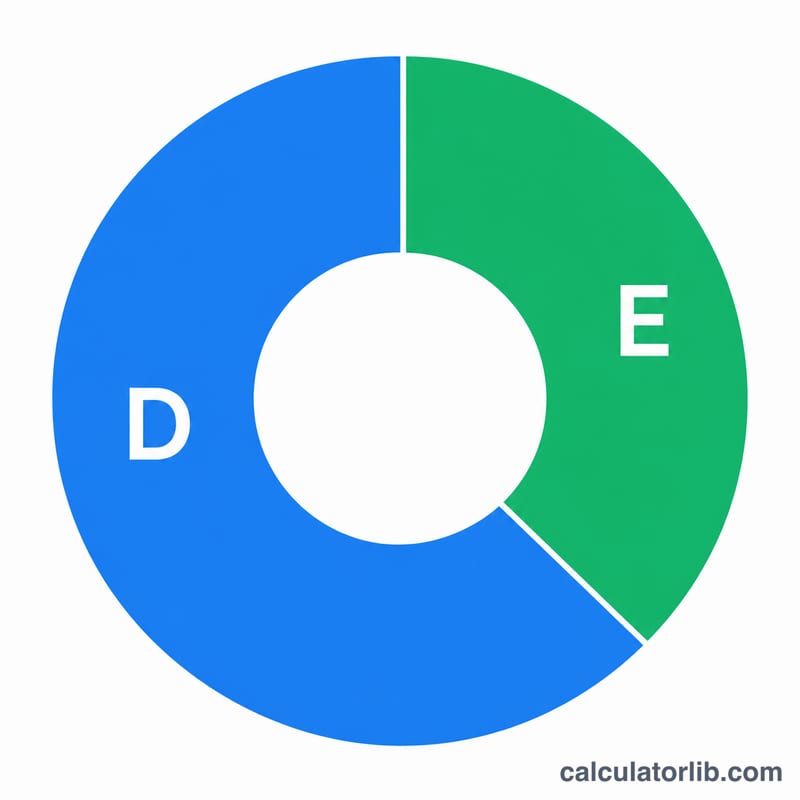
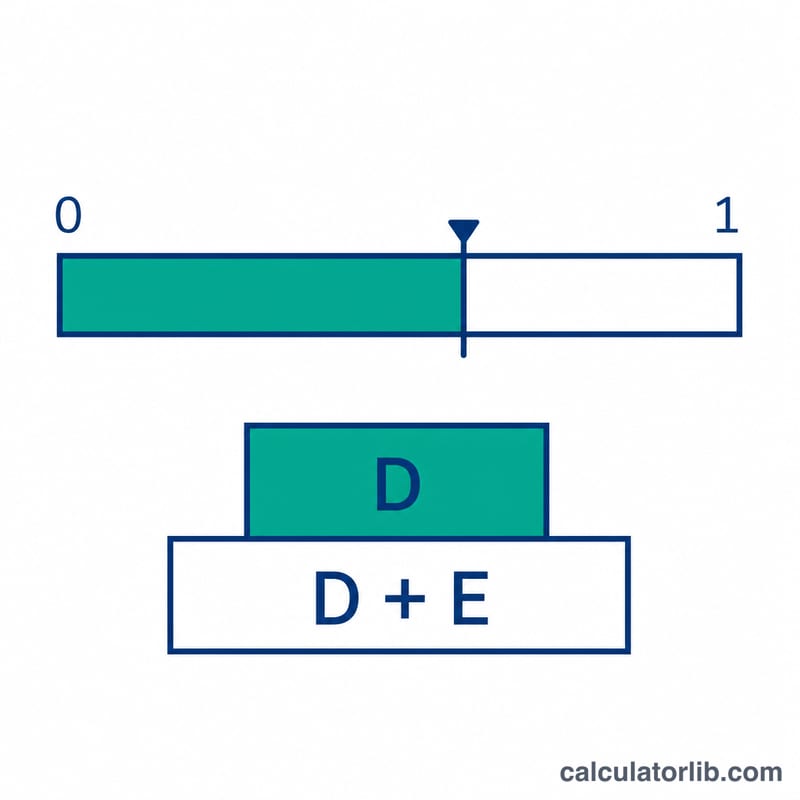
$$\text{Debt-to-Capital Ratio} = \frac{\text{Total Debt}}{\text{Total Debt} + \text{Total Equity}}$$ The denominator, total capital, is simply debt plus equity. Multiply the result by 100 to read it as a percentage. A ratio of \(0.4\) (40%) means 40 cents of every dollar of capital comes from debt.
Worked Example
Suppose a company has $400,000 in total debt and $600,000 in total equity. Total capital is $$\$400{,}000 + \$600{,}000 = \$1{,}000{,}000.$$ The ratio is $$\frac{400{,}000}{1{,}000{,}000} = 0.40,$$ or 40%. This indicates a moderate, generally healthy level of leverage.
FAQ
What is a good debt-to-capital ratio? It varies by industry, but ratios below \(0.5\) (50%) are often considered conservative, while values above that suggest higher leverage and risk.
How is it different from debt-to-equity? Debt-to-equity divides debt by equity alone; debt-to-capital divides debt by debt plus equity, so it always falls between 0 and 1.
Should I use book or market values? Book values from the balance sheet are most common, but analysts sometimes use market values of equity for a forward-looking view.