

What Is the Net Debt to EBITDA Ratio?
The Net Debt to EBITDA ratio is a leverage metric that shows how many years of current earnings (EBITDA) a company would need to pay off its net debt. It is widely used by lenders, credit-rating agencies, and investors to gauge a firm's ability to service and repay its obligations. A lower ratio signals a healthier balance sheet, while a high ratio indicates heavy borrowing relative to earnings.
How to Use This Calculator
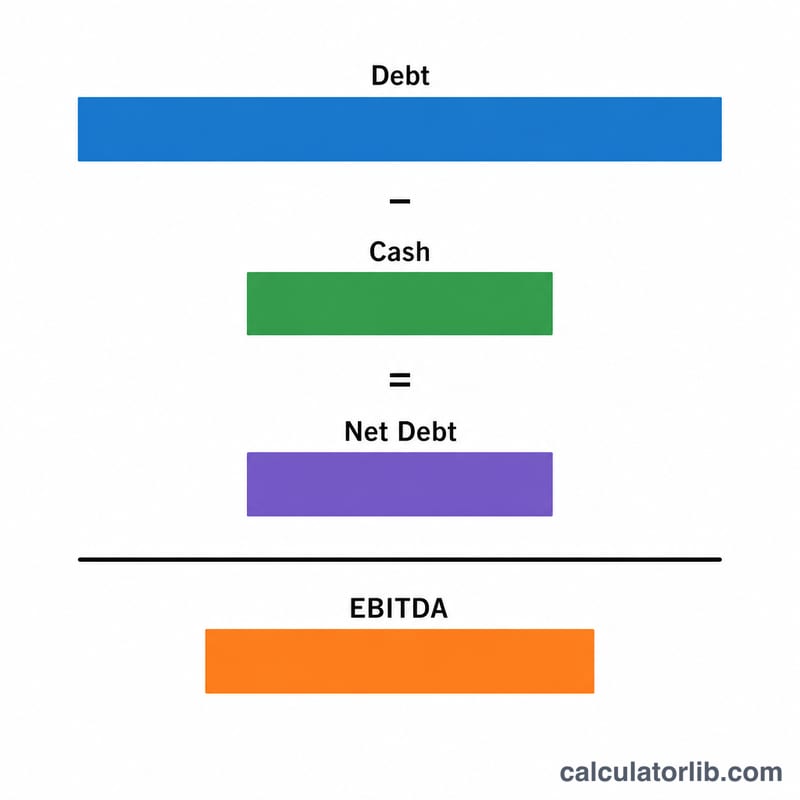
Enter three figures: Total Debt (short- and long-term interest-bearing debt), Cash & Equivalents (cash and liquid short-term investments), and EBITDA (earnings before interest, taxes, depreciation, and amortization). The calculator subtracts cash from total debt to find net debt, then divides by EBITDA to produce the leverage multiple, expressed as an "x".
The Formula Explained
$$\text{Net Debt to EBITDA} = \frac{\text{Total Debt} - \text{Cash \& Equivalents}}{\text{EBITDA}}$$ Subtracting cash recognizes that liquid reserves could be used immediately to reduce debt. Dividing by EBITDA expresses the remaining debt in terms of annual operating earnings — so a ratio of \(2.0\text{x}\) means it would take roughly two years of EBITDA to clear net debt.
Worked Example
Suppose a company has $5,000,000 in total debt, $1,000,000 in cash, and EBITDA of $2,000,000. Net debt is $$\$5{,}000{,}000 - \$1{,}000{,}000 = \$4{,}000{,}000$$ Dividing by EBITDA: $$\$4{,}000{,}000 \div \$2{,}000{,}000 = \mathbf{2.0\text{x}}$$ This is generally considered a moderate, manageable level of leverage.
FAQ
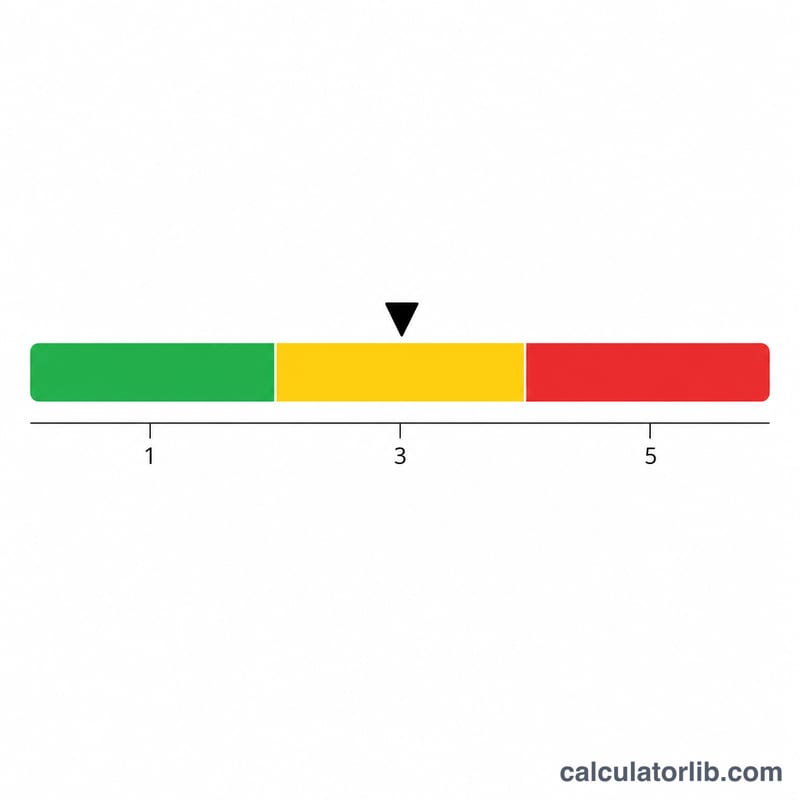
What is a good Net Debt to EBITDA ratio? Many analysts view below \(3.0\text{x}\) as healthy, though acceptable levels vary by industry; capital-intensive sectors tolerate higher ratios.
Can the ratio be negative? Yes. If a company holds more cash than debt, net debt is negative, producing a negative ratio — a sign of a strong net-cash position.
Why use net debt instead of total debt? Net debt reflects the debt that cannot be immediately covered by available cash, giving a more realistic picture of repayment burden.