
What Is Net Profit?
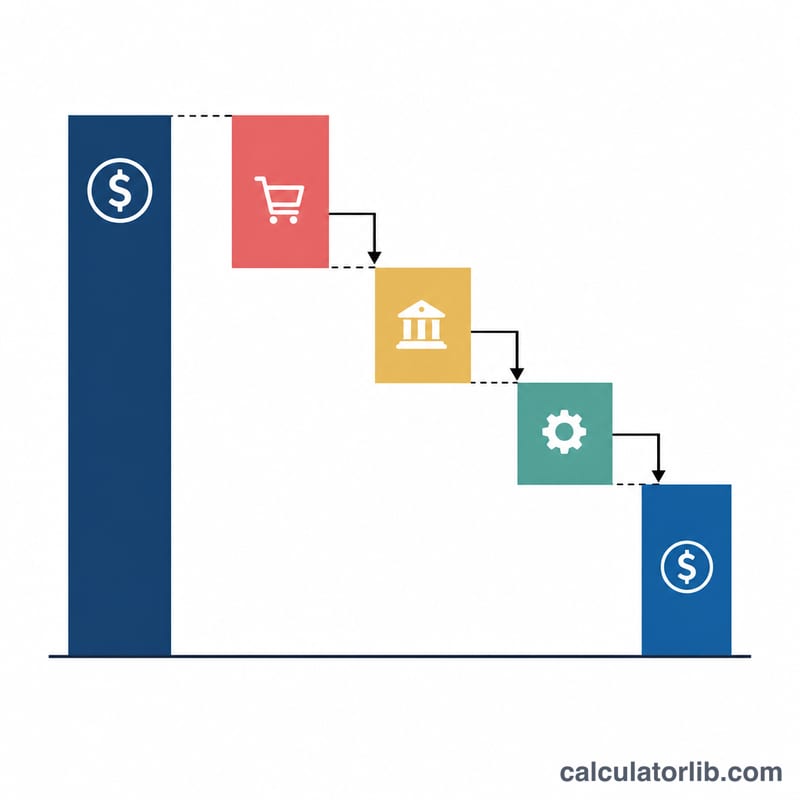
Net profit — also called the bottom line — is what remains of a company's revenue after every cost has been subtracted, including operating expenses, taxes, and interest on debt. It is the truest single measure of whether a business actually made money during a period. This calculator subtracts expenses, taxes, and interest from total revenue and also reports your net profit margin.
How to Use This Calculator
Enter your total revenue for the period, then your total operating expenses (cost of goods sold, salaries, rent, marketing, etc.). Add any taxes and interest paid. Leave taxes or interest at zero if they don't apply. The tool instantly returns your net profit and net profit margin.
The Formula Explained
The calculation is straightforward:
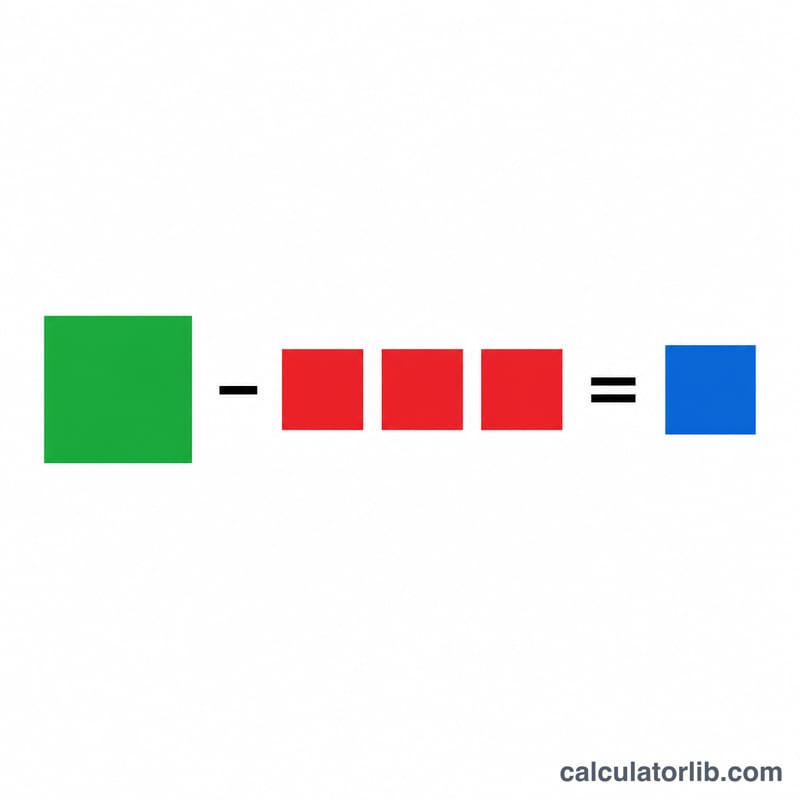
$$\text{Net Profit} = \text{Total Revenue} - \text{Total Expenses} - \text{Taxes} - \text{Interest}$$
The net profit margin then divides net profit by revenue and multiplies by 100 to express profitability as a percentage. A higher margin means more of every sales dollar is kept as profit.
Worked Example
Suppose a business earns $100,000 in revenue, spends $60,000 on expenses, pays $8,000 in taxes and $2,000 in interest. Net profit = $$100{,}000 - 60{,}000 - 8{,}000 - 2{,}000 = \$30{,}000$$ $30,000. The margin = $$30{,}000 \div 100{,}000 \times 100 = 30\%$$ 30%.
FAQ
What is the difference between gross and net profit? Gross profit subtracts only the direct cost of goods sold. Net profit subtracts everything — operating costs, taxes, and interest too.
Can net profit be negative? Yes. If total costs exceed revenue, net profit is negative, meaning the business operated at a loss.
What is a good net profit margin? It varies by industry, but margins of 10% are often considered healthy, with 20% or more being strong.