
What is the Economic Order Quantity?
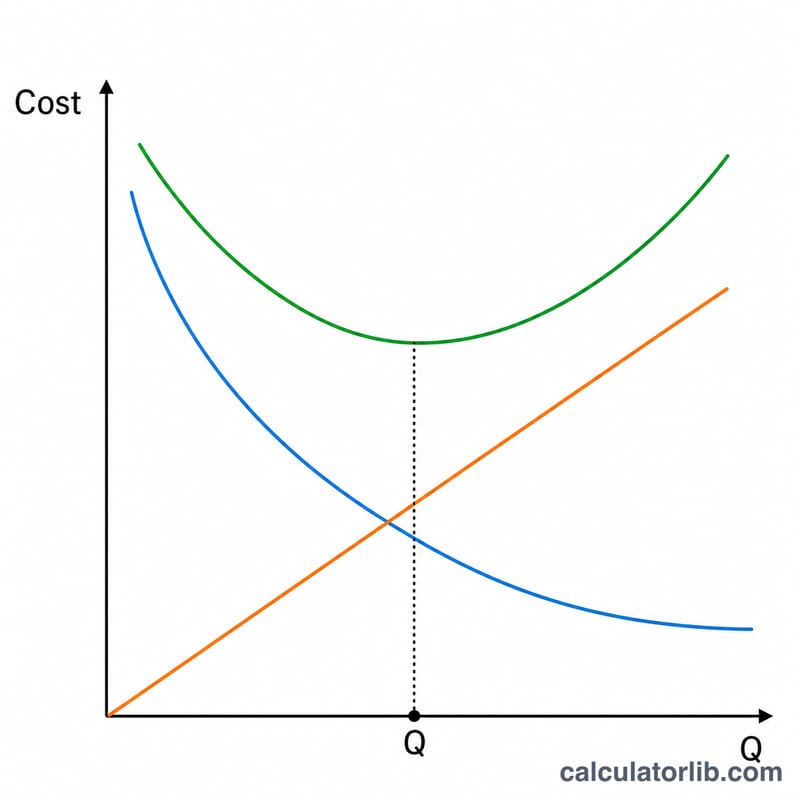
The Economic Order Quantity (EOQ) is the ideal number of units a business should order at one time to minimize the combined cost of ordering and holding inventory. Ordering in large batches reduces the number of orders (lowering ordering costs) but raises the average inventory level (increasing holding costs). The EOQ formula finds the sweet spot where these two costs balance.
How to use this calculator
Enter three values: annual demand (how many units you sell or use per year), ordering cost (the fixed cost of placing one order — paperwork, shipping setup, processing), and holding cost (the cost to store one unit for a year — warehousing, insurance, capital tied up). The calculator returns the optimal order size, how many orders to place per year, the days between orders, and the minimized total annual inventory cost.
The formula explained
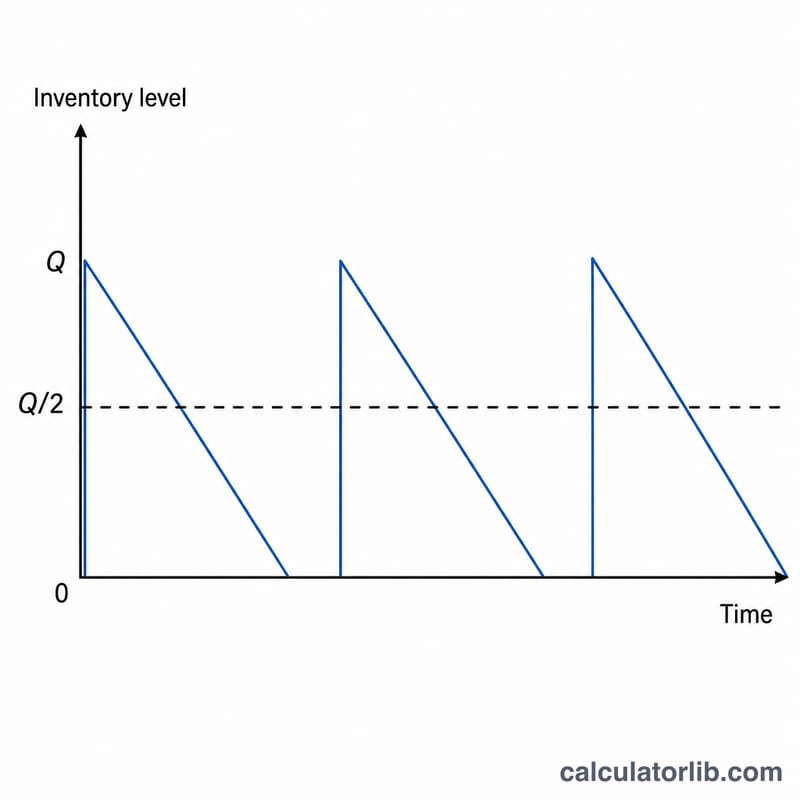
The classic Wilson EOQ model is $$\text{EOQ} = \sqrt{\dfrac{2 \cdot D \cdot S}{H}}$$ where \(D\) is annual demand, \(S\) is the cost per order, and \(H\) is the annual holding cost per unit. Total cost is $$TC = \frac{D}{Q} \cdot S + \frac{Q}{2} \cdot H$$ Taking the derivative of \(TC\) with respect to \(Q\) and setting it to zero produces the EOQ formula. At the EOQ, ordering cost and holding cost are exactly equal.
Worked example
A retailer sells 10,000 units a year. Each order costs $50 to place, and holding one unit for a year costs $2. $$\text{EOQ} = \sqrt{\frac{2 \times 10{,}000 \times 50}{2}} = \sqrt{500{,}000} \approx 707 \text{ units}$$ That means about 14.14 orders per year, roughly every 25.8 days, with a total annual inventory cost of about $1,414.
FAQ
Does EOQ assume constant demand? Yes. The basic model assumes steady demand, a fixed ordering cost, and a constant holding cost with no quantity discounts or stockouts.
What units should I use for holding cost? Use cost per unit per year. If you only know holding cost as a percentage of unit value, multiply that percentage by the unit price first.
Should I always order exactly the EOQ? The total cost curve is flat near the optimum, so rounding the EOQ to a convenient pack or pallet size adds very little cost.