What This Calculator Does
The Concrete Slab Cost Calculator estimates the total price to pour a flat concrete slab — such as a patio, driveway, shed base, or garage floor. It converts your slab dimensions into the volume of concrete required (in cubic yards), multiplies by your local price per cubic yard, and adds labor and finishing costs to give a complete project total.

How to Use It
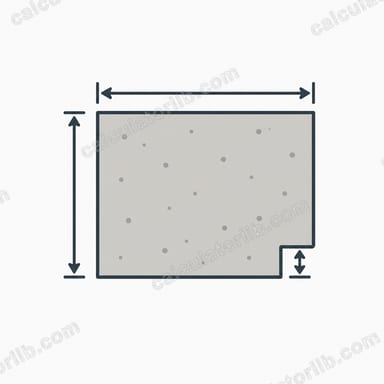
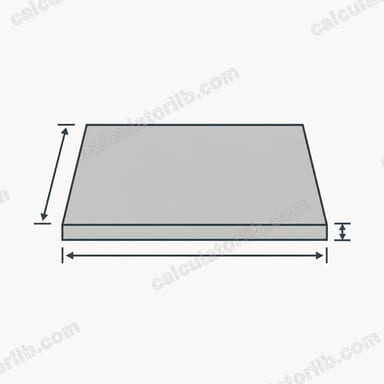
Enter the slab's length and width in feet and its thickness in inches. Then provide the price you pay per cubic yard of concrete (ready-mix prices commonly range from $120–$170), your labor estimate, and any finishing cost (broom finish, stamping, sealing, etc.). The calculator returns the required concrete volume and a full cost breakdown.
The Formula Explained
First the slab volume is found in cubic feet: length × width × (thickness ÷ 12), since thickness is entered in inches. Because concrete is sold by the cubic yard, that figure is divided by 27 (the number of cubic feet in a cubic yard). The volume in cubic yards is then multiplied by your price per yard, and labor plus finishing are added on top.
$$\text{Total Cost} = \frac{L \times W \times (T/12)}{27} \times \text{Price/yd}^3 + \text{Labor} + \text{Finishing}$$ $$\text{where}\quad \left\{ \begin{aligned} L &= \text{Length (ft)} \\ W &= \text{Width (ft)} \\ T &= \text{Thickness (in)} \end{aligned} \right.$$
Worked Example
For a 20 ft × 20 ft slab that is 4 inches thick: volume = 20 × 20 × (4 ÷ 12) = 133.33 cubic feet = 4.94 cubic yards. At $150 per yard the concrete costs about $740.74. Adding $500 labor and $200 finishing gives a total of roughly $1,440.74.
$$\text{volume} = 20 \times 20 \times (4 \div 12) = 133.33 \text{ cubic feet} = 4.94 \text{ cubic yards}$$Typical Slab Thicknesses and Cost Ranges
The table below uses US units (feet, inches, cubic yards) and US dollars. Thicknesses reflect common residential practice in the United States. Local building codes and your soil conditions may require something different, so check them before you pour.
| Slab use | Typical thickness | Ready-mix price (per yd³) | Labor (per sq ft, approx.) | Finishing (per sq ft, approx.) |
|---|---|---|---|---|
| Patio / walkway | 4 in | $120–$170 | $2–$5 | $1–$3 |
| Shed base | 4 in | $120–$170 | $2–$5 | $1–$3 |
| Garage floor | 4–6 in | $120–$170 | $2–$5 | $1–$3 |
| Driveway | 5–6 in | $120–$170 | $2–$5 | $1–$3 |
| Heavy-duty (vehicles, equipment) | 6 in or more | $120–$170 | $2–$5 | $1–$3 |
The labor and finishing figures are rough approximations only. They vary a great deal by region, site access, job size and the finish you choose (broom, stamped, exposed aggregate, and so on). The calculator asks for labor and finishing as total dollar amounts, so multiply your per-square-foot rate by the slab area (length × width).
Cost Comparison for Common Slab Sizes
Volume is calculated as \(\frac{L \times W \times (T/12)}{27}\) cubic yards. The assumptions are concrete at $150 per yd³, labor at $3 per sq ft and finishing at $1 per sq ft. These are illustrative values, not quotes.
| Slab | Area (sq ft) | Volume (yd³) | Concrete at $150/yd³ | Labor + finishing ($4/sq ft) | Total |
|---|---|---|---|---|---|
| 10×10 ft shed base, 4 in | 100 | 1.23 | $185.19 | $400.00 | $585.19 |
| 12×12 ft patio, 4 in | 144 | 1.78 | $266.67 | $576.00 | $842.67 |
| 20×20 ft garage, 4 in | 400 | 4.94 | $740.74 | $1,600.00 | $2,340.74 |
| 20×20 ft garage, 6 in | 400 | 7.41 | $1,111.11 | $1,600.00 | $2,711.11 |
| 12×40 ft driveway, 5 in | 480 | 7.41 | $1,111.11 | $1,920.00 | $3,031.11 |
Worked check for the 20×20 ft slab at 4 in: \(\frac{20 \times 20 \times (4/12)}{27} = \frac{133.33}{27} = 4.94\) yd³. The concrete costs \(4.94 \times 150 = 740.74\). Labor is \(400 \times 3 = 1{,}200\) and finishing is \(400 \times 1 = 400\). The total is \(740.74 + 1{,}200 + 400 = 2{,}340.74\) dollars.
Going from 4 in to 6 in on the same garage slab adds 50% more concrete (about 2.47 yd³, or $370.37 here). The total rises by only about 16%, because labor and finishing depend on area, not thickness.
Practical Tips for Ordering and Budgeting
- Round up and add a waste margin. Add 5–10% to the calculated volume to cover uneven subgrade, spillage and slightly over-thick spots. Then round the order up to the next half or whole cubic yard. For example, the 20×20 ft, 4 in slab needs 4.94 yd³. Adding 10% gives about 5.43 yd³, so you would order 5.5 yd³.
- Watch for short-load fees. Many ready-mix suppliers charge extra for small orders, often under about 4–5 yd³. Ask about the threshold and the fee. For a very small slab, mixing bagged concrete yourself may be cheaper.
- Budget for extras the calculator does not include. These typically include a compacted gravel base, rebar or wire mesh, form lumber, control joints, a vapor barrier where needed, sealer, excavation or demolition of old concrete, delivery or pump charges, and permits or inspections.
- Get multiple local quotes. Concrete and labor prices vary by region, season and job access. Compare at least three written quotes, and check whether each includes base preparation, reinforcement, finishing and cleanup.
- Confirm thickness and specifications locally. Check the required thickness, concrete strength and reinforcement with your local building authority or a qualified contractor, especially for driveways and garage floors.
This is general information to help with planning, not professional advice. Final costs depend on your site and local conditions.
FAQ
Should I add extra concrete for waste? Yes — contractors typically order 5–10% extra to cover spillage and uneven subgrade. Increase your thickness or volume slightly to build in a buffer.
Does price per yard include delivery? Ready-mix quotes usually cover delivery within a set radius, but small loads may carry a short-load fee. Confirm with your supplier.
What thickness should I use? 4 inches is standard for patios and walkways; driveways and load-bearing slabs are often 5–6 inches.