
What This Calculator Does
The Yards of Concrete for a Slab Calculator tells you how many cubic yards of concrete to order for a rectangular slab such as a patio, driveway, shed base, or garage floor. Concrete is sold by the cubic yard, so converting your slab's dimensions into yards is the key to ordering the right amount.
How to Use It
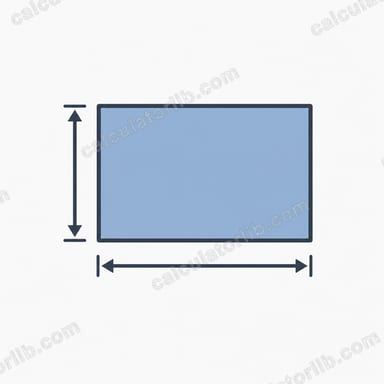
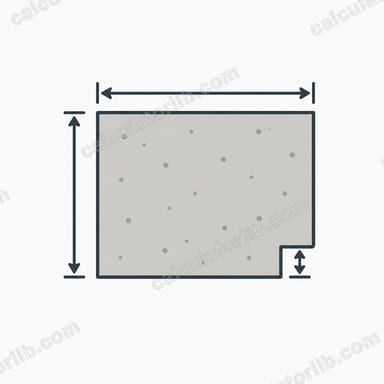
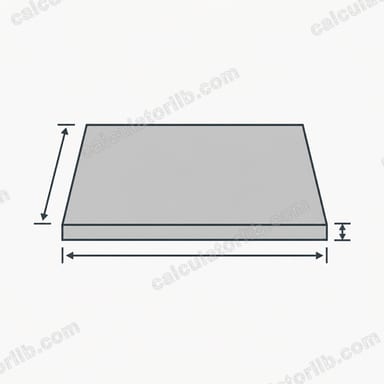
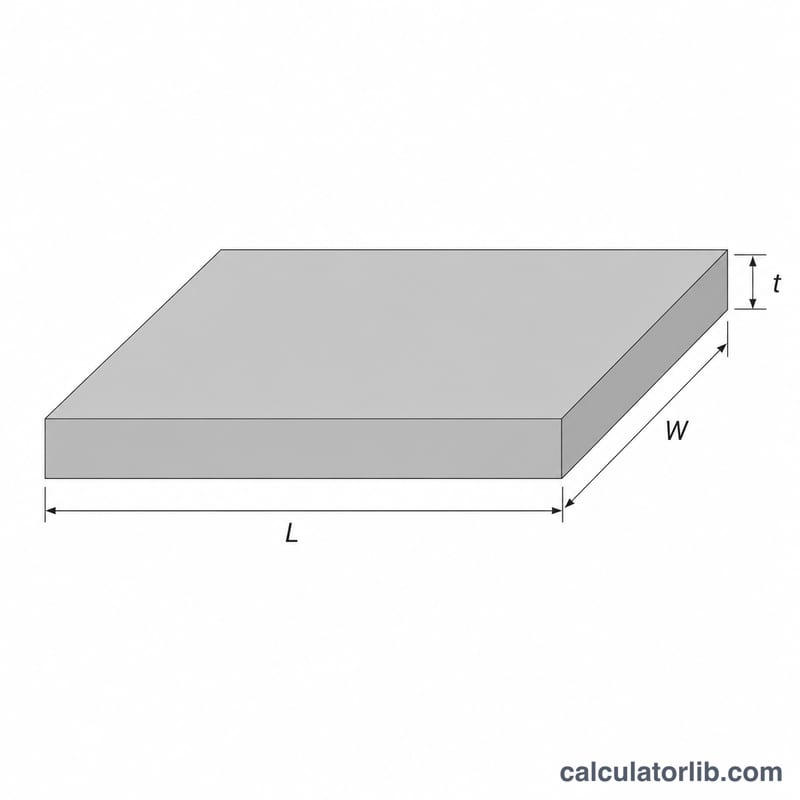
Enter the slab's length and width in feet and its thickness in inches (common slab thicknesses are 4 inches for patios and 5–6 inches for driveways). Optionally add a waste allowance — 5% to 10% is typical to cover spillage and an uneven subgrade. The calculator returns the cubic yards you need, both before and after the waste buffer.
The Formula Explained
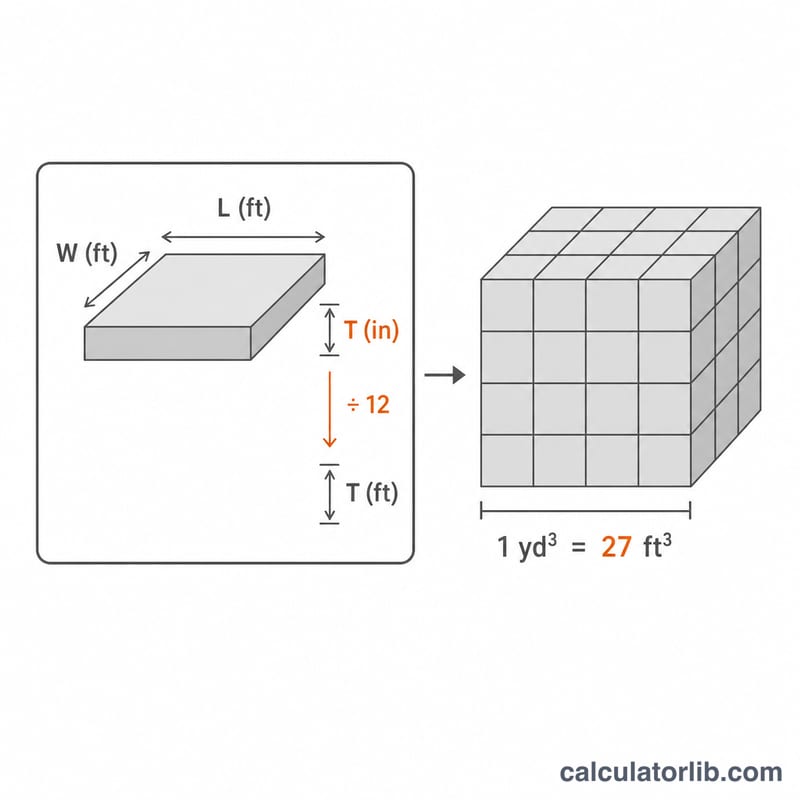
Volume in cubic feet equals length × width × thickness, where thickness must first be converted from inches to feet by dividing by 12. Since one cubic yard equals 27 cubic feet (3 ft × 3 ft × 3 ft), divide the cubic feet by 27 to get cubic yards:
$$\text{yards} = \frac{L \times W \times \dfrac{\text{thickness\_in}}{12}}{27}$$
Worked Example
For a 20 ft × 10 ft slab poured 4 inches thick: thickness in feet = \(4 \div 12 = 0.3333\) ft. Volume = \(20 \times 10 \times 0.3333 = 66.67\) cubic feet. Cubic yards = \(66.67 \div 27 = 2.47\) yards. With a 10% waste allowance you would order about 2.72 yards, which you'd round up to 3 yards when placing the order.
FAQ
Why divide by 27? A cubic yard is 3 feet on each side, and \(3 \times 3 \times 3 = 27\) cubic feet.
Should I round up? Yes — concrete suppliers deliver in fixed increments (often quarter or half yards), and running short mid-pour is far costlier than a little extra.
How much waste should I add? A 5–10% allowance covers spillage, over-excavation, and uneven ground; use the higher end for irregular or hand-dug forms.