
What This Calculator Does
Concrete is sold by the cubic yard, but slabs, patios, driveways and footings are measured in square feet. This calculator bridges that gap: enter the surface area in square feet and the slab thickness in inches, and it returns the number of cubic yards of concrete you need to order.
How to Use It
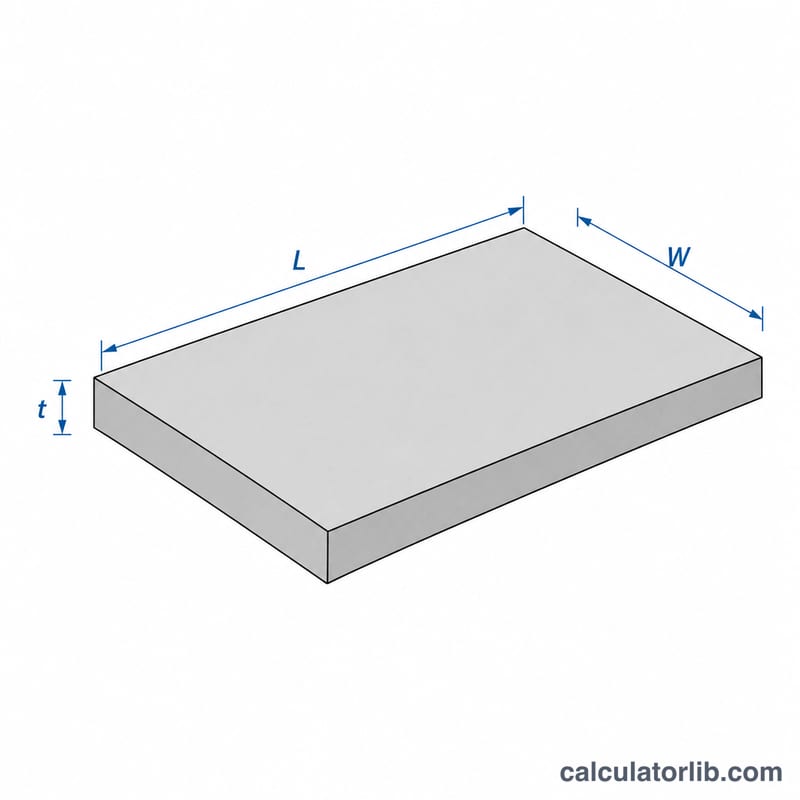
Measure the length and width of the area in feet and multiply them to get square feet. Enter that value, then enter the slab thickness in inches (4 inches is typical for patios and walkways, 6 inches for driveways). The result shows the raw cubic yards plus a version with a 10% waste allowance for spillage, uneven subgrade and over-excavation.
The Formula
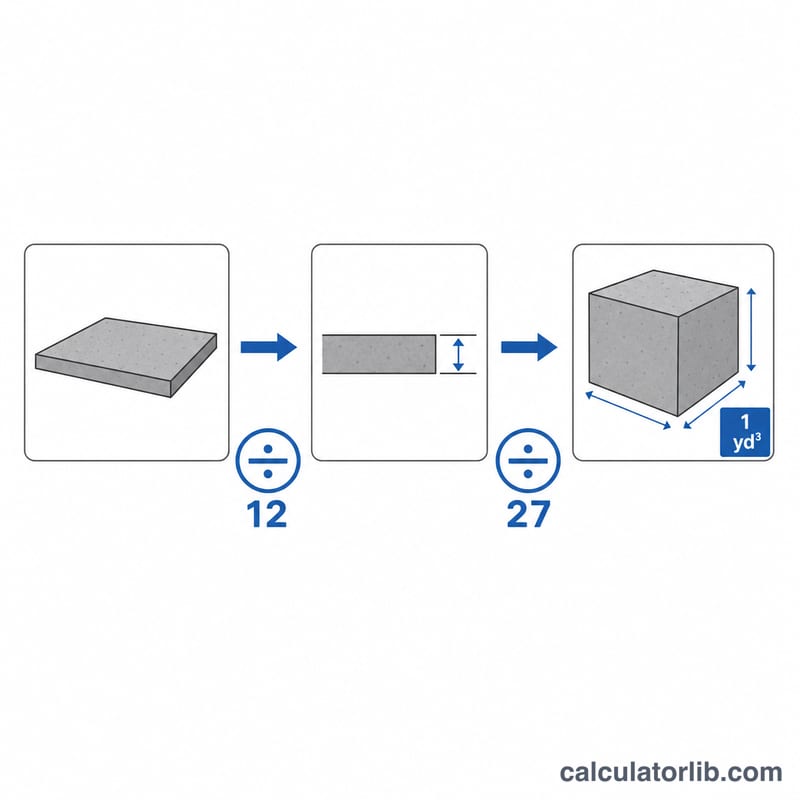
Concrete volume is computed in three steps. First, convert thickness from inches to feet by dividing by 12. Multiply by the area to get cubic feet. Finally divide by 27 (there are 27 cubic feet in a cubic yard):
$$\text{Yards} = \frac{\text{Area (ft}^2\text{)} \times \dfrac{\text{Thickness (in)}}{12}}{27}$$
Worked Example
Suppose you are pouring a 100 ft² patio at 4 inches thick. Thickness in feet = \(4 \div 12 = 0.333\) ft. Cubic feet = \(100 \times 0.333 = 33.33\) ft³. Cubic yards = \(33.33 \div 27 = 1.23\) yd³. Adding 10% waste gives about 1.36 yd³, so you would order 1.5 yards from the ready-mix supplier.
FAQ
Why add a waste allowance? Subgrade is rarely perfectly level and some concrete is always lost to spillage and form leakage, so ordering 5–10% extra avoids running short mid-pour.
How thick should my slab be? Sidewalks and patios are usually 4 inches; driveways and garage floors 5–6 inches. Always follow local building codes.
Can I round my order? Yes — suppliers deliver in quarter- or half-yard increments, so round up to the next available amount.