What is the Concrete Weight Calculator?
This tool estimates how much a slab, footing, column or any rectangular concrete pour will weigh. Knowing the weight matters for structural loading, transport logistics, crane and formwork capacity, and for planning how much demolition debris you'll haul away. The calculator works in both metric (meters → kilograms) and imperial (feet → pounds) units.
How to use it
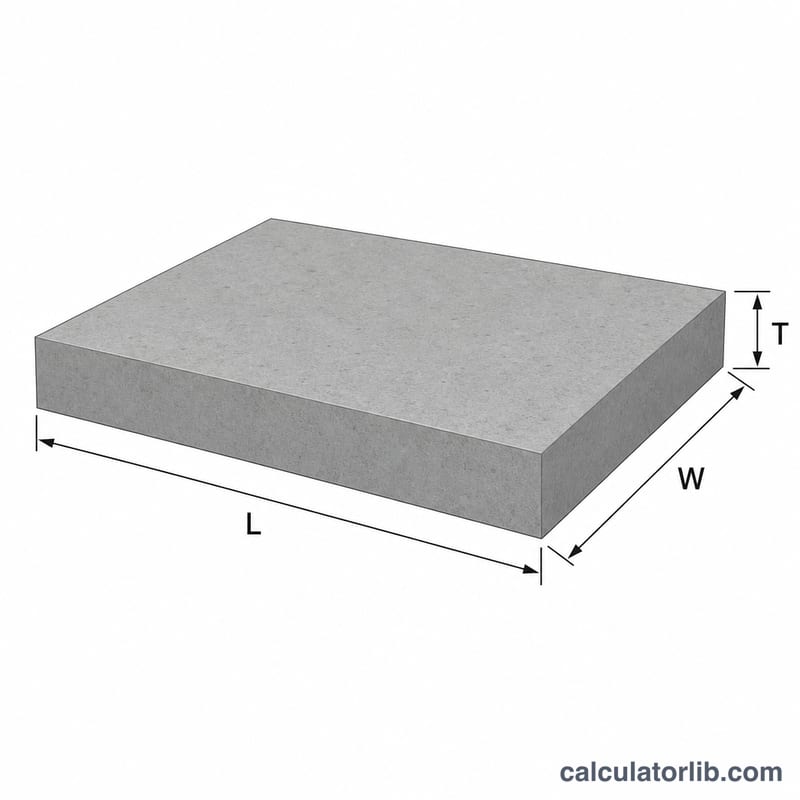
Enter the length, width and thickness (depth) of your pour in consistent units, then choose the unit system. The default density is the standard value for normal-weight cured concrete: 2400 kg/m³ (about 150 lb/ft³). If you are using lightweight, high-density or aggregate-specific concrete, you can override the density field with your own value.
The formula explained
The math is two steps. First compute the volume: \( V = \text{Length} \times \text{Width} \times \text{Thickness} \). Then multiply that volume by the density of the material: \( \text{Weight} = V \times \rho \). Density is mass per unit volume, so volume (m³) × density (kg/m³) yields mass in kilograms. The same logic applies in imperial units with ft³ and lb/ft³.
$$\text{Weight (kg)} = \text{Length (m)} \times \text{Width (m)} \times \text{Thickness (m)} \times \text{Density (2400 kg/m}^3)$$
$$\text{Weight (lb)} = \text{Length (ft)} \times \text{Width (ft)} \times \text{Thickness (ft)} \times \text{Density (150 lb/ft}^3)$$
Worked example
A patio slab 3 m long, 3 m wide and 0.1 m thick has a volume of \( 3 \times 3 \times 0.1 = 0.9 \) m³. At 2400 kg/m³ that is $$0.9 \times 2400 = 2160 \text{ kg}$$ or 2.16 tonnes. A crew can plan equipment and transport around that figure.
Typical Densities of Concrete and Related Materials
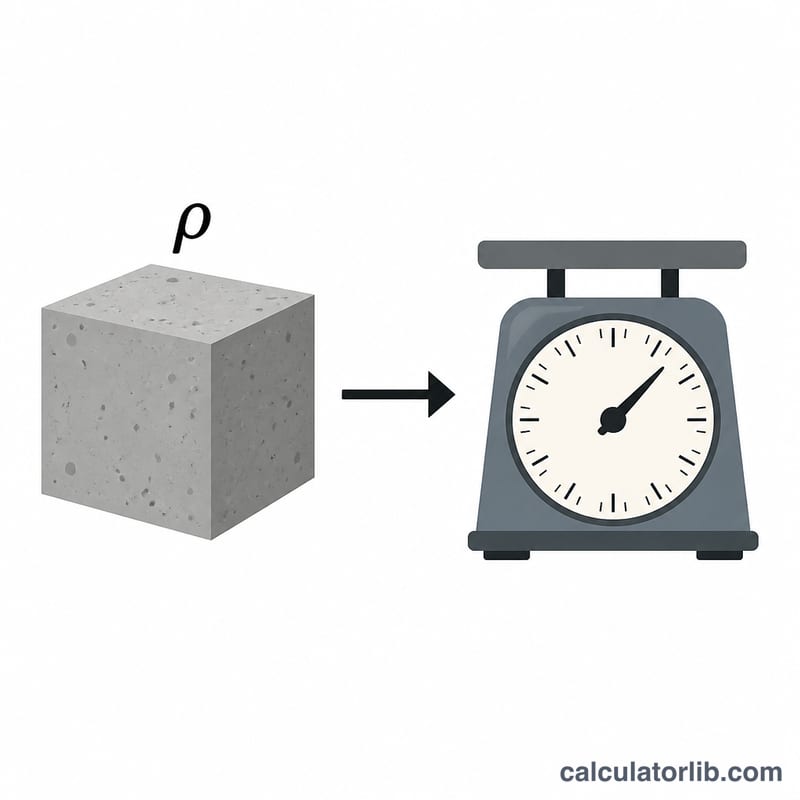
The calculator uses a default density of 2400 kg/m³ (about 150 lb/ft³), a common value for normal-weight concrete. Real density depends on the aggregate, cement content, water content, air voids and any steel reinforcement. The values below are approximate ranges, not guaranteed figures.
| Material | Density (kg/m³) | Density (lb/ft³) |
|---|---|---|
| Normal-weight plain concrete | 2300–2400 | ≈144–150 |
| Reinforced concrete | 2400–2500 | ≈150–156 |
| Lightweight structural concrete | 1440–1840 | ≈90–115 |
| Heavyweight concrete (barite/magnetite aggregate) | 3000–4000+ | ≈187–250+ |
| Aerated / autoclaved concrete | 300–900 | ≈19–56 |
| Fresh (wet) concrete | ≈2400 | ≈150 |
If you have a mix design, supplier data sheet or measured density for your concrete, enter that value in the density field instead of the default. Conversion used: 1 kg/m³ ≈ 0.06243 lb/ft³.
Weight of Common Slab and Pour Sizes
All weights below use a density of 2400 kg/m³ (150 lb/ft³) with Weight = Length × Width × Thickness × Density. Volumes are rounded.
| Pour | Dimensions | Volume (m³) | Volume (ft³) | Weight (kg) | Weight (tonnes) | Weight (lb) |
|---|---|---|---|---|---|---|
| Small paving slab area | 1 m × 1 m × 0.1 m | 0.1 | 3.53 | 240 | 0.24 | ≈529 |
| Shed base | 3 m × 3 m × 0.1 m | 0.9 | 31.78 | 2160 | 2.16 | ≈4,762 |
| Garage-size slab | 6 m × 3 m × 0.15 m | 2.7 | 95.35 | 6480 | 6.48 | ≈14,286 |
| Driveway | 5 m × 4 m × 0.1 m | 2.0 | 70.63 | 4800 | 4.8 | ≈10,582 |
| Strip footing | 0.6 m × 0.3 m × 10 m | 1.8 | 63.57 | 4320 | 4.32 | ≈9,524 |
| Imperial patio slab | 10 ft × 10 ft × 4 in | ≈0.944 | 33.33 | ≈2,268 | ≈2.27 | 5000 |
Imperial check: 4 in = 1/3 ft, so volume = 10 × 10 × 0.3333 = 33.33 ft³, and 33.33 × 150 lb/ft³ = 5000 lb. Reinforced concrete may weigh slightly more, and the weight of the sub-base is not included.
Unit Conversions for Concrete Weight
| Quantity | Equivalent |
|---|---|
| Volume | 1 m³ = 35.315 ft³ = 1.308 yd³ |
| Mass | 1 kg = 2.2046 lb |
| Metric tonne | 1 tonne = 1000 kg = 2204.6 lb |
| Short US ton | 1 short ton = 2000 lb = 907.2 kg |
| Length | 1 in = 0.0254 m |
| Length | 1 ft = 0.3048 m |
| Density | 2400 kg/m³ ≈ 149.8 lb/ft³ ≈ 4046 lb/yd³ (about 2.02 short tons per yd³) |
Reminder: slab thickness is often given in inches. Before using the imperial formula (length in ft × width in ft × thickness in ft × density in lb/ft³), divide the thickness in inches by 12. For example, 6 in = 0.5 ft. Keep all dimensions in the same unit system as the density you enter.
FAQ
Why 2400 kg/m³? It's the accepted average for standard reinforced and plain normal-weight concrete; real mixes range roughly 2300–2500 kg/m³.
Does this include rebar? No — it estimates the concrete only. Steel reinforcement adds a small additional weight (steel is ~7850 kg/m³).
How do I weigh an irregular shape? Break it into rectangular sections, calculate each separately, and add the weights together.