
What is the Stellar Luminosity Calculator?
This tool estimates the total energy a star radiates per second — its luminosity — from just two properties: its radius and its surface (effective) temperature. It treats the star as an ideal black body and applies the Stefan-Boltzmann law, a cornerstone of stellar astrophysics. Results are given both in watts and as a multiple of the Sun's luminosity (L☉).
How to Use It
Enter the stellar radius in solar radii (the Sun = 1 R☉) and the surface temperature in kelvin. The calculator converts the radius to meters using the IAU nominal solar radius (6.957×10⁸ m), then evaluates the luminosity. For reference, the Sun has a radius of 1 R☉ and an effective temperature of about 5772 K.
The Formula Explained
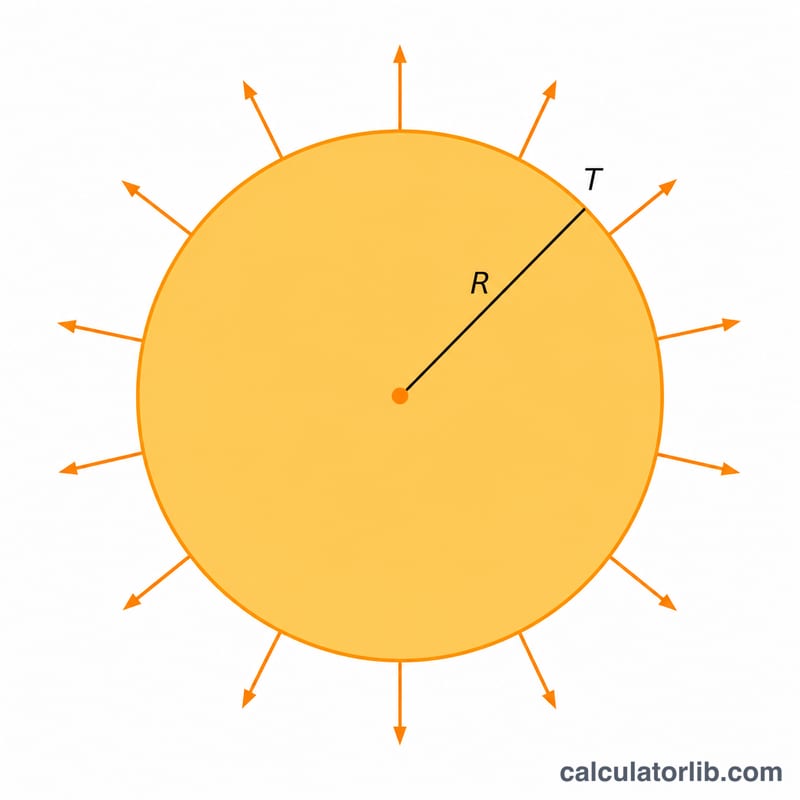
The Stefan-Boltzmann law states that the power radiated per unit area of a black body scales with the fourth power of temperature: \(j = \sigma T^{4}\). Multiplying by the star's total surface area, \(4\pi R^{2}\), gives the full luminosity:
$$L = 4\pi R^{2} \sigma\, T^{4}$$Because of the \(T^{4}\) dependence, a small change in temperature has a large effect on luminosity — doubling the temperature increases output sixteenfold.
Worked Example
For a Sun-like star with \(R = 1\ R_{\odot} = 6.957\times10^{8}\ \text{m}\) and \(T = 5772\ \text{K}\): surface area = \(4\pi(6.957\times10^{8})^{2} \approx 6.082\times10^{18}\ \text{m}^{2}\). With \(\sigma = 5.670374419\times10^{-8}\) and \(T^{4} = (5772)^{4} \approx 1.110\times10^{15}\),
$$L \approx 6.082\times10^{18} \times 5.670\times10^{-8} \times 1.110\times10^{15} \approx 3.83\times10^{26}\ \text{W}$$essentially one solar luminosity.
FAQ
Does this assume a perfect black body? Yes. Real stars deviate slightly, but the effective temperature is defined so the black-body formula gives the correct luminosity.
What value of the solar luminosity is used? The IAU nominal value \(L_{\odot} = 3.828\times10^{26}\ \text{W}\).
Can I use it for any object? The law applies to any spherical thermal radiator, including planets and brown dwarfs, given a radius and effective temperature.